
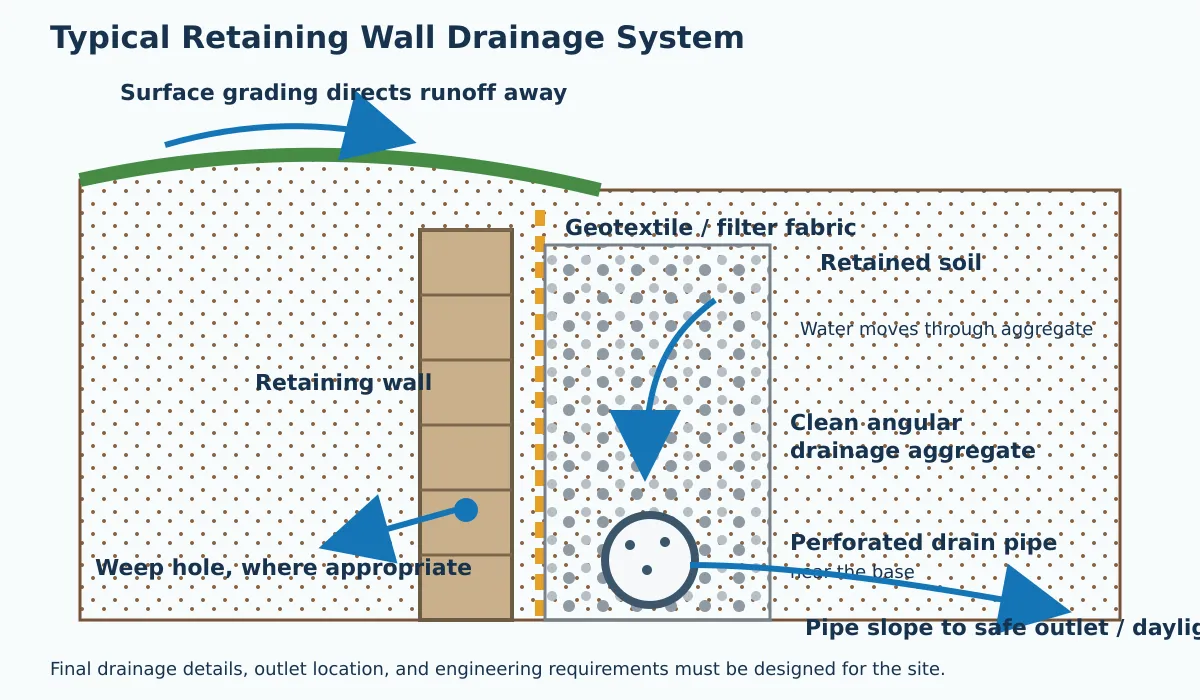
Most retaining walls need a complete drainage system to prevent water from building up behind the wall. That system typically combines clean angular drain rock, geotextile filter fabric, a perforated pipe near the base, and a safe outlet; the right design depends on the wall height, soil, slope, materials, and nearby water sources.
Here are five essential methods to manage water behind retaining walls:
- Gravel Backfill: Creates a fast-draining zone to reduce water pressure. Use clean, angular gravel sized ¾–1½ inches and install at least 12 inches thick.
- Weep Holes: Small openings spaced 3–7 feet apart allow water to escape, preventing pressure buildup.
- Perforated Drainage Pipes: Installed at the wall’s base, these pipes redirect water to a safe, approved outlet, reducing stress on the structure.
- Filter Fabric: Prevents soil from clogging drainage systems, ensuring long-term performance.
- Drainage Aggregate Layer: A one-foot layer of crushed stone allows water to flow freely and minimizes pressure.
Each technique addresses specific drainage challenges, and combining them provides the best results. Permitting and engineering requirements vary by city, wall height, slope, loading, and site conditions; verify requirements with the local jurisdiction and a qualified professional.
Planning a retaining wall or larger outdoor living project in Orange County? Explore Pacific Pavers’ retaining wall installation services or schedule a consultation.
5 Drainage Solutions to Prevent Retaining Wall Failure
Factors That Determine Drainage & Design Needs
A successful retaining wall isn’t just about stacking blocks; it’s a carefully engineered system. The right drainage and design strategy depends entirely on your property’s unique conditions. A plan that works for a short garden wall in sandy soil could fail completely for a tall wall holding back a clay slope. Understanding these key factors is the first step toward building a wall that is both beautiful and built to last. It ensures you’re not just getting a temporary fix, but a long-term investment in your landscape.
Soil Type
The ground your wall is built on plays a huge role in its design. Different soils handle water in completely different ways, which directly impacts the amount of pressure pushing against your wall. For instance, heavy clay soil holds a lot of water and expands, creating immense pressure that requires a robust drainage system and reinforcement. On the other hand, sandy soil drains quickly but can be unstable and wash away without support like a geotextile fabric to hold it in place. A professional site assessment is crucial to identify your soil type and design a drainage solution that properly manages water flow and ensures your wall’s stability for years to come.
Wall Height
As a retaining wall gets taller, the pressure behind it increases exponentially. This is why height is a primary factor in determining the necessary reinforcement and drainage. A short, decorative wall under four feet might only need a simple gravel backfill. However, once a wall reaches four to six feet, it often requires engineered reinforcement, like geogrid, layered within the backfill to add strength. For any wall over six feet, a professional engineer must be involved to create a detailed plan. These taller structures demand advanced drainage systems and significant reinforcement to safely manage the powerful forces at play and comply with local building codes.
Wall Materials
The materials you choose for your retaining wall affect more than just its appearance—they also influence its drainage needs. Solid materials like poured concrete or cinder blocks don’t have natural gaps for water to escape, which means pressure can build up quickly if a drainage system isn’t integrated into the design. This is why features like weep holes and perforated pipes are essential when using non-porous blocks. Choosing the right materials is a balance of aesthetics and engineering. We help homeowners select options from our gallery of completed projects that not only match their vision but also work with the necessary structural and drainage requirements for a lasting installation.
Wall Location and External Water Sources
Where you place your retaining wall on your property is just as important as how it’s built. A wall at the bottom of a hill will naturally have to manage more water runoff than one on flat ground. You also need to account for nearby water sources that could saturate the soil behind the wall. This includes everything from roof downspouts and lawn irrigation systems to underground pipes or areas with a high water table. A thorough site plan, like the 2D and 3D designs we create, considers the entire landscape to identify and redirect these external water sources, protecting your wall from overwhelming hydrostatic pressure.
For complex grades, drainage paths, or HOA requirements, Pacific Pavers can map the wall and surrounding outdoor space with 2D and 3D design before construction.
1. Use Gravel Backfill for Easy Drainage
Gravel backfill plays a key role in ensuring proper drainage for retaining walls. By placing a layer of clean, angular gravel directly behind the wall, you create a fast-draining zone that helps prevent water from building up and exerting pressure on the structure.
Why Gravel is Great for Reducing Water Pressure
Gravel backfill is highly effective at managing water because it allows water to flow quickly through its voids. This prevents hydrostatic pressure from building up behind the wall – a critical factor, as excessive pressure can lead to bowing, cracking, or even collapse.
For this purpose, clean, angular gravel or crushed stone sized between 3/4-inch and 1 1/2-inch is ideal. The angular shape creates more void space between particles, which helps water drain efficiently. This size range also prevents fine particles from clogging the system. Round gravel, on the other hand, should be avoided because it doesn’t interlock well and offers less support.
How to Install Gravel Backfill
Installing gravel backfill is a straightforward process. First, excavate at least 12 inches behind the wall – more for taller walls. Then, fill the space with 3/4-inch crushed stone and wrap it with geotextile fabric.
For example, contractors like Pacific Pavers typically follow a systematic approach: they excavate the required area, place the crushed stone, and wrap the backfill zone with geotextile fabric. This method ensures proper drainage while preventing soil from migrating into the gravel layer.
Is Gravel Right for Your Wall Type?
Gravel backfill is compatible with a wide range of retaining wall types, including concrete block, timber, and stone walls. Its drainage benefits apply universally, regardless of the material or construction method. Whether you’re working on a segmental block wall, a poured concrete structure, or a natural stone wall, the use of clean, angular gravel remains a consistent best practice.
While installation details may vary slightly based on wall design and local building codes, the core principle – creating a free-draining zone behind the wall – stays the same. This makes gravel backfill a reliable option for everything from small residential walls to large engineered structures. It also lays the groundwork for other drainage techniques.
| Gravel Size | Recommended Thickness | Primary Benefit |
|---|---|---|
| 3/4″ to 1 1/2″ | 12+ inches | Ensures effective drainage and support |
2. Install Weep Holes to Let Water Escape
After adding gravel backfill, weep holes play a key role in managing water drainage. These small openings in retaining walls allow trapped water to escape, preventing it from accumulating behind the wall. By providing a controlled outlet, weep holes help reduce water pressure that could otherwise compromise the wall’s strength.
How Weep Holes Relieve Water Pressure
Weep holes are essential for keeping hydrostatic pressure in check. They give water an immediate escape route, which helps prevent the wall from bowing, cracking, or even collapsing due to the stress of accumulated water pressure.
To work effectively, weep holes should be spaced every 3 to 7 feet horizontally. A diameter of 2 to 4 inches is typically ideal for residential walls, as this size ensures proper drainage without weakening the structure. Positioning the holes at a slight downward angle further improves water flow, allowing gravity to do the work and minimizing pooling near the wall.
Tips for Proper Weep Hole Installation
Installing weep holes is relatively simple for new retaining walls made from concrete blocks, masonry, or poured concrete. Gaps can be left between blocks, or pipes made from materials like PVC or HDPE can be inserted to create the openings. Prefabricated drainage components are also an option. PVC pipes, in particular, are a popular choice because they provide smooth water flow and are resistant to clogging.
Retrofitting weep holes into existing walls, however, is more complex. This process often involves drilling through the wall and adding protective sleeves or filters to prevent soil from clogging the openings.
Keeping Your Weep Holes Clear
To keep weep holes functioning properly, regular maintenance is a must. Inspections should check for blockages caused by debris, soil, or plant roots. Adding mesh screens over the openings can make maintenance easier by preventing small particles from entering while still allowing water to flow freely.
Best Wall Materials for Weep Holes
Weep holes are a versatile drainage solution that complements other methods and enhances wall stability. They work well with most wall types, including concrete block, poured concrete, brick, and stone walls. However, in segmental block walls with open joints, natural drainage through the gaps often eliminates the need for weep holes. For specialized walls, like reinforced or mechanically stabilized earth (MSE) walls, alternative drainage methods such as pipes or engineered systems are generally preferred. In some cases, vertical exit pipes through the wall can serve a similar purpose.
Professionals, like those at Pacific Pavers (https://pacificpavers.com), often include weep holes in their drainage designs to ensure retaining walls remain durable and effective.
| Wall Type | Weep Hole Compatibility | Installation Method |
|---|---|---|
| Concrete Block | Excellent | Leave gaps or insert pipes during construction |
| Poured Concrete | Excellent | Insert sleeves before pouring |
| Brick/Stone | Excellent | Form openings in mortar joints |
| Segmental Block | Limited | Natural drainage through joints preferred |
3. Add a Perforated Pipe for Drainage Behind Your Retaining Wall
Perforated drainage pipes, typically 4 inches in diameter and made from PVC or HDPE, are a key component in managing water behind retaining walls. These pipes work by channeling water away from the wall’s foundation, forming the backbone of an effective drainage system. When combined with gravel backfill and weep holes, they create a unified solution to prevent water buildup.
Why Perforated Pipes Are So Effective
Installed at the base of a retaining wall, a perforated drainage pipe acts as a pathway for water, capturing both groundwater and surface water before it can accumulate. This significantly reduces hydrostatic pressure, which could otherwise cause the wall to bow, crack, or even collapse. The pipe achieves this by offering multiple entry points for water through its perforations and directing it to a safe outlet. In Orange County, drainage planning should account for clay-heavy soil, hillside runoff, irrigation, and roof or downspout discharge so collected water reaches an appropriate outlet instead of another vulnerable part of the property.
How to Correctly Place Your Drainage Pipe
Installing a perforated drainage pipe starts with excavating a trench, laying the 4-inch pipe on a 2% slope, and surrounding it with 3/4-inch gravel wrapped in geotextile fabric. A crucial step is “daylighting” the pipe – connecting it to a stormwater outlet or drainage area where water can safely exit. For residential projects, PVC is often preferred because it allows for smooth water flow and is less prone to clogging. On larger commercial sites, a 6-inch diameter pipe may be necessary to handle higher water volumes. Proper installation, paired with routine inspections, ensures the system performs well over the long term.
What Maintenance Does a Drainage Pipe Need?
While filter fabric reduces the need for frequent maintenance, occasional inspections are still necessary to check for sediment buildup, root intrusion, or blockages at the outlet. When installed with the right grading and filtration, these systems can remain effective for decades with minimal upkeep.
Does Your Retaining Wall Need a Perforated Pipe?
Perforated drainage pipes are compatible with a wide range of retaining wall types, though the specifics of installation may vary. For example, segmental block walls often include built-in drainage features that integrate easily with a pipe system. On the other hand, poured concrete walls may require additional weep holes or outlets to optimize drainage. These principles also apply to timber, concrete block, and stone walls.
Pacific Pavers, a leading hardscape contractor based in Orange County, CA, incorporates perforated pipe systems alongside other drainage techniques to create durable, site-specific retaining walls. By combining multiple methods, they ensure maximum drainage efficiency and structural integrity tailored to the unique conditions of each project.
sbb-itb-11ea599
4. Use Filter Fabric to Prevent Clogs
Filter fabric, also known as geotextile fabric, builds on earlier drainage techniques like gravel backfill and perforated pipes to improve efficiency. This synthetic material acts as a barrier, allowing water to flow through while keeping soil out of drainage zones. It’s a key component in ensuring the long-term performance of any drainage system.
How Filter Fabric Protects Your Drainage System
By stopping soil from migrating into drainage systems, filter fabric helps reduce hydrostatic pressure buildup. This ensures water flows freely through the gravel backfill and keeps perforated pipes from clogging. A common residential setup for retaining walls includes a 4-inch perforated drain pipe wrapped in geotextile fabric, which enhances drainage and longevity.
A Quick Guide to Installing Filter Fabric
Installing filter fabric is straightforward and requires only a few basic tools like a utility knife, measuring tape, and landscape staples. To install, lay the fabric along the back of the retaining wall, extend it up the wall face, and wrap it around drainage components before backfilling. If using a perforated drain pipe, wrap the pipe in filter fabric first, then surround it with gravel to stop sediment from clogging the system.
Does Filter Fabric Require Upkeep?
When properly installed, filter fabric greatly reduces the need for maintenance. It prevents sediment buildup, a leading cause of drainage system failure. Without filter fabric, retaining walls may require expensive excavation and cleaning over time to remove accumulated sediment. With it, your drainage system can function consistently for decades with minimal upkeep.
When to Use Filter Fabric with Your Wall
Filter fabric works well with various types of retaining walls, though installation methods may differ slightly. The choice between non-woven and woven geotextile fabric depends on your drainage requirements:
| Feature | Non-Woven Geotextile Fabric | Woven Geotextile Fabric |
|---|---|---|
| Water Permeability | High | Moderate/Low |
| Soil Retention | High | High |
| Best Use | Drainage, filtration | Separation, stabilization |
| Typical Application | Retaining wall drainage | Road base, erosion control |
For most retaining wall drainage systems, non-woven fabric is preferred due to its excellent water permeability and filtration properties. It pairs effectively with concrete block walls, timber walls, and natural stone structures.
At Pacific Pavers, filter fabric is combined with other drainage techniques to create durable, low-maintenance retaining walls. This thoughtful integration ensures a reliable drainage system that stands the test of time.
5. Create a Drainage Aggregate Layer
The drainage aggregate layer is a critical component in any retaining wall drainage system. Made up of angular crushed stone, this layer is placed directly behind the wall to create a permeable pathway for water. By allowing water to flow away efficiently, it helps reduce hydrostatic pressure, which can otherwise compromise the wall’s stability. This layer works hand-in-hand with weep holes and perforated pipes, ensuring the entire drainage system operates effectively.
The Role of Aggregate in Water Management
Water can exert a substantial amount of pressure – up to 62.4 lb/ft³ – against retaining walls, which makes proper drainage essential for maintaining structural integrity. The drainage aggregate layer plays a key role by offering multiple pathways for water to escape. Instead of pooling behind the wall, water moves freely through the void spaces between the stones, minimizing the risk of pressure buildup.
A one-foot layer of angular crushed stone is particularly effective for this purpose. The angular shape and consistent size of the stones maximize the void space, enabling steady water flow even during heavy rain. This not only prevents water accumulation but also contributes to the long-term durability of the wall.
How to Build Your Aggregate Layer
Installing a drainage aggregate layer involves careful preparation and placement. First, excavate a space behind the wall to accommodate a one-foot thick layer of well-graded aggregate. The material should be placed in lifts, with each layer lightly compacted to maintain void space and ensure permeability. The goal is to strike a balance between structural support and effective drainage.
Maintaining Your Drainage Aggregate
When paired with geotextile fabric, the drainage aggregate layer requires minimal upkeep over time. The fabric acts as a filter, preventing soil from migrating into the aggregate and clogging the drainage system. After heavy rainfall, periodic inspections can help identify and address any potential blockages. However, proper installation of the filter fabric significantly reduces the likelihood of these issues, allowing water to flow freely while keeping soil particles out.
Which Walls Benefit Most from an Aggregate Layer?
This type of drainage layer is versatile and works well with all common retaining wall designs, including segmental block, poured concrete, and timber walls. For segmental block systems, the aggregate can even fill hollow cores, creating vertical drainage channels that improve water flow. Installation methods may vary depending on the wall type and manufacturer guidelines. For example, poured concrete walls typically require the full thickness of the aggregate layer behind the structure, reinforcing the importance of reducing hydrostatic pressure to extend the wall’s lifespan.
Pacific Pavers incorporates these drainage aggregate layers alongside other drainage solutions to optimize performance across Orange County. They ensure that every project meets the necessary material and thickness specifications for reliable, long-lasting results.
The Role of Reinforcement
While a top-notch drainage system is your retaining wall’s first line of defense, it’s only half of the equation for long-term stability. Reinforcement is the other essential element, providing the structural strength your wall needs to stand firm against the immense pressure of the earth it holds back. Think of drainage and reinforcement as a team; they work together to ensure your wall is safe, durable, and built to last. One without the other leaves the entire structure vulnerable. A wall with great drainage but no reinforcement might not be strong enough to support the soil, while a reinforced wall with poor drainage will eventually be pushed over by water pressure.
Proper reinforcement prevents the wall from settling, cracking, or collapsing, especially for taller walls or those supporting heavy loads like a driveway or patio. It essentially anchors the wall into the surrounding soil, creating a single, cohesive structure that can withstand immense force. When you’re planning a retaining wall project, it’s crucial to discuss both drainage and reinforcement with your contractor. A professional approach, like the one we take at Pacific Pavers, always involves creating a comprehensive plan that addresses both of these critical components, ensuring your investment is protected for years to come.
Reinforcement is as Important as Drainage
It’s easy to focus on water as the main enemy of a retaining wall, but neglecting reinforcement is just as risky. These two elements are equally critical to a wall’s success. Poor drainage leads to hydrostatic pressure, where trapped water pushes relentlessly against the wall. On the other hand, a lack of reinforcement means the wall has no structural backbone to resist the natural pressure of the soil itself. Without it, the wall can slowly settle, develop cracks, or even suffer a catastrophic collapse, particularly if it’s holding back a significant slope or supporting additional weight from a structure above.
You simply can’t skip one and expect the other to pick up the slack. Drainage manages the external threat of water, while reinforcement provides the internal strength to handle the constant load of the earth. They are two sides of the same coin, and a professionally built wall will always incorporate both. When you see a retaining wall that has stood the test of time, you can be sure it has a robust system for both managing water and reinforcing its structure, working in harmony to keep it upright and strong.
Types of Reinforcement
Not all retaining walls are built the same, so the type of reinforcement used will vary depending on the project’s specific needs. The right choice depends on factors like the wall’s height, the type of soil behind it, and what kind of load it will be supporting. For a small, decorative garden wall, the requirements will be much different than for a tall wall holding back a hillside next to your driveway. Understanding the common types of reinforcement can help you have a more informed conversation with your contractor about what’s best for your property. The three main methods you’ll encounter are geogrid, concrete footings, and rebar or mesh.
Geogrid
Geogrid is a high-strength polymer mesh that acts as a powerful soil reinforcement. It’s laid in horizontal layers within the soil behind the retaining wall as it’s being built. Each layer of geogrid extends back into the hillside, effectively tying the wall blocks to the soil mass behind them. This creates a reinforced zone that distributes pressure over a much larger area, making the entire structure incredibly stable. It’s an essential component for most segmental retaining walls over a few feet tall, as it prevents the wall from bowing or overturning under the immense weight of the soil.
Concrete Footing
A concrete footing is a solid, continuous concrete base poured beneath the retaining wall. Its primary job is to provide a stable foundation and prevent the wall from sinking, settling, or shifting over time. This is especially important in areas with soft soil or for heavy wall types like poured concrete or mortared stone. The footing distributes the wall’s weight evenly across the ground, creating a level and secure starting point. For many larger or more complex walls, a concrete footing is a non-negotiable part of ensuring long-term structural integrity and is often required by local building codes.
Rebar and Mesh
When you’re working with concrete, whether it’s a poured wall or a concrete footing, reinforcement is needed to give it tensile strength. Concrete is very strong under compression but can crack under tension or bending forces. That’s where rebar (steel reinforcing bars) and wire mesh come in. These steel elements are placed inside the concrete forms before the concrete is poured. They bond with the concrete as it cures, creating a composite material that can handle a much wider range of stresses. This internal skeleton is what prevents large cracks from forming and ensures the concrete components of your wall remain solid.
Building Codes and Professional Standards
Building a retaining wall involves more than just good construction practices; it also requires adherence to legal and safety standards. Permitting and engineering requirements vary by city, wall height, slope, loading, and site conditions, so verify requirements with the local jurisdiction and a qualified professional. Working with a licensed contractor who understands applicable codes is essential for a successful and compliant project.
Specific Code Requirements
While it can seem technical, understanding the basics of building codes can empower you as a homeowner. For example, the IBC has specific rules for retaining walls. Section 1807.2 requires walls to be designed to resist overturning and sliding, while Section 1610.1 addresses the force of soil and water pressure. In simple terms, this means a wall must be engineered to handle the pressures pushing against it. The code even specifies that if a wall is built without a proper drainage system, it must be designed to withstand the full force of water-saturated soil, known as hydrostatic pressure. This is why professional contractors prioritize drainage—it’s often a code requirement and makes for a more efficient and reliable design.
Owner’s Rights
As the property owner, you have the right to be confident in the work being done. This includes the right to review the engineering plans and calculations for your retaining wall, especially for larger or more complex projects that require a permit. A reputable contractor should be transparent and willing to share these documents with you. These plans show that the wall has been designed by a qualified professional to meet all safety standards and local building codes. At Pacific Pavers, we provide detailed 2D and 3D designs so our clients can visualize the final product and feel confident in the structural planning behind it. Don’t hesitate to ask for this information; it’s your assurance that the job is being done right.
Orange County Rain, Irrigation, and Runoff Considerations
A well-built retaining wall must be able to withstand the challenges of your local climate. Weather patterns, from heavy seasonal rains to temperature fluctuations, can put significant stress on any outdoor structure. In Orange County, our primary concern is managing the intense rainfall that can occur during the winter months, but it’s also important to consider how the year-round sun and temperature changes can affect materials. A design that doesn’t account for these environmental factors is a design that’s destined to fail. A professional will always assess the local climate and incorporate features that ensure your wall can handle whatever Mother Nature throws at it, season after season.
Primary Local Drainage Conditions
Severe freezes are uncommon in Orange County, so drainage planning should focus primarily on heavy rain, irrigation, slope runoff, and safe discharge points.
Heavy Rain, Irrigation, and Slope Runoff
For us in Orange County, the biggest drainage threats are heavy rainfall, irrigation, and runoff moving down a slope. These sources can quickly saturate the soil, dramatically increasing the weight and pressure against your retaining wall. An undersized or poorly designed drainage system can easily become overwhelmed, leading to water buildup and potential failure. This is why a robust drainage system, complete with properly sized pipes, clean gravel backfill, and safe discharge points, is so critical.
Orange County Contractor Insights: What We See on Every Job Site
After hundreds of retaining wall installations across Orange County, we have observed a few recurring patterns that general guides rarely cover. The most common issue we see in existing walls is not a lack of drainage pipe — it is a pipe that was daylighted to an outlet that immediately saturates the neighboring property or runs back toward the foundation. In Orange County’s hillside communities like Ladera Ranch, Yorba Linda, and Anaheim Hills, proper outlet planning is just as important as the drainage system itself.
Another frequent finding: homeowners install weep holes but then landscape directly against the wall face, burying the weep holes under soil or mulch. Within one rainy season, the wall develops visible damp spots and the drainage system is effectively disabled. Keeping weep holes exposed and clear is a simple maintenance step that significantly extends wall life.
For retaining walls on HOA-governed properties in communities like Newport Coast and Villa Park, the drainage outlet must often tie into the community’s stormwater system rather than discharging onto a neighboring common area. This requires coordination with the HOA board and may influence wall placement and design. Pacific Pavers handles this coordination as part of our design-build service, ensuring the wall meets both structural requirements and community standards.
Common Mistakes and Warning Signs
Even with the best intentions, mistakes can happen during the design and construction of a retaining wall. Knowing what these common errors are can help you ask the right questions and ensure your project is on the right track. More importantly, being able to spot the early warning signs of a problem with an existing wall can save you from costly repairs or a complete failure down the road. A retaining wall should be a permanent, worry-free feature of your landscape. By staying informed, you can protect your investment and ensure the safety of your outdoor space.
Specific Installation Mistakes
The single most common and damaging installation mistake is providing inadequate drainage. As we’ve discussed, water is the primary enemy of a retaining wall. When a contractor fails to install a proper drainage system—including gravel backfill, a perforated pipe, and weep holes—water gets trapped behind the wall. This leads to a massive buildup of hydrostatic pressure, which can cause the wall to bulge, crack, or even collapse entirely. This mistake is often a result of cutting corners to save time or money, but it inevitably leads to a much more expensive problem in the future.
Other Design Mistakes
Beyond drainage, another critical error is skimping on reinforcement. A wall might look fine on the surface, but without the necessary geogrid or steel, it lacks the internal strength to do its job. This is especially dangerous for taller walls or those supporting significant loads. Without proper reinforcement, the wall is simply a stack of blocks fighting a losing battle against the constant pressure of the earth. Over time, it will begin to settle, lean, or crack as the structure gives way. A professional design always calculates the specific reinforcement needed to ensure the wall functions as a complete, stable system.
Specific Warning Signs
You don’t have to be an engineer to spot the signs of a failing retaining wall. Keep an eye out for some key indicators that something is wrong. Look for damp spots on the face of the wall or water pooling at the base, which signals a drainage problem. Visible cracks, especially horizontal ones, are a major red flag. Watch for any bulging, where the wall appears to be swelling outward, or leaning forward. You might also notice the wall pulling away from the adjacent soil at the top. If you see any of these warning signs, it’s time to call a professional for an assessment before the problem gets worse.
Beyond the Basics: More Retaining Wall Drainage Tips
While the primary drainage techniques form the backbone of any effective system, there are additional considerations that can significantly influence the long-term success of your retaining wall. These factors often determine whether your investment stands the test of time or ends up requiring costly repairs.
When Should You Call a Professional?
For retaining walls taller than 4 feet or those built on challenging sites, professional expertise is essential. Factors like soil type, water table levels, and local climate can greatly affect drainage design, making expert guidance invaluable.
Local professionals conduct site evaluations and create custom designs that address these unique challenges, ensuring the drainage system aligns with both functional and aesthetic goals. For example, Pacific Pavers, with a 4.9-star rating from 127 reviews, showcases how experienced contractors can deliver durable, low-maintenance retaining walls while offering installation warranties for peace of mind.
Professionals also help identify potential risks, such as high water tables or frost heave, which are prevalent in certain U.S. regions. In such cases, they may recommend advanced solutions like French drains or dry wells when standard methods fall short. For instance, steep slopes in areas like Orange County often require tiered retaining wall systems with interconnected drainage pipes and accessible maintenance points. Contractors ensure these complex designs comply with local codes and effectively address environmental challenges.
Don’t Forget to Check Local Building Codes
Local building codes play a critical role in determining drainage requirements, materials, and installation standards. Permitting and engineering requirements vary by city, wall height, slope, loading, and site conditions; verify requirements with the local jurisdiction and a qualified professional.
Ensuring compliance with these codes is crucial to avoid costly mistakes. Homeowners should consult their local building department or work with a licensed contractor to confirm requirements before starting a project. For example, Pacific Pavers adheres to all local regulations in their Orange County projects, including HOA renovations, ensuring that work meets both municipal and community standards. This highlights the importance of customized drainage solutions tailored to specific project requirements.
How Your Property’s Environment Affects Drainage
The local environment plays a key role in determining the best drainage design for your retaining wall.
In Orange County, clay-heavy soil, hillside runoff, irrigation, and roof or downspout discharge can all affect drainage planning. Even during dry periods, irrigation or a sudden heavy storm can overwhelm a poorly designed system, making safe discharge points and site-specific planning essential.
Create a Simple Maintenance and Inspection Plan
Routine maintenance is key to keeping your drainage system functioning effectively. Warning signs of trouble include water stains, soil erosion, pooling water, or visible wall damage like bulging or cracks.
While modern systems with drainage aggregate and geotextile fabric require minimal upkeep, periodic inspections – especially after heavy rainfall – can help catch and resolve issues early. This proactive approach minimizes the risk of costly repairs down the line.
Exploring Advanced Drainage Technologies
In addition to traditional methods, modern drainage solutions offer enhanced performance for difficult sites. Options like geocomposite panels, dry wells, and French drain systems equipped with sump pumps can provide superior results. These advanced technologies are particularly useful in urban or constrained spaces where conventional methods may fall short.
However, these solutions often require professional installation and design to ensure optimal performance, especially in challenging environments.
How Often Should You Inspect Retaining Wall Drainage?
For Orange County homeowners, the most critical inspection period is the transition from dry summer to winter rain. Conduct a visual check in October or early November before the first heavy storm arrives. Look at each weep hole to confirm it is free of debris, soil, or insect nests. Check the outlet end of any perforated pipe for blockage. Walk the top of the wall after the first significant rainfall (over 1 inch in 24 hours) and look for ponding, damp wall faces, or erosion at the base. A 15-minute inspection twice a year — once before rain season and once after the first big storm — catches most developing drainage issues before they cause structural damage.
For walls in hillside communities like Trabuco Canyon or Modjeska Canyon where runoff volume is higher, quarterly inspections during the rainy season (November through March) are recommended. Pacific Pavers offers inspection and maintenance services for existing retaining walls to help Orange County homeowners protect their investment.
Final Thoughts on a Long-Lasting Retaining Wall
Ensuring proper drainage is critical for the durability and stability of retaining walls. Techniques like gravel backfill and drainage aggregate layers play a crucial role in managing water flow effectively. Together, these methods help prevent hydrostatic pressure buildup, which is one of the leading causes of retaining wall failure.
Without adequate drainage, problems like soil erosion, instability, frost heave, and material wear can arise. These issues don’t just harm the wall’s appearance – they can lead to structural damage and costly repairs.
Some key factors to keep in mind include spacing weep holes 3–7 feet apart (with diameters of 2–4 inches), installing a 4-inch perforated drain pipe at a 2% slope, and using a 12-inch layer of angular gravel (sized between 3/4 and 1 1/2 inches). These precise measurements highlight the importance of professional installation.
For retaining walls taller than 4 feet or in areas with challenging soil conditions, professional expertise is essential. Contractors like Pacific Pavers use high-quality materials and proven techniques to ensure long-lasting results. They assess factors such as soil type, water flow, and climate to design custom drainage solutions that not only maximize the wall’s performance but also meet local building codes. Their process includes using clean, angular gravel for backfill, installing perforated pipes with proper slopes, wrapping pipes in geotextile fabric, and strategically placing weep holes. By following these practices with expert guidance, you can ensure your retaining wall remains strong and reliable for years.
Whether you’re building a new wall or addressing drainage problems in an existing one, acting now can save you from expensive repairs down the road. Consulting with experienced professionals ensures your site-specific needs are met, giving you peace of mind and a durable retaining wall.
FAQs
How Do I Know if My Wall’s Drainage is Failing?
Signs of failing retaining wall drainage include water pooling behind the wall, soil erosion, cracks, bulging, or leaning. These problems often mean water pressure is building up because gravel backfill, weep holes, or drainage pipes are not working properly. Regular inspection and professional repairs help keep the wall stable.
How Do I Choose the Right Drainage Method for My Wall?
Choose a retaining wall drainage method based on wall height, slope, soil type, wall material, and local weather. Common solutions include gravel backfill, weep holes, filter fabric, drainage aggregate, and perforated pipes. A professional can evaluate the site and recommend the safest combination.
Do retaining walls need drainage?
Most retaining walls need a drainage path because water trapped behind the wall creates hydrostatic pressure. A typical system combines clean angular drain rock, geotextile filter fabric, and a perforated pipe routed to a safe outlet. Site-specific needs depend on soil, slope, wall material, height, and nearby water sources.
Does a 2-foot retaining wall need drainage?
Even a short retaining wall can need drainage when it holds back clay soil, receives irrigation or runoff, or lacks a natural outlet. Height alone is not enough to decide; review the soil, slope, wall material, and water sources before construction.
What is the drain behind a retaining wall called?
The pipe is commonly called a perforated drain pipe, footing drain, or drain tile. It sits near the base of the drainage aggregate and carries collected water to a safe outlet.
Planning a qualified $30K+ outdoor living project in Orange County? Schedule a consultation with Pacific Pavers to receive a complimentary professional design package valued at $6,500, including custom 2D/3D plans, material guidance, and HOA support when needed.
Related Blog Posts
- Tiered Retaining Wall Design: Spacing, Drainage & Stability Guide
- Complete Guide to Retaining Wall Installation
- Best Plants for Retaining Walls in Orange County
- Best Drainage Systems for Synthetic Turf
Key Takeaways
- Prioritize drainage to fight water pressure: Trapped water is the primary cause of retaining wall failure. A well-designed system using gravel, pipes, and weep holes gives water an escape route, preventing the immense pressure that leads to cracks and bulges.
- Layer your solutions for a complete system: The most effective retaining walls don’t rely on a single drainage method. Combining gravel backfill, perforated pipes, and filter fabric creates a comprehensive system that manages water efficiently and prevents clogs for long-term stability.
- Pair drainage with proper reinforcement: Drainage manages water, but reinforcement like geogrid provides the structural strength to hold back soil. For any wall over four feet tall, consulting a professional is essential to ensure the design is safe, effective, and compliant with local building codes.

Jeff Tobin is the founder of Pacific Pavers, an award-winning outdoor living company serving Orange County, California. With a 30-person team of ICPI-certified professionals, Jeff specializes in transforming residential and HOA properties through custom paver installations, pool remodeling, and complete outdoor living spaces. His company philosophy—”Flawless craftsmanship. Clear communication. Zero stress.”—reflects his commitment to delivering premium results and exceptional customer experiences. As a BBB-accredited business and Belgard Master Craftsman, Pacific Pavers has become known for process-driven operations and elite craftsmanship in the hardscape industry.