
An Orange County driveway must handle hot sun, curb appeal, and daily tire loads. Choosing the wrong surface can leave homeowners with repairs or a finish they regret.
Request your complimentary Pacific Pavers design consultation before choosing between driveway pavers and concrete.
Driveway pavers vs concrete driveway is a choice between flexible design and a simple poured slab. Pavers offer individual units that can be replaced if a section is stained or damaged, plus more choices for color, pattern, and curb appeal. Poured concrete creates a clean, uniform surface and can suit homeowners who prefer a simpler look and installation plan. Drainage also matters in Orange County: permeable paver systems are designed to let water soak through the surface. Research indexed by the National Library of Medicine found paver driveways reduced stormwater runoff compared with asphalt. The better fit depends on budget, style, drainage goals, site preparation, and how you want future repairs handled.
So which surface gives your home the right mix of appearance, upkeep, and long-term value? Start with “Driveway pavers vs concrete driveway: the quick answer.” Then weigh cost, maintenance, drainage, design details, and future repair choices for your property. Here’s how.
Driveway pavers vs concrete driveway: the quick answer
Quick answer: In the driveway pavers vs concrete driveway choice, pavers fit homeowners who value design detail and easier spot repair. Poured concrete can fit a simpler plan where a uniform surface and a lower starting bid matter most.
For an Orange County home, the choice is not only about the first bid. The driveway frames the entry each day. It should also fit the home’s style, repair plan, and long-term use.
The short comparison
| Decision point. | Driveway pavers. | Poured concrete. |
|---|---|---|
| Upfront cost. | Usually the larger starting budget. | Usually the simpler starting budget. |
| Curb appeal. | Patterns, borders, and color blends. | Clean, broad, uniform finish. |
| Repairs. | Units can be reset or replaced. | Slab patches may show. |
| Lifespan planning. | Individual areas can be serviced. | Whole-slab condition matters. |
| Premium home entry. | Supports detailed hardscape plans. | Fits a restrained look. |
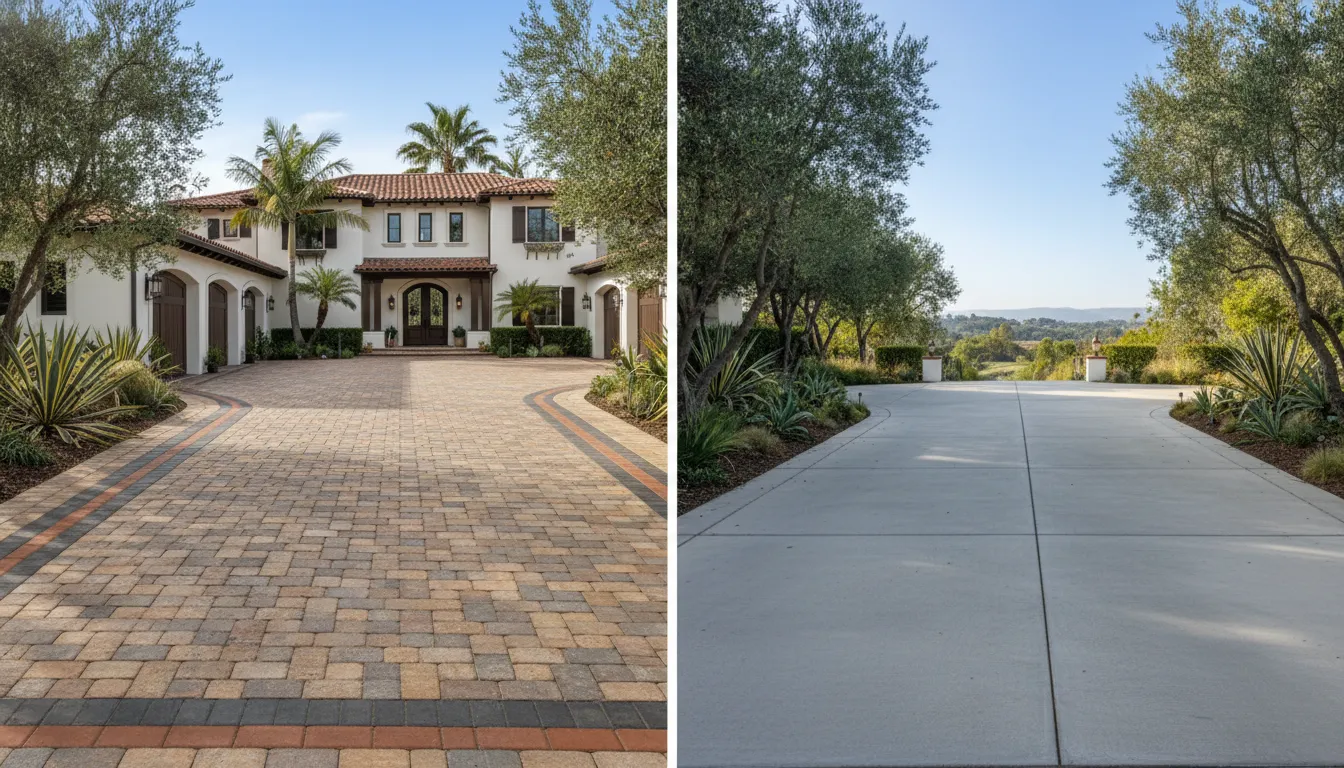
The table shows the central tradeoff. Concrete can keep the first scope more modest. Pavers call for more design choices at the start, but repairs can focus on the affected area.
That repair difference matters where a driveway shares sight lines with an coordinating paver entryway or front garden. A small repair that blends well can help keep a planned front-yard design intact.
What matters beyond price?
A driveway is a large visible surface at the front of a home. Pavers let a homeowner coordinate the drive with walkways, borders, steps, and entry areas. Concrete provides a quiet field when detailed paving is not the goal.
Surface choice can also shape a drainage discussion. Some paving systems are planned with openings and a prepared base that lets water pass through. The EPA guide to permeable pavement outlines this rainwater approach for suitable sites.
Fit for a premium home
For a refined entry, pavers often make sense when the driveway is part of the landscape plan. Borders, material blends, and transitions can be set together. The result can support a custom look from curb to front door.
Pacific Pavers focuses on premium outdoor spaces. Its role in this comparison is practical: weigh the finish goal, repair needs, and planned look of the property. Concrete remains a sound option when a simple finish and lower starting scope guide the project.
Learn more about our concrete design services.
Which option costs less up front, and which holds value better?
First cost and overall scope
In a driveway pavers vs concrete driveway comparison, poured concrete often starts at a lower price. It forms one broad surface, without the layout detail that comes with individual pavers. For homeowners focused on the initial bill, concrete can be the practical starting point.
The lowest installation price does not answer every question. A driveway shapes much of the home’s front approach, from the street to the garage and entry path. Materials that support a planned border, pattern, or transition may carry more value for a design-focused project.
Ask each contractor for the same scope before weighing bids. Compare site preparation, base work, drainage needs, edge details, removal of old material, and the finished surface. This prevents a simpler proposal from looking like the better value when it leaves needed work out.
Design, upkeep, and long-term value
Pavers usually make more sense for homeowners who prioritize design and curb appeal. They allow planned colors, patterns, and borders that can connect a driveway with walks or nearby outdoor spaces. This matters when the driveway is a visible part of the home’s overall look.
Repairability can also affect a long-term choice. A paver design is made from separate units, so a contractor can assess a limited trouble spot. Homeowners who care about future repair planning may prefer that approach over a single poured surface.
Use timing as one more cost question. Poured concrete needs several days to a week to cure after it is installed, based on Cornell University guidance on driveway surfaces. Ask how the schedule affects vehicle access and daily routines during the work.
Long-term property value is not only a resale question. It can also mean choosing a driveway that fits the home’s style and remains practical to maintain. Homeowners who place weight on appearance, repair options, and a cohesive entry often see pavers as the stronger fit.
Project fit with Pacific Pavers
Pacific Pavers works on substantial outdoor projects rather than small patch repairs. Its project minimum is $30,000. That threshold helps homeowners decide early whether a paver driveway plan aligns with the size and budget of their project.
For qualified projects, Pacific Pavers includes a complimentary design package valued at $6,500. The design phase helps set the driveway pattern, material choices, borders, and connections to other areas. It is useful when homeowners are comparing more than a basic paved surface.
Concrete may win on first price, while pavers may better serve a broader design plan. Compare complete scopes, use timelines, repair needs, and the role of curb appeal. Those details show which option offers the right value for the property and project goals.
To get a clearer picture of the investment, estimate your paver driveway cost with our interactive tool.
Schedule your complimentary driveway consultation to review driveway pavers, concrete alternatives, drainage, and curb appeal before you approve a final scope.
How each driveway handles Orange County conditions
Sun, movement, and visible wear
In a driveway pavers vs concrete driveway choice, local fit matters as much as the look. Orange County projects may need a plan for strong sun, drainage, sloped entries, and neighborhood review. The right answer depends on the lot, base work, and repair plan.
Concrete forms one hard surface after cement, aggregate, and water are placed together. Cornell describes this basic concrete driveway material and notes that a poured drive must cure after placement. A continuous slab can show a crack across a larger area if movement occurs below it.
A segmental paver drive is different because the surface is made from separate units. If base or soil movement affects a limited area, a contractor can lift and reset that section. This approach can keep a local repair from becoming a broad patch.
Slopes and water flow
A sloped driveway needs a water plan before color or pattern choices begin. The design team should study where rain enters, how it crosses the drive, and where it leaves. Edge support and base design also matter where vehicles turn or brake on a grade.
For sites suited to a permeable system, paver design can help manage runoff at the surface. A study indexed by the National Library of Medicine found that paver driveways reduced stormwater runoff compared with asphalt driveways. That finding does not replace a site drainage review. It also does not make every paver layout permeable.
- Ask how the base will handle the site’s soil and vehicle loads.
- Confirm where water travels on the slope and at the garage edge.
- Decide whether a permeable system fits the site’s drainage plan.
- Review how a settled or stained area would be repaired later.
Coastal exposure and neighborhood fit
Near the coast, a driveway choice should account for exposure and routine cleanup needs. Ask how the selected finish will look after sun, grit, moisture, and vehicle use. With pavers, separate units can be addressed when a small area is stained or damaged.
A concrete drive offers a clean, simple field when a uniform finish is the goal. Pavers offer more ways to set borders, patterns, and transitions to walks or entries. In either case, choose a design that works with the home’s exterior instead of competing with it.
Learn more about our concrete design services.
For an HOA-managed property, submit the surface type, color, border plan, and drainage details before installation. This step can clarify what the review group needs to see. It also keeps the choice practical. Appearance, water handling, and future repairs should be clear before work starts.
See your driveway design in 2D and 3D before approving materials, borders, and layout details.
Why design flexibility matters for luxury curb appeal
A driveway that fits the home
A driveway covers a large part of the view from the street. Its surface can either support the home’s design or compete with it. In a driveway pavers vs concrete driveway choice, pavers allow more control over shape, scale, and detail.
That control matters on a custom home. A clean running-bond pattern can suit modern lines and quiet stonework. A more detailed layout can echo a traditional facade, tiled roof, or formal entry court. The goal is not decoration for its own sake. It is a driveway that looks planned with the house.
Color is part of that plan. Warm blends can relate to stucco and clay roof tones, while cooler grays can sit well beside stone or contemporary finishes. A border can frame the drive, mark an apron, or guide the eye toward the entry. Homeowners comparing options can review Pacific Pavers’ paver driveway designs as a starting point for material and layout ideas.
Patterns for larger driveway layouts
Estate driveways and circular driveways make design choices easier to see. Large fields of one color may look flat, even when the material is refined. Bands, borders, and changes in pattern can break up wide paving areas. They can also define the motor court, drop-off loop, parking area, or connection to a walkway.
Scale is important. A small, busy pattern may feel restless across a long approach. A broad field pattern with a clear edge can create a calmer arrival. On a circular drive, a contrasting border can explain the curve at a glance. It also helps the drive read as part of the front landscape, rather than a plain paved route.
Surface choice can involve more than appearance. In one published study, paver driveways reduced stormwater runoff when compared with asphalt driveways. Readers weighing permeable layouts can view the driveway runoff study for the source findings. The right application depends on the site, base, drainage plan, and selected paver system.
Seeing the design before installation
Luxury curb appeal is easier to judge when the plan is visual. A flat sample shows color and finish, but it does not show how a border turns around a circle. It also cannot show how a pattern meets the garage, front steps, or planting beds.
A 2D plan helps organize dimensions, curves, bands, and transitions. A 3D view helps show how those choices relate to the home’s elevation and entry sequence. Pacific Pavers’ 2D and 3D designs can make pattern and color choices clearer before work begins.
That same visual package can support an HOA review when a community asks for a proposed layout and finish selection. Owners can show the planned drive, border placement, and color direction in one clear set. For a high-visibility project, early review helps avoid a design that looks right on a sample but misses the home’s scale.
What should you expect for maintenance and repairs?
When comparing driveway pavers vs concrete driveway options, maintenance is not about finding a surface with no work. It is about choosing how routine care and future fixes will fit your home. Both surfaces need cleaning and prompt attention when stains or movement appear.
Routine cleaning and sealing
For Pacific Pavers clients, maintenance planning should match the finish selected during design. A driveway with lighter pavers, darker borders, or a high-visibility entry layout may need a different cleaning rhythm than a plain gray slab. Routine care starts with keeping leaves, soil, and spills from sitting on the driveway. Sweeping and timely stain cleanup help keep either surface neat. For pavers, ask when joint sand should be checked and refreshed.
Sealing is a choice to discuss based on the paver type, desired look, traffic, and site conditions. A contractor can explain whether a sealer suits the installed product. Ask how it may change the color, finish, and future care schedule.
A useful care plan separates a cosmetic issue from a repair concern. A stain may affect the look of the surface. A low or rocking section may need a closer check. Record where a change appears before deciding on service.
Stains, cracks, and spot repairs
Stains and cracks show an important ownership difference. With a poured concrete slab, a patched spot may remain visible against older concrete. A crack or shifted area also raises a practical question: how large will the repair area be?
A paver surface gives the repair crew smaller working units. If a unit chips or stains, the crew can discuss replacing that piece. If a section settles, units can be lifted while the support below is reviewed.
This does not mean pavers never need care. It means a repair plan may focus on the affected units and their base. With a slab, ask how patch color and texture may compare with the surrounding drive after work is complete.
When new pavers are installed, ask whether spare matching units can be kept for later use. Keep those pieces in a protected spot. If a future replacement is needed, the original size, shape, and blend may be on hand.
Lifetime ownership planning
Plan for upkeep at the start, not only after a visible issue develops. Ask for guidance on stain cleanup, joint sand, sealing, replacement units, and drainage observations. Clear instructions help you know what is routine and what needs an on-site review.
Cleaning habits matter for either surface. Remove fresh spills with a method suited to the installed material. Do not test a harsh cleaner across a wide area. Before deep cleaning or sealing, confirm which process fits your specific driveway.
Pay attention to where water goes during a storm. Pooling, washed-out joints, or a low spot should be noted for follow-up. A study indexed by the National Library of Medicine found less runoff from paver driveways than asphalt driveways.
Your property layout, base, and drainage details still guide long-term care. For either material, request a written maintenance plan before installation. That document should set out cleaning guidance, sealing discussions, repair options, and whom to call when the surface changes.
How to choose the right driveway material for your home
Choosing between driveway pavers vs concrete driveway options starts with how you will use the space. Budget matters, but so do appearance, drainage goals, HOA rules, and plans for the home. A useful choice fits daily parking needs while supporting the look you want at the curb.
Where poured concrete can make sense
Poured concrete can be a sound choice when your goal is a simple, continuous surface with a basic layout. It may fit a project where pattern choices are not a priority. Plan for installation timing. Poured concrete needs several days to a week to cure after placement.
Before choosing it, review what matters beyond the initial surface. Check HOA material and color rules before approving a design. Ask how the finish will match the house, planting, and nearby walks. If curb appeal matters to your home plans, compare finished samples instead of choosing from cost alone.
When pavers deserve a closer look
Pavers are worth considering when pattern, border detail, or a matching outdoor design ranks high on your list. They also let you discuss permeable system options when water movement is a concern. The right drainage choice depends on the base, soils, slope, and local rules.
Do not assume every paver layout manages water in the same way. In one published study, paver driveways reduced stormwater runoff when compared with asphalt driveways. Read the driveway runoff study, then ask how a proposed system is built for your lot.
A five-step driveway decision check
Use this short process before choosing a material or accepting a proposal. It keeps design goals and site limits in the same conversation.
- Set your priorities. Rank budget, curb appeal, design detail, drainage, care, and project timing. Your top two goals should guide the first comparison.
- Check home and HOA fit. Review approved colors, borders, and surface types. Compare each option with your home’s style and planned front yard updates.
- Review water goals. Note pooling spots, slope, and where rain should go. Stormwater-friendly driveways can let water soak into soil. A University of Vermont guide explains this option.
- Compare real designs. Request concrete finish choices and paver patterns for the same driveway footprint. Compare what you will see each day, not vague product labels.
- Ask for a clear scope. Request details on the base, edging, drainage plan, timeline, and care guidance. Choose the proposal that answers your main site questions.
A basic driveway may point toward poured concrete. A design-led or drainage-focused project may favor paver options. The right choice follows site details, clear expectations, and a plan you understand.
Book a complimentary driveway design consultation to compare pavers, concrete, drainage, and curb appeal for your Orange County property.
Request a complimentary design consultation before you decide on driveway pavers vs concrete driveway details for your Orange County home.
Frequently Asked Questions
How long does a new concrete driveway take before I can use it?
A poured concrete driveway cannot be used immediately after installation. Concrete must set and gain strength before it handles vehicles. Cornell explains that poured concrete needs several days to a week to cure. Your installer should set the exact no-parking period based on the concrete mix, weather, slab design, and site conditions.
Do driveway pavers help with rainwater runoff?
Permeable driveway pavers can help manage rainwater when they are installed over a suitable draining base. A study indexed by the National Library of Medicine found that paver driveways reduced stormwater runoff compared with asphalt driveways. Results depend on the paver system, underlying soil, slope, maintenance, and whether local drainage rules permit a permeable design.
Can damaged driveway pavers be repaired more easily than poured concrete?
Individual driveway pavers can often be removed and replaced in the affected area, if matching units are available. A damaged poured concrete driveway usually requires patching or replacing a larger slab section, and the repair may remain visible. For either surface, identify the cause first, such as soil movement, drainage issues, roots, or heavy vehicle loads, so the damage does not quickly return.
What should Orange County homeowners compare besides driveway installation price?
Compare the full project scope, not only the initial quote. Ask about base preparation, drainage, permits, demolition, reinforcement, curing or access timing, sealing, repairs, and warranty terms. Permeable pavers may support on-site drainage goals because water can soak into a properly built base. The University of Vermont Sea Grant guide explains how stormwater-friendly driveways can help filter water through soil.
Ready to Plan Your Orange County Driveway Project?
Waiting to choose a driveway surface can keep a worn, cracked, or unfinished entry from supporting the home impression you want. Starting now gives you time to compare pavers and poured concrete with your budget, design goals, and maintenance priorities in mind. A clear plan today helps you move toward a driveway choice that fits your property, project schedule, and long-term expectations.
Ready to choose a driveway approach with confidence? A focused project conversation can clarify your priorities before you commit to a surface, scope, or installation path. Request your complimentary design consultation to discuss your driveway goals, compare suitable options, and plan the next practical step for your Orange County home.

Jeff Tobin is the founder of Pacific Pavers, an award-winning outdoor living company serving Orange County, California. With a 30-person team of ICPI-certified professionals, Jeff specializes in transforming residential and HOA properties through custom paver installations, pool remodeling, and complete outdoor living spaces. His company philosophy—”Flawless craftsmanship. Clear communication. Zero stress.”—reflects his commitment to delivering premium results and exceptional customer experiences. As a BBB-accredited business and Belgard Master Craftsman, Pacific Pavers has become known for process-driven operations and elite craftsmanship in the hardscape industry.