
Tiering makes retaining walls more stable by dividing a tall wall into shorter, offset sections. This method reduces soil pressure on each wall, minimizes structural stress, and improves durability. By spacing tiers properly – typically twice the height of the lower wall – each section works independently, lowering the risk of failure. Tiered designs are ideal for sloped landscapes, offering better drainage and functionality for outdoor spaces like gardens or patios. Proper spacing, reinforcement, and drainage systems are crucial for success, especially in areas with challenging soil or weather conditions.
Structural Benefits of Tiered Retaining Walls
Reduction of Lateral Earth Pressure
One of the biggest advantages of tiered retaining walls is how they reduce lateral earth pressure. By splitting the retained soil into smaller sections, each tier handles a smaller load. This means less pressure is exerted on each wall compared to a single, taller wall, minimizing the risk of structural failure and making material use more efficient.
For example, research from FHWA and TxDOT shows that a two-tiered system – each wall 10 feet tall with a 16-foot horizontal offset – requires much less reinforcement than a single 20-foot wall. This is because each 10-foot section only deals with the soil directly behind it, avoiding the cumulative pressure of the full height.
Proper spacing between tiers is key here. When the horizontal offset is large enough, each wall functions independently, avoiding "surcharge loading" on the lower walls. This separation ensures better stability and reduces overall stress on the structure.
Improved Global Stability and Stress Distribution
Tiered walls also enhance stability by spreading stresses across multiple walls and soil layers, which lowers the chances of large-scale failures like deep-seated or compound slips. The offset between tiers interrupts potential slip surfaces, making the system less likely to experience major movement or settlement compared to a single tall wall.
Think of it like using multiple smaller beams instead of one heavy beam. Each tier serves as its own support, offering multiple layers of resistance to soil movement. This redundancy ensures that even if one tier faces stress, the others continue to maintain stability.
In well-designed systems, the reinforcement length for each wall is typically shorter. For instance, a 10-foot wall in a tiered system usually requires reinforcement about 7 feet long (0.7 times the wall height), which is much less than what would be needed for a single tall wall of the same total height.
Research Findings Supporting Tiering
Studies back up the structural benefits of tiered retaining walls, especially in tough conditions. Research from TxDOT and FHWA highlights that multi-tiered walls with proper offsets can act as independent structures. This independence lowers reinforcement needs and boosts overall stability.
One real-world case involved a two-tiered wall with a 75% offset and a friction angle of 34°. Even under stress, the system maintained stability without compromising critical slip surfaces. Another example featured a four-tiered wall with 50% offsets, designed based on the soil’s friction angle. This system successfully prevented slope failure and minimized settlement on a steep embankment. Each wall required far less reinforcement than a single tall wall would have needed.
These findings have shaped updated design guidelines. According to FHWA recommendations, if the offset distance exceeds certain calculations based on wall height and soil friction angle, the walls can be treated as independent. This allows engineers to design each tier to handle its own load rather than the combined pressures of the entire system.
Moreover, research shows that global stability often drives the design of tiered retaining walls, especially on sloped sites or with weaker soils. Tiered systems address these challenges by offering multiple retention points and spreading stress throughout the slope, making them more effective than single-wall solutions in such scenarios.
Keystone Tech Talk #4: Tiered Walls a Basic Design Tutorial
Key Design Principles for Tiered Retaining Walls
These principles are designed to ensure that the benefits of reduced lateral pressure and improved stability are fully achieved.
Spacing and Offset Guidelines
The horizontal offset between tiers plays a crucial role in maintaining structural stability. According to FHWA guidelines, the horizontal distance from the base of the upper wall to the back of the lower wall should be at least twice the height of the lower wall (a 2:1 ratio). This spacing prevents surcharge loading and allows each wall to act as an independent structure.
For example, a 6-foot lower wall would require a 12-foot setback to treat the tiers as separate structures. This reduces the need for additional reinforcement and simplifies the overall design process.
However, the exact offset depends on soil conditions. For instance, a 10-foot wall built in soil with a friction angle of 34° should have a minimum offset of 14.8 feet. When property constraints make achieving this spacing impossible, the system must be designed as a connected structure, requiring more reinforcement and a more complex analysis.
If offsets fall below the 2:1 ratio, this results in surcharge loading. This situation demands longer geogrids and deeper excavation, which increases both the cost and complexity of the project.
Reinforcement and Soil Stabilization Techniques
Proper spacing is just the beginning. Effective reinforcement is essential for distributing loads and stabilizing the soil. Geogrids and other soil reinforcements are critical in tiered wall systems, as they help resist soil movement and distribute loads evenly. Unlike single walls, tiered systems require reinforcement strategies that account for the added loads from upper walls.
Typically, reinforcement lengths are 0.7 times the height of each wall. However, when tiers are closely spaced or the site presents challenging conditions, reinforcement lengths may need to be extended, particularly at the base of the lower walls.
Longer reinforcement increases the contact area between geogrids and the soil, reducing the risk of pullout failure. This is especially important in tiered systems, where the load patterns are more complex due to the interaction between multiple walls.
Compaction of backfill around the reinforcement is equally important. Each layer of soil must be compacted to the specified density to ensure the geogrids function as intended. Poor compaction can lead to settlement issues and reduce the effectiveness of the reinforcement system.
Site-Specific Factors to Consider
While standard reinforcement and offset guidelines provide a foundation, site-specific conditions often require additional adjustments. Factors such as soil type, slope angle, drainage conditions, and seismic activity play a significant role in determining the final design.
For example, poorly draining soils or high groundwater levels can create hydrostatic pressure behind the walls, a common cause of retaining wall failure. These conditions demand enhanced drainage solutions and potentially stronger reinforcement to handle the added water pressure. Clay soils, which retain water longer, are particularly problematic during wet seasons.
Sites with steep slopes or weak soils may require greater offsets, longer reinforcement lengths, or entirely different wall designs. The slope angle influences how loads transfer between tiers and can increase the risk of global slope failure.
Local climate also impacts design. In areas with freeze-thaw cycles, foundations must extend below the frost line to prevent shifting. The frost line depth varies by region, ranging from about 12 inches in southern states to over 48 inches in northern climates.
To ensure the wall system performs under both normal and extreme conditions, a qualified engineer should evaluate the site’s soil, drainage, and slope characteristics. This evaluation is essential for designing a system that can adapt to changing conditions over time.
Drainage design is another critical aspect of tiered systems. Each tier requires its own drainage setup, including free-draining gravel backfill, perforated drain pipes behind each wall, and weep holes at the base. Properly managing drainage from upper tiers is essential to avoid adding pressure to lower walls.
sbb-itb-11ea599
Tiered vs. Single-Tall Retaining Walls: A Comparison
When planning a retaining wall project, deciding between a tiered system and a single-tall wall directly impacts both performance and cost. Each option has its strengths, depending on the site conditions and project goals.
Comparison of Structural Stability and Aesthetics
Tiered retaining walls distribute lateral loads across multiple levels, improving stability. This design reduces the risk of deep-seated slope failures and is better equipped to handle surcharge loads from nearby structures.
In contrast, single-tall walls must withstand all lateral pressure at once. This increases the likelihood of issues like overturning, sliding, or structural failure, especially for walls exceeding 3–4 feet in height. Proper spacing is key for tiered walls, as it allows each tier to function as an independent, stable structure.
A real-world example from Orange County, CA, compared a 6-foot single-tall retaining wall with a two-tiered system featuring 3-foot tiers spaced 8 feet apart. Within 5 years, the single-tall wall exhibited bulging and cracking, while the tiered system remained intact after 10 years.
From a design perspective, tiered walls offer more flexibility. They support terraced landscaping, multi-level patios, and integrated features like outdoor kitchens or firepits. This design also blends naturally with sloped terrain, creating a smoother visual transition. On the other hand, single-tall walls, while simpler, lack the ability to incorporate varied elevations or complementary landscape elements.
| Feature | Tiered Retaining Walls | Single-Tall Retaining Walls |
|---|---|---|
| Structural Stability | Higher (with proper spacing) | Lower for tall walls; higher risk |
| Aesthetics | Flexible and visually varied | Monolithic, limited design options |
| Space Requirements | Needs more horizontal space | Requires less horizontal space |
| Suitability for Steep Slopes | Excellent | Limited by height restrictions |
| Maintenance | Easier to repair individual tiers | More difficult if failure occurs |
These differences in structure and appearance also influence project costs and construction methods.
Cost and Construction Complexity
The financial and construction challenges of tiered versus single-tall walls often depend on wall height and site conditions. Tiered walls typically carry higher upfront costs due to their segmented design and added engineering requirements. However, their distributed load design helps reduce long-term maintenance expenses by minimizing structural problems.
Single-tall walls are generally more affordable for shorter heights but may require expensive reinforcements, such as deeper footings, advanced drainage systems, or geogrid support for walls taller than 4 feet.
Building tiered walls demands detailed planning, precise spacing, and coordinated construction to maintain stability and load distribution. While single-tall walls are easier to construct for low heights, taller versions often need advanced techniques like deeper foundations or additional reinforcement. For slopes steeper than 2:1 (horizontal:vertical), tiered walls usually require slope stability analysis and geogrid reinforcement, whereas single-tall walls only need similar measures at greater heights.
Maintenance also leans in favor of tiered systems. Their design reduces the likelihood of cracking, bulging, and failure caused by uneven soil pressure or moisture buildup. Single-tall walls, particularly those exceeding 4 feet, are more vulnerable to these issues.
Local regulations can further shape the decision. Many areas allow single-tall walls up to 4 feet without a permit, while taller or tiered systems often require engineered designs, specific spacing, and regular slope stability checks. Professional contractors like Pacific Pavers ensure compliance with local codes in Orange County, CA, delivering designs that balance structural reliability and visual appeal.
Applications in Professional Hardscape Projects
Tiered retaining walls are a game-changer when it comes to professional hardscape projects, especially in areas with challenging terrains like Southern California. By transforming steep, unusable slopes into functional outdoor spaces, these walls create level terraces perfect for gardens, patios, or walkways – all while maintaining the structural stability needed for long-term success.
Transforming Outdoor Spaces with Tiered Walls
Hardscape contractors rely on tiered retaining walls to tackle significant elevation changes on sloped properties. In places like Orange County, where hills dominate the landscape, these walls not only make outdoor spaces more usable but also blend naturally with the surroundings.
Visually, tiered walls break up large, steep slopes into smaller, more manageable sections, creating opportunities for creative landscaping. Features like built-in seating or water elements can be incorporated to enhance the design.
Take, for instance, a project in Orange County that turned a steep slope into three distinct terraces. The redesign included a play area, a patio with a firepit, and a garden. This approach didn’t just stabilize the hillside – it also added significant usable space and boosted the property’s overall value.
To ensure these walls stand the test of time, proper tier spacing is critical (at least twice the height of the lower wall). Soil analysis, drainage planning, and reinforcement measures are also essential. When executed correctly, these strategies lead to designs that are both functional and visually appealing.
Pacific Pavers‘ Expertise in Tiered Retaining Wall Design
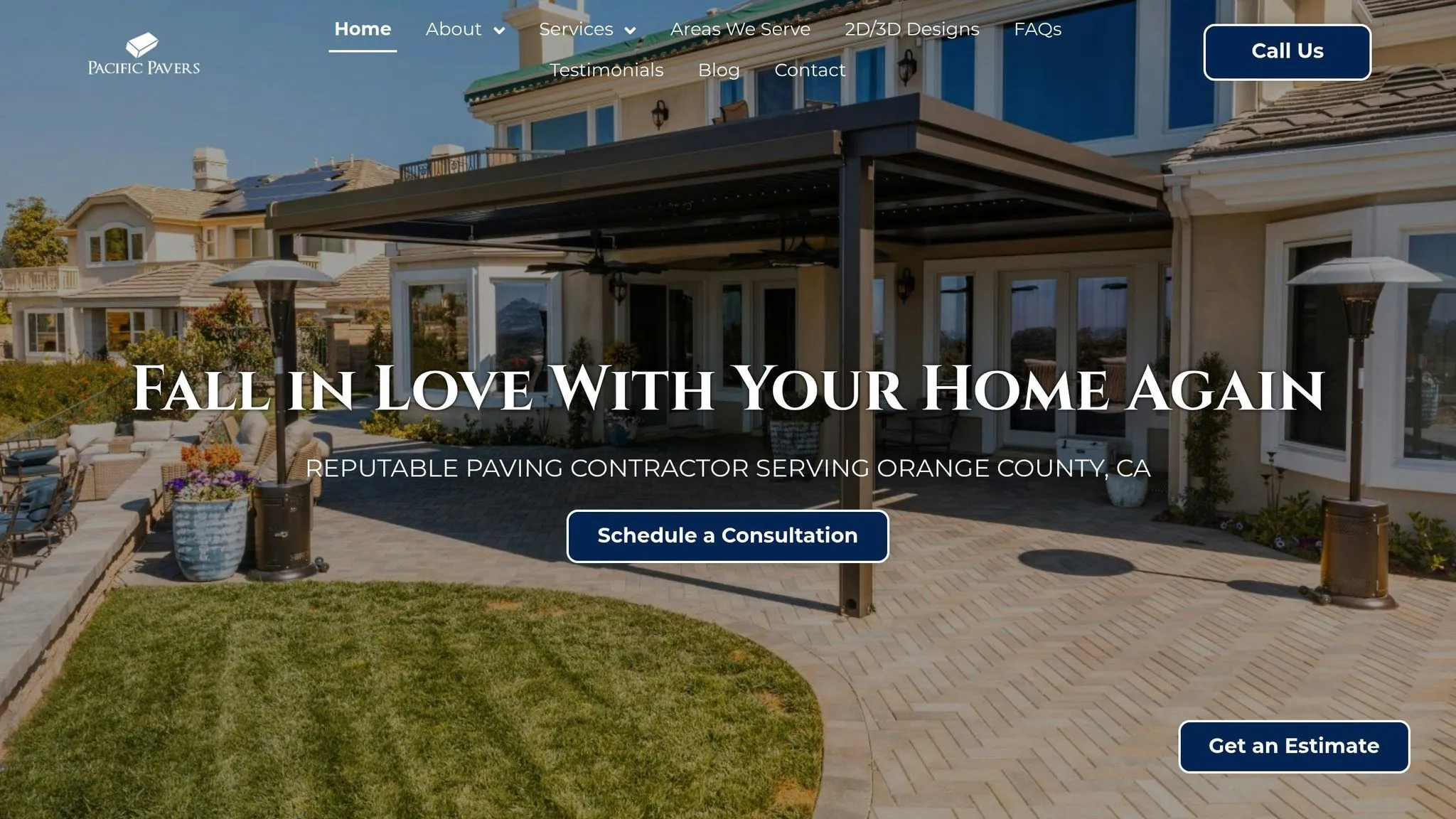
Pacific Pavers takes a meticulous approach to tiered retaining wall projects, starting with a detailed site assessment and soil analysis. This ensures each design is tailored to meet the specific elevation challenges of the site while balancing both functionality and aesthetics.
In Orange County, where variable soil conditions, seismic activity, and strict local codes are common, Pacific Pavers excels by combining precise engineering with adaptive construction techniques. Their process includes geotechnical assessments, seismic load designs, and flexible construction methods to handle minor ground shifts. Every project adheres to or exceeds building code requirements, ensuring both safety and compliance.
What sets Pacific Pavers apart is their ability to integrate tiered walls into broader outdoor living designs. Many of their projects include additional features like outdoor kitchens, firepits, and patios, creating cohesive landscapes that enhance usability and curb appeal. These added amenities also significantly increase property value.
For sites with complex layouts or closely spaced tiers, Pacific Pavers works closely with civil engineers to develop reinforced solutions. This collaboration ensures safety and structural integrity, even in situations where standard spacing guidelines can’t be followed. The result? Beautiful, functional outdoor spaces that meet the highest standards of both design and safety.
Conclusion: Why Tiering Improves Retaining Wall Stability
The engineering principles behind tiered retaining walls clearly demonstrate their advantages over single, tall structures. By breaking down soil loads into smaller, more manageable sections, tiering reduces the lateral pressure on each wall segment while enhancing overall system stability. This method turns what could be a daunting structural challenge into a series of reliable, interconnected components.
Proper 2:1 spacing ensures each tier functions independently, meeting the 1.5 safety factor for sliding and overturning with ease, while also minimizing the need for extensive reinforcement. Research consistently highlights how this design reduces the risk of slip surface failures that could compromise the entire retaining system.
Beyond structural benefits, tiering brings practical and visual enhancements. Tiered walls create functional terraces that blend seamlessly with sloped landscapes, improving both drainage and soil management. Their aesthetic appeal complements their performance, making them a smart choice for both stability and design.
The role of professional expertise in building tiered retaining walls is indispensable. As Pacific Pavers emphasizes:
"Quality is at the forefront of everything we do at Pacific Pavers. Our commitment begins with using premium materials and employing highly skilled installers who are experts in their craft. We follow industry best practices and adhere to rigorous standards to ensure each project is completed with precision." – Pacific Pavers
This level of craftsmanship ensures that tiered systems not only withstand environmental stresses but also enhance outdoor spaces. Addressing complex factors like soil mechanics, reinforcement placement, and drainage integration requires skill and precision. When designed and constructed by professionals, tiered retaining walls deliver long-lasting stability, functionality, and beauty, transforming outdoor areas into secure, visually appealing spaces that endure for years to come.
FAQs
How does tiering enhance the stability of retaining walls in difficult soil conditions?
Tiered retaining walls enhance stability by breaking up the weight of the retained soil across several levels. This approach reduces the pressure on any one wall, making it an effective solution for managing tougher soil conditions. It also promotes better drainage, helps prevent erosion, and avoids the buildup of excessive force that could compromise the wall’s integrity.
What’s more, tiered designs can be tailored to meet the unique challenges of a site, whether it’s steep slopes or less stable soil. With the right materials and skilled craftsmanship – like the expertise provided by Pacific Pavers – you can create a durable, long-lasting retaining wall that elevates both function and style in your outdoor space.
How does a tiered retaining wall design improve drainage and prevent soil erosion?
A tiered retaining wall design is a smart way to control water flow and prevent soil erosion by dividing a slope into smaller, more stable sections. This approach helps water drain more efficiently between the tiers, reducing the hydrostatic pressure that can weaken the wall over time.
The stepped design also slows down water runoff, which helps keep soil in place and prevents it from being washed away. Adding features like gravel backfill and perforated pipes improves drainage even further, boosting the wall’s stability and protecting the surrounding area. If you’re looking for tailored solutions for retaining walls, Pacific Pavers provides designs customized to fit your outdoor space perfectly.
What are the key mistakes to avoid when building tiered retaining walls for lasting stability?
To keep tiered retaining walls stable for the long haul, there are a few common pitfalls you’ll want to steer clear of. One big mistake is neglecting to compact the soil properly behind each tier. Without this step, the soil can settle unevenly, weakening the structure over time. Another issue is poor drainage. When water builds up behind the walls, it adds pressure that can eventually cause them to fail.
Spacing and height between tiers are also crucial. If the tiers aren’t spaced correctly, the weight from the upper levels can put too much strain on the lower ones. Finally, using the wrong materials or skipping professional advice can jeopardize the wall’s durability. For expert help, Pacific Pavers offers custom-designed retaining walls built to fit your outdoor space and stand the test of time.
Related Blog Posts
- Retaining Wall Drainage: 5 Key Techniques
- Checklist for Retaining Wall Aesthetic Upgrades
- Retaining Walls with Built-In Drainage Systems
- Best Retaining Wall Materials for Sloped Yards

Jeff Tobin is the founder of Pacific Pavers, an award-winning outdoor living company serving Orange County, California. With a 30-person team of ICPI-certified professionals, Jeff specializes in transforming residential and HOA properties through custom paver installations, pool remodeling, and complete outdoor living spaces. His company philosophy—”Flawless craftsmanship. Clear communication. Zero stress.”—reflects his commitment to delivering premium results and exceptional customer experiences. As a BBB-accredited business and Belgard Master Craftsman, Pacific Pavers has become known for process-driven operations and elite craftsmanship in the hardscape industry.