
Choosing between pavers and concrete for your pool deck comes down to cost, durability, maintenance, and design preferences. Here’s a quick breakdown:
- Pavers: More expensive upfront ($16–$24 per sq ft) but easier to repair, highly durable, and offers a wide range of design options. They resist cracking and provide better slip resistance and drainage, making them ideal for wet areas like pool decks.
- Concrete: Cheaper initially ($8–$16 per sq ft) with faster installation. It offers a clean, smooth look but is prone to cracking over time and can be slippery unless textured. Repairs are more noticeable and often costly.
Quick Comparison
| Factor | Pavers | Concrete |
|---|---|---|
| Cost | $16–$24 per sq ft | $8–$16 per sq ft |
| Durability | Resists cracking; long-lasting | Prone to cracks over time |
| Repairs | Easy; replace individual units | Visible patches or slab replacement |
| Slip Resistance | High; textured and joint gaps | Moderate; depends on finish |
| Design Options | Wide variety of colors/patterns | Limited to stamping or staining |
| Water Drainage | Excellent; through joints | Relies on surface slope |
If you prioritize long-term durability and design flexibility, pavers are a better choice. If upfront cost and a simpler look are more important, concrete may suit your needs. Both options can create a stylish pool deck, but your decision should also factor in local conditions, maintenance preferences, and future plans.
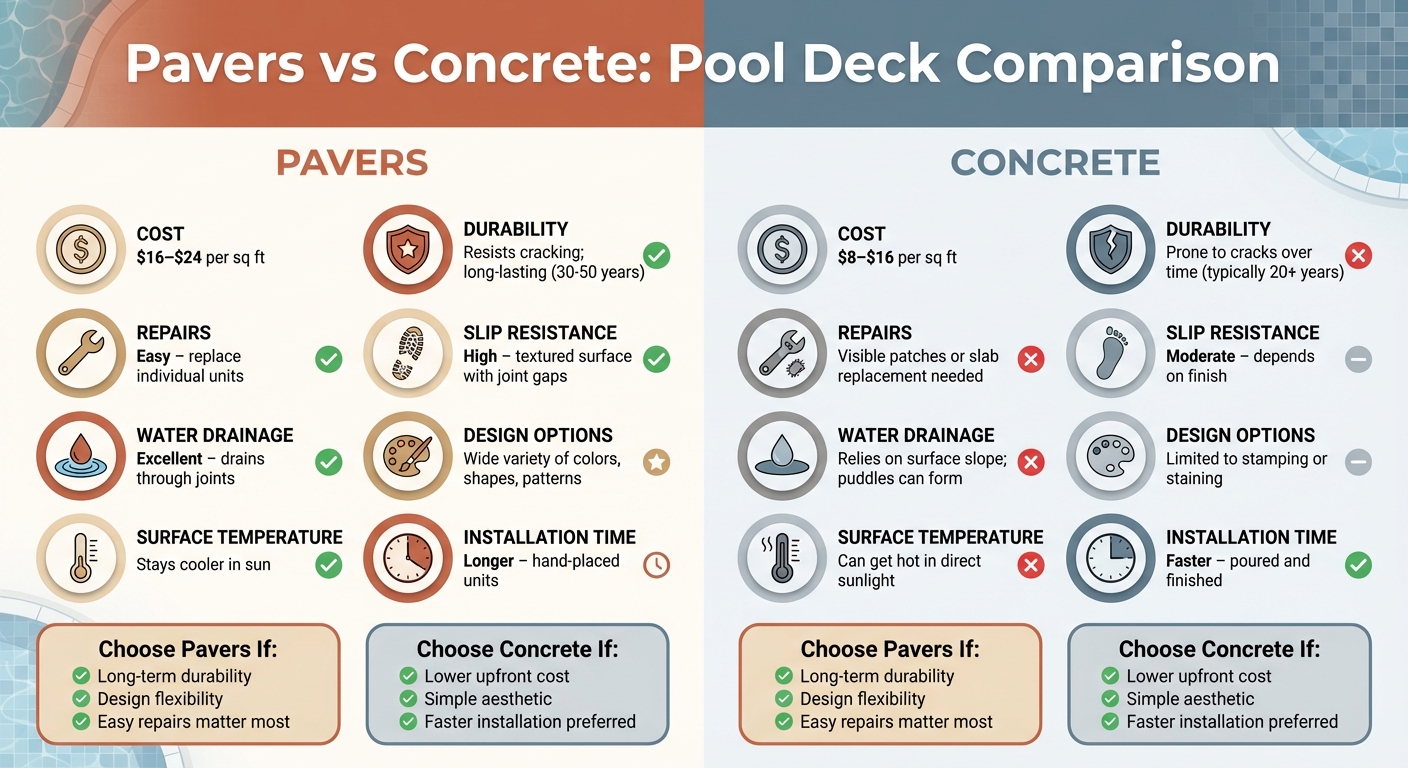
Pavers vs Concrete Pool Deck Comparison: Cost, Durability & Maintenance
Pool Patio Materials: Stamped Concrete vs. Pavers
What Are Pavers for Pool Decks?
Pavers are individual interlocking units crafted from materials like concrete, natural stone, or brick, and they’re laid over a prepared base. Most concrete pavers are made by mixing sand, water, cement, and color pigment. This composition creates a porous surface that supports excellent drainage.
These pavers blend strength with design versatility. With a wide range of colors, shapes, and textures, you can create patterns like herringbone, basketweave, or running bond. Natural stone options – like travertine – offer timeless beauty and can last for generations, while concrete pavers are a more affordable choice with customizable finishes. Their textured surfaces and the gaps between them not only improve slip resistance but also allow water to drain away, minimizing standing water around your pool. These features make pavers a practical and stylish option for pool decks.
Main Characteristics of Pavers
Pavers aren’t just about looks – they’re built for function too. One standout feature is their ability to resist cracking. Unlike solid concrete, pavers can flex slightly with minor ground movement. If one paver cracks, chips, or breaks, you can simply replace it without disrupting the entire deck. This modular design also makes future updates easier. Need to expand your deck or access underground utilities? You can lift and relay sections without cutting or patching.
Pavers also work seamlessly with other outdoor features. Whether you’re designing patios, walkways, outdoor kitchens, or fire pits, you can use matching or complementary pavers to create a cohesive outdoor space. Pacific Pavers, based in Orange County, specializes in custom installations, helping homeowners design pool decks that flow beautifully with other hardscape elements like outdoor kitchens and fire pits.
How Pavers Are Installed
The installation process starts with excavation to the required depth. A compacted base of crushed stone is laid down, followed by a 1-inch bedding layer of sand to ensure proper drainage.
Once the base is prepared, the pavers are arranged in the chosen pattern, with edge pieces cut to fit. Edge restraints are installed to keep the pavers from shifting. Finally, joint sand or polymeric sand is swept into the gaps between the pavers, and the surface is compacted to lock everything in place. This sand-filled joint system is key – it stabilizes the pavers, enhances drainage, and helps prevent weeds from growing between them. While this method takes more time and precision than pouring concrete, the result is a durable, customizable pool deck that can last for decades.
What Is Poured Concrete for Pool Decks?
Poured concrete offers a sleek and seamless alternative to segmented paver systems. Unlike pavers, which consist of individual pieces, poured concrete forms a single, continuous slab around your pool. The process involves mixing the concrete on-site or delivering it by truck, pouring it into pre-set forms, leveling it, and letting it cure into a solid surface. The result? A smooth and uninterrupted pool deck with a timeless appearance.
You can choose from a variety of finishes to customize the look and functionality of your deck. A broom finish, for instance, creates subtle lines that improve traction – perfect for wet areas. Stamped concrete, on the other hand, uses textured mats to mimic the look of stone or other materials at a fraction of the cost. However, keep in mind that stamped concrete may require resealing as UV exposure can fade the colors over time. For a more vibrant touch, stained or colored concrete allows you to add pigments that complement your pool and home’s design.
Many homeowners are drawn to poured concrete for its uniform appearance, relatively quick installation, and lower initial cost compared to pavers. For example, broom-finished concrete typically costs between $8 and $12 per square foot, while stamped concrete ranges from $12 to $16 per square foot. By comparison, high-quality pavers can cost anywhere from $16 to $24 per square foot.
Main Characteristics of Poured Concrete
Poured concrete creates a strong, durable surface that can handle heavy foot traffic and standard residential loads. While standard gray concrete can become quite hot under the sun, lighter shades or added pigments can help reduce heat absorption. Around pools, concrete holds up well against damage from properly balanced pool chemicals. However, areas with standing water can become slippery, especially if the surface is too smooth – making textured finishes a smart choice for poolside safety.
Over time, you might notice hairline cracks due to UV exposure and temperature changes. Stamped concrete, while able to mimic premium materials like slate or flagstone, has some limitations. Patterns may repeat, color options are more restricted, and making changes after installation can be both challenging and costly. Additionally, cracks or discoloration in stamped concrete tend to stand out more than in segmented pavers. These differences will be directly compared to paver systems in the next section.
How Concrete Is Installed
The installation process starts with preparing the site and ensuring proper grading. A compacted gravel base is added, along with reinforcement like rebar or wire mesh, to minimize cracking. Contractors also establish slopes to direct water away from the pool and nearby structures. Once the site is ready, the concrete is poured and leveled. The finish – whether it’s broomed, stamped, or colored – is applied next. Control joints are carefully placed to guide any cracks into specific lines rather than letting them spread unpredictably across the slab.
After curing, a specialized sealer is applied to enhance durability, maintain color, and protect against stains. In areas like Orange County, CA, professionals such as Pacific Pavers can help homeowners decide whether poured concrete or pavers are better suited to local soil conditions and design preferences. They can also integrate the concrete deck with other backyard features like fire pits, outdoor kitchens, or patio covers, creating a cohesive and functional outdoor space. This approach results in a sturdy, low-maintenance pool deck that offers a distinct contrast to the modular design of pavers.
sbb-itb-11ea599
Pavers vs Concrete: Side-by-Side Comparison
Now that you’re familiar with how pavers and concrete work, let’s break down how they stack up in the areas that matter most for your pool deck. The table below gives a quick comparison of key factors, followed by a deeper dive into costs, durability, safety, and design.
| Factor | Pavers | Poured Concrete |
|---|---|---|
| Upfront Cost | $16–$24 per sq ft installed | $8–$16 per sq ft (broom to stamped) |
| Installation Time | Longer; each unit placed by hand | Faster; poured and finished as slabs |
| Cracking Resistance | High; flexible joints absorb movement | Prone to visible cracks over time |
| Repairs | Easy; swap individual pavers | Patching or slab replacement often needed |
| Slip Resistance | Naturally textured; joints aid drainage | Can be slippery unless finished properly |
| Surface Temperature | Stays cooler, especially light colors | Can get hot in direct sun |
| Water Drainage | Excellent; drains through joints | Relies on surface slope; puddles can form |
| Design Flexibility | Wide variety of colors, shapes, patterns | Uniform slabs; stamping mimics other materials |
| Maintenance | Joint sand replenishment; periodic sealing | Regular sealing; visible crack repairs |
| Lifespan | 30–50 years with proper care | Typically a couple of decades |
Cost and Installation
Pavers come with a higher upfront cost, ranging from $16 to $24 per square foot installed, compared to concrete, which costs $8 to $12 per square foot for broom-finished surfaces and $12 to $16 per square foot for stamped finishes. This price difference is largely due to labor: pavers require precise placement on a prepared sand bed, while concrete is poured and finished as large slabs, making it faster and more cost-effective for simple, flat designs.
However, site complexity can impact costs for both materials. Features like curves, elevation changes, or poor soil conditions may increase expenses. While pavers adapt well to uneven or challenging layouts without the need for custom forms, concrete is often more economical for straightforward, large-scale decks. For design-heavy projects, the added visual appeal and long-term benefits of pavers often justify the higher initial investment.
Durability, Repairs, and Maintenance
Pavers excel in durability because their flexible joints allow the surface to adjust to soil shifts and temperature changes without cracking. In contrast, concrete slabs are rigid and more likely to crack due to ground movement, shrinkage, or UV exposure. This is especially true in poolside environments where chlorinated or saltwater exposure, combined with temperature fluctuations, can accelerate surface wear and discoloration in concrete – particularly if it isn’t sealed regularly.
When it comes to repairs, pavers are much simpler to fix. Damaged units can be replaced individually, leaving the rest of the deck untouched. Maintenance for pavers generally involves sweeping, occasional pressure washing, and re-sanding or sealing the joints as needed. Concrete, on the other hand, requires sealing to protect against wear, and cracks or chips can be patched – but these repairs often remain visible, especially on stamped finishes. If damage becomes extensive, resurfacing or replacing the entire slab might be necessary, which can be costly and disruptive. In the long run, pavers’ easy repair process helps maintain their appearance and reduce costs.
Safety, Comfort, and Water Drainage
Pavers offer excellent slip resistance, especially those with textured or tumbled surfaces. The joints between pavers also improve drainage, helping to prevent standing water that could lead to slips. Concrete can be broom-finished or treated with additives to enhance traction, but if finished too smoothly or if sealers build up, it can become dangerously slick when wet. Around pools, the superior drainage of pavers can make a noticeable difference in reducing slip hazards.
Another advantage of pavers is their comfort underfoot. Light-colored pavers or those made from natural stone tend to stay cooler in the sun compared to dense or dark materials. The joints also help dissipate heat, making them more comfortable for bare feet on hot summer days. Standard gray concrete, however, can become uncomfortably hot in direct sunlight, though lighter colors and certain finishes can help reflect heat. Pavers also allow water to seep through the joints, reducing puddles and drying the surface faster after rain or splashes. Concrete, being largely impermeable, relies on proper grading to direct water off the surface. If the slab isn’t sloped correctly or settles unevenly, puddles can form, creating safety and maintenance challenges.
Design Options and Appearance
When it comes to design, pavers offer nearly endless possibilities. They come in a wide range of shapes, sizes, colors, and textures, allowing for intricate layouts like herringbone, basketweave, or running bond. Pavers can also be seamlessly integrated with other outdoor features – such as patios, walkways, or fire pits – creating a cohesive look for your backyard.
Concrete also has design potential. Stamping can mimic the look of stone, brick, or wood, and stains or integral color can add variety. However, concrete’s monolithic surface limits pattern flexibility, and any cracks that develop can disrupt decorative finishes, making them more noticeable. In contrast, paver joints naturally accommodate small movements without compromising the overall design. For homeowners in Orange County, CA, companies like Pacific Pavers specialize in creating custom paver and concrete pool decks, helping navigate HOA rules and blending designs with other outdoor elements like patio covers and outdoor kitchens.
How to Choose Between Pavers and Concrete
What to Consider Before Deciding
To make the best decision, it’s important to weigh a few key factors based on your needs and circumstances.
Start by considering your budget. Concrete tends to have a lower initial cost, but pavers, while more expensive upfront, can save you money in the long run since individual pieces can be replaced as needed, avoiding costly repairs.
Next, think about your soil and climate. If you live in an area with shifting ground or expansive clay, pavers are a better choice because they adapt to movement and allow for better drainage. On the other hand, concrete’s rigidity might lead to cracks or water pooling unless it’s expertly graded.
Your design goals and how long you plan to stay in your home are also crucial. Pavers offer nearly endless customization options, are highly durable, and are easy to repair, making them ideal for a long-term investment. If you’re on a tighter budget or only plan to stay in your home for a few years, concrete might be the more practical choice.
Finally, take into account your willingness to maintain the surface. Pavers need occasional upkeep, like replenishing joint sand and cleaning, while concrete requires regular resealing and may show more noticeable repairs over time.
When to Choose Pavers or Concrete
Here’s how to decide which material suits your pool deck:
Choose pavers if you value design flexibility, durability, and easy repairs. They’re a great option for intricate layouts, high-traffic areas, and neighborhoods where curb appeal is important. Pavers also work well in challenging soil or weather conditions and are ideal if you anticipate expanding or modifying your outdoor space later. For homeowners in Orange County, CA, Pacific Pavers specializes in custom paver installations that can seamlessly integrate with features like patio covers, outdoor kitchens, and pool remodeling, creating a polished, cohesive backyard.
Choose concrete if you’re focused on keeping upfront costs low and want a simple, clean surface. Concrete is a practical choice for basic pool shapes on stable ground, especially if you prefer a minimalist aesthetic or need to match existing concrete areas. While cracks may develop over time, regular sealing can help maintain its appearance and functionality for years. Pacific Pavers also offers concrete design and installation services, delivering durable, visually appealing solutions tailored to your budget and timeline.
Conclusion
Both pavers and concrete can create a stylish and functional pool deck when installed correctly, but the best choice depends on what matters most to you. Pavers stand out for their durability, design versatility, and ease of repair. Since individual pieces can be replaced without disrupting the entire surface, they’re a practical option. They also offer better slip resistance and drainage, making them ideal for wet areas like pool decks. On the flip side, concrete is known for its lower initial cost and its clean, modern appearance.
When it comes to repairs, pavers make things simple – damaged sections can be swapped out without much hassle. Concrete, however, requires more extensive fixes, often involving patching or replacing entire slabs. This difference becomes even more important when considering how each material holds up over time.
Regional factors also play a big role in deciding between the two. Things like sun exposure, soil movement, or even HOA guidelines can influence how well the material performs in your area. That’s where Pacific Pavers comes in. They specialize in custom installations for pool decks, patios, outdoor kitchens, and complete backyard makeovers. Their team can assess your site, budget, and design preferences to help you choose the right material and layout.
Whether you’re drawn to the long-lasting elegance of pavers or the affordable simplicity of concrete, professional installation is key to ensuring your pool deck looks great and functions well for years to come. Turn your vision into reality with Pacific Pavers – schedule a consultation today for a personalized estimate.
FAQs
What are the maintenance needs for pavers compared to concrete on a pool deck?
When it comes to maintenance, pavers and concrete have distinct needs, especially for pool decks. Pavers are known for being relatively low-maintenance and simple to repair. If a piece gets damaged, you can replace it individually without much hassle. They’re also less prone to cracking and handle temperature shifts more effectively. That said, to keep them looking their best and to prevent weeds from sprouting between the joints, you might need to re-sand occasionally and apply a sealant.
Concrete, on the other hand, often comes with a lower upfront cost but can be more prone to cracking, particularly in regions with varying temperatures. To protect it from water damage, stains, and fading, regular sealing is essential. However, repairing concrete can be trickier – cracks usually require patching or resurfacing, which may not blend seamlessly with the original finish.
Both materials have their perks, but pavers generally stand out for their durability and adaptability, making them a favorite for pool decks. If you’re considering upgrading your space, professionals like Pacific Pavers can provide the expertise to turn your ideas into reality.
Which is more slip-resistant for pool decks: pavers or concrete?
When it comes to creating a slip-resistant pool deck, pavers often outperform concrete. Many pavers feature textured surfaces that provide better traction, even when wet, making them a safer option for areas around pools. On the other hand, concrete can become slippery unless it’s treated with a non-slip coating or given a textured finish.
If safety is a top concern, pavers are a dependable choice. They not only enhance slip resistance but also offer more design flexibility and are less likely to crack over time compared to concrete. For a safe and visually appealing pool deck, consider reaching out to professionals like Pacific Pavers for expert installation and custom designs.
What’s the best material for pool decks in areas with shifting soil or extreme weather?
When dealing with shifting soil or extreme weather, pavers tend to outperform concrete. Their interlocking design allows for minor movement, which helps prevent cracking – a common issue with concrete in such conditions. Plus, if a paver gets damaged, you can simply replace that one piece without disturbing the rest of the surface.
Concrete, while strong, is more susceptible to cracking under these circumstances and often demands more frequent repairs or resurfacing. For areas with challenging conditions, pavers offer better flexibility and durability over time, making them a practical and long-lasting choice for your pool deck.
Related Blog Posts
- Concrete vs Pavers: Which Costs Less Long-Term?
- Best Materials for Weather-Resistant Pavers
- How Permeable Pavers Work for Pool Decks
- Ultimate Guide to Pool Deck and Landscape Integration

Jeff Tobin is the founder of Pacific Pavers, an award-winning outdoor living company serving Orange County, California. With a 30-person team of ICPI-certified professionals, Jeff specializes in transforming residential and HOA properties through custom paver installations, pool remodeling, and complete outdoor living spaces. His company philosophy—”Flawless craftsmanship. Clear communication. Zero stress.”—reflects his commitment to delivering premium results and exceptional customer experiences. As a BBB-accredited business and Belgard Master Craftsman, Pacific Pavers has become known for process-driven operations and elite craftsmanship in the hardscape industry.