
In Orange County, a new driveway, patio, or walkway has to do more than cover the ground. It should complement the home, support the way your family uses the property, and manage practical details such as slope, drainage, traffic, and transitions. Concrete cobblestone pavers can bring old-world character to that plan without requiring every surface to look rustic.
Request your complimentary design consultation
Concrete cobblestone pavers for Orange County homes create a distinctive surface while leaving room for thoughtful transitions and complementary materials.
Concrete cobblestone pavers are manufactured concrete units shaped, finished, or textured to evoke traditional cobblestone. They provide a repeatable modern paving unit with the visual movement of historic stone streets, making them useful for full surfaces, borders, bands, and carefully planned transitions.
The strongest design usually comes from deciding where the cobblestone character matters most. A textured field can make an arrival court feel established. A restrained border can frame a quieter patio. A transition band can connect a driveway to a front entry. The appropriate choice depends on the property’s architecture, the intended use, the site conditions, and the level of visual emphasis you want.
What Are Concrete Cobblestone Pavers?
Concrete cobblestone pavers are manufactured concrete paving units designed to resemble the irregular texture, scale, and visual rhythm associated with traditional cobblestone. They are not naturally quarried stone cobbles. Instead, they are a crafted interpretation that can offer more consistent dimensions and a more controlled layout.
How do manufactured pavers differ from natural cobblestone?
Natural cobblestone varies because each stone may differ in color, thickness, shape, and surface character. Concrete cobblestone-style units are produced as part of a product system, so the installer can plan the pattern, joint spacing, borders, and transitions with greater consistency. Product details still vary, so the exact unit, finish, thickness, and installation requirements should be confirmed before specifying it.
The visual difference is important, but so is the design freedom. Concrete units can interpret a historic look while working with contemporary architecture, larger-format field pavers, planting beds, walls, or outdoor rooms. A cobblestone-inspired edge does not have to make the entire property feel like a historic street. It can be a focused detail that gives the overall plan more depth.
What creates the cobblestone character?
Texture, joint rhythm, smaller scale, color variation, and edge treatment all affect the final impression. Narrow units and stronger variation create a more traditional look. Cleaner color relationships and a controlled border can feel more tailored. Review a full installation or a scaled design rather than judging one sample alone. The same product can look very different when repeated across a driveway, used around a courtyard, or placed beside large-format paving.
Why Do Orange County Homeowners Choose the Cobblestone Look?
Orange County homes often combine strong architectural character with outdoor spaces designed for entertaining. Concrete cobblestone pavers can reinforce that relationship by adding detail to an arrival area, courtyard, patio, or garden path without relying on a large collection of unrelated materials.
Where does texture help a design?
Texture gives a broad hardscape surface a more layered appearance. It can help distinguish a front entry from a vehicle area, define the edge of an outdoor room, or create a visual pause between the home and landscape. Used carefully, it adds interest while allowing simpler paving, walls, planting, or furnishings to provide balance.
Too much texture can make a smaller area feel crowded. It may also compete with a highly detailed facade, elaborate planting, or multiple masonry materials. That is why a design should identify a focal point before selecting a pattern. The goal is a coordinated property, not a surface that calls attention to itself at every turn.
How should scale and color relate to the home?
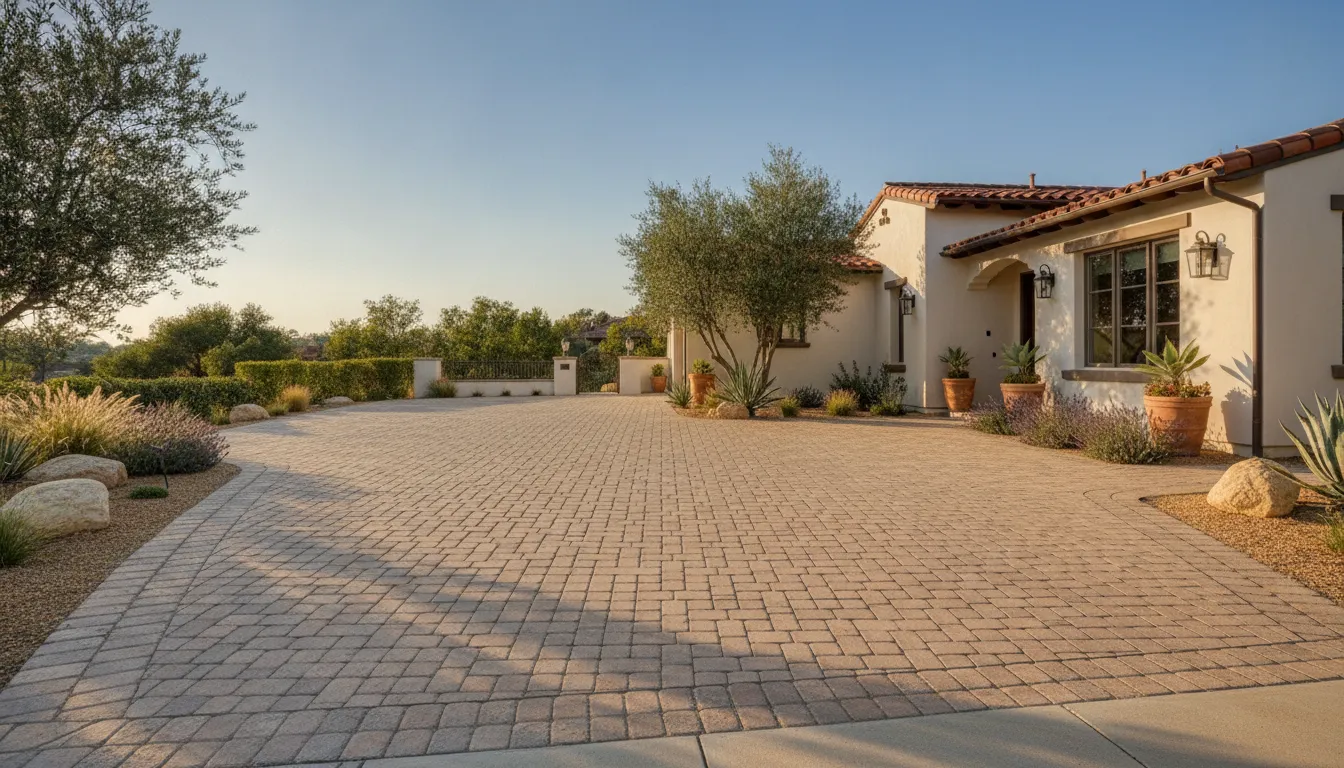
Unit scale should relate to the dimensions of the paved area and the architecture. Smaller units may suit a curved entry or intimate courtyard. A broad driveway or terrace may benefit from a quieter field with cobblestone used as a border or band. Color should support the home’s stucco, stone, brick, roof, doors, and landscape rather than compete with them.
Warm neutrals may work well with Spanish or Mediterranean influences, while restrained gray blends can support a contemporary exterior. These are starting points, not rules. The most reliable way to choose is to compare samples beside the actual home and view the proposed relationship in a 2D or 3D design.
Where Do Concrete Cobblestone Pavers Work Best?
The best application depends on traffic, circulation, drainage, desired emphasis, and the relationship to adjacent materials. Concrete cobblestone pavers can work across several outdoor areas, but the installation details and design role should change with each use.
Are they a good choice for driveways?
A driveway is often an effective setting because its paving establishes the first impression of the property. Consider vehicle paths, turning movements, garage access, slope, street connections, and the point where the driveway meets a walkway or entry court. A full cobblestone field can create a formal arrival, while a cobblestone border can define a larger field without making the whole drive visually busy.
Traffic and site conditions should guide product selection and construction details. Pacific Pavers can help evaluate a paver driveway design in relation to the architecture, landscape, grading, and entry sequence.
How can they work on patios and walkways?
Patios can use a cobblestone pattern to support a courtyard, outdoor dining area, or gathering space. Plan furniture locations, clear walking routes, steps, doors, and planting edges before settling on the field pattern. A quieter center with a detailed perimeter can create hierarchy and make the space easier to furnish.
On a walkway, the pattern should support natural movement to a front door, pool, gate, or garden. Width, cross slope, transitions, and changes in elevation matter as much as appearance. A coordinated paver patio plan can connect the seating area to the rest of the hardscape without forcing one pattern across every surface.
Can cobblestone be used as a border?
Yes. A border, band, or accent can be one of the most flexible applications. It can separate planting from a driveway, frame a patio, identify an entry, or mark a change between vehicle and pedestrian areas. Keep its width proportionate to the adjoining field paver. A narrow band reads as a quiet edge, while a wide band becomes a major visual feature.
| Application | Primary design priority | Question to resolve early |
|---|---|---|
| Driveway | Arrival scale and vehicle movement | How will the pattern meet the garage, street, slope, and drainage? |
| Patio | Comfort and visual hierarchy | Will texture support furniture, circulation, and the home’s architecture? |
| Walkway | Clear movement and transitions | Does the width guide people naturally to the destination? |
| Border | Definition and proportion | Is the band balanced with the field paver and planting? |
What Should a Concrete Cobblestone Paver Installation Include?
The visible pattern is only one part of a successful installation. Soil, excavation, aggregate base, grading, drainage, edge restraint, setting material, jointing, and final inspection all contribute to how the finished surface performs. A driveway, patio, and walkway should not automatically receive the same construction assembly.
- Review the property and intended use. Evaluate the existing surface, soil, slope, access, adjacent structures, drainage outlets, and expected traffic. Determine whether an existing slab can be part of the plan or whether removal and excavation are more appropriate.
- Establish elevations and drainage. Shape the area so water moves toward an appropriate outlet without creating problems at doors, foundations, walls, planting beds, or neighboring properties. A common grade benchmark may not suit every site. The final approach must respond to existing elevations and accessibility.
- Prepare and compact the base. Install the specified aggregate in controlled lifts and compact it thoroughly. The required base depth depends on soil, traffic, drainage, and design. A fixed depth should never be treated as a universal guarantee for every Orange County property.
- Choose the drainage system. Confirm whether the project needs drains, collection points, geotextile, or another site-specific measure. When appropriate, permeable interlocking concrete pavement can allow water to move through open joints and underlying layers. The EPA explains permeable pavement systems, but permeability is a system decision, not an automatic feature of every cobblestone-style product.
- Install edge restraint. Secure the perimeter where paving meets soil, planting, concrete, walls, or a driveway approach. The restraint should align with the finished elevations and remain coordinated with drainage and transitions.
- Place, align, and cut the pavers. Set units over the specified setting layer and maintain the planned pattern, lines, spacing, and borders. Accurate cuts around curves, structures, drains, and steps keep an irregular-looking pattern intentional.
- Fill joints and inspect the result. Apply the specified jointing material, compact as appropriate, clean the surface, and inspect grades, edges, transitions, joint fill, and drainage. Final acceptance should reflect the completed site, not only the appearance of an individual paver.
These steps describe the decisions a professional installation should address, not a substitute for a site evaluation. Product specifications and local conditions determine the final assembly.
See how your cobblestone paver design could come together
How Can Cobblestone Details Fit a Larger Paver Design?
Cobblestone details work best when they have a clear job in the overall composition. They can define arrival, frame an outdoor room, guide movement, or separate uses. A restrained treatment may be more effective than covering every area with the smallest or most textured unit.
How should borders and transitions be planned?
Resolve the border width, pattern direction, joint alignment, and meeting points before installation begins. A transition that ends abruptly at a door, step, curve, or drain can look accidental. When lines respond to the home’s architecture and the way people approach the space, the change in material feels deliberate.
Can large-format pavers and cobblestone work together?
They can, when the relationship is intentional. Larger field pavers can create visual calm across a terrace or driveway, while smaller cobblestone units add definition at an edge or entry. The materials do not need to match exactly, but they should share a logical connection through undertone, texture, or architectural style.
Pacific Pavers’ 2D and 3D design process can help homeowners review the relationship between field paving, borders, transitions, walls, and landscape before construction. The project gallery can also help compare how detailed paving looks at property scale.
How Durable Are Concrete Cobblestone Pavers?
Concrete cobblestone pavers can be a durable option for driveways, patios, walkways, and borders, but durability is not determined by the surface unit alone. Product selection, soil, base preparation, drainage, edge restraint, jointing, workmanship, and use all affect long-term performance. Lowe’s provides a product overview of concrete cobblestone pavers, while the project installer must evaluate the actual property and specified system.
What affects long-term performance?
Settlement or shifting can result when the support beneath the pavers is weak, uneven, poorly drained, or not compacted appropriately. Edges can also move when perimeter restraint is missing or poorly coordinated. A thoughtful design therefore treats the base and drainage plan as part of the finished product, not as hidden details that can be skipped.
What maintenance should homeowners expect?
Maintenance depends on the product, jointing material, exposure, nearby planting, and how the surface is used. Keep the area clear of debris, address drainage or settlement concerns early, and follow the manufacturer’s cleaning and sealing guidance. Avoid assuming that every textured paver needs the same treatment. Ask for care instructions for the exact product installed.
If a localized area is damaged, individual units may be removable and replaceable depending on the installation and available materials. That can be a practical advantage of modular paving, but color and weathering differences may occur. Keep product information and installation records for future maintenance.
Frequently Asked Questions
Are concrete cobblestone pavers durable?
They can be durable when the product is suited to the use and the complete system is installed correctly. Soil, base preparation, drainage, edge restraint, jointing, workmanship, and traffic all matter. A site-specific evaluation is more useful than a blanket performance promise.
How much do concrete cobblestone pavers cost to install?
There is no responsible universal figure because cost depends on the area, access, excavation, existing conditions, drainage, selected product, pattern, borders, and project scope. A qualified contractor should review the property and provide a project-specific proposal rather than relying on a generic online number.
Are concrete cobblestone pavers slippery when wet?
Surface texture, slope, drainage, cleaning, and the selected product all influence how a paved area feels when wet. Pool areas and other barefoot locations deserve especially careful review. Do not choose a product from an image alone. Confirm the intended use and maintenance requirements with the installer and manufacturer.
Do concrete cobblestone pavers require a lot of maintenance?
Maintenance varies by product and site. Routine care may include removing debris, watching for drainage issues, and following manufacturer guidance for cleaning or sealing. Proper installation records and product information make future care easier. Address movement, joint loss, or drainage changes early instead of waiting for a larger repair.
Get Your Complimentary Design Consultation
Plan Your Cobblestone Paver Design in Orange County
Concrete cobblestone pavers can serve as a full paving material, a focused border, or a transition detail within a larger outdoor plan. The right choice balances appearance with traffic, grading, drainage, access, maintenance, and the architecture of the home. Pacific Pavers serves Orange County homeowners with design-driven hardscape planning, 2D and 3D visualization, and installation coordination.
Pacific Pavers describes a complimentary design package for qualified projects on its consultation page. Review the current qualification and scheduling details there, then request your complimentary design consultation to discuss the property and determine whether this design approach fits your project.

Jeff Tobin is the founder of Pacific Pavers, an award-winning outdoor living company serving Orange County, California. With a 30-person team of ICPI-certified professionals, Jeff specializes in transforming residential and HOA properties through custom paver installations, pool remodeling, and complete outdoor living spaces. His company philosophy—”Flawless craftsmanship. Clear communication. Zero stress.”—reflects his commitment to delivering premium results and exceptional customer experiences. As a BBB-accredited business and Belgard Master Craftsman, Pacific Pavers has become known for process-driven operations and elite craftsmanship in the hardscape industry.