
Your front entry is the first thing guests see, the path you walk every day, and the single strongest curb appeal investment you can make for your Orange County home. A well-designed paver entryway transforms a basic walkway into a welcoming arrival experience that sets the tone for your entire property. Whether you own a Spanish-style home in San Clemente, a coastal cottage in Newport Beach, a contemporary residence in Irvine, or an estate in Villa Park. Pacific Pavers can help you select the right front entry paver ideas to elevate your home’s first impression and deliver a return that lasts for decades.
Get a free consultation and design package for your front entry project →
Front Entry Paver Ideas: What Makes a Great Front Entry Paver Design?
Front entry paver ideas start with understanding that a walkway is more than a path from the driveway to your door. It is a deliberate composition of materials, patterns, proportions, and details that work with your home’s architecture and landscape. The best designs consider the width and length of the walkway, the scale of the pavers relative to the space. The transition from driveway to steps, and how lighting and borders frame the approach.
Pacific Pavers approaches every entry project with these principles in mind, ensuring the final design reflects both your personal taste and your home’s architectural heritage. Learn about selecting paver colors that complement your home to ensure your front entry ties into the broader design. In Orange County, where outdoor living is a year-round lifestyle and architectural styles range from Mission Revival to mid-century modern to Tuscan estate. The ideal design varies by neighborhood and home. What works for a contemporary home in Anaheim Hills may look out of place on a Spanish colonial in San Juan Capistrano. The key is matching the paver style to the home’s character while adding your own taste.
Here are the key factors that separate a great entry design from an average one:
- Proportion – the walkway width should match the scale of your home’s frontage
- Material quality – premium pavers hold their color and structure for decades in OC’s climate
- Pattern choice – the right pattern reinforces your home’s architectural style
- Transition planning – how the entry meets the driveway, steps, and front door matters as much as the path itself
- Lighting integration – plan for illumination from the start, not as an afterthought
Summary: The best front entry paver designs match the scale of your home, use premium materials suited to the local climate, and coordinate transitions with your driveway and steps. Pacific Pavers recommends starting with a clear understanding of these five factors before choosing paver materials or patterns.
Spanish and Mediterranean Entry Paver Designs
Spanish and Mediterranean-style homes dominate Orange County’s older neighborhoods (think Corona del Mar, San Clemente, and parts of Mission Viejo). These homes feature clay tile roofs, stucco finishes, arched doorways, and warm earth tones. The paver entry should reinforce that aesthetic, not compete with it.
For Spanish-style homes, the goal is a warm, handcrafted look that complements terra cotta roofs and textured stucco. The best front entry paver ideas for this architecture use materials and patterns that have been part of the Mediterranean tradition for centuries. Pacific Pavers has extensive experience designing entryways for Spanish and Mediterranean homes throughout Orange County.
Best Materials for Spanish-Style Entries
- Warm-toned concrete pavers – terra cotta, sandstone, and saltillo-inspired colors work naturally with Spanish architecture
- Travertine or limestone – cream and beige tones with a tumbled finish add refined Old World character
- Tumbled or textured finishes – these echo handcrafted materials and avoid looking too modern or machine-made
Patterns That Complement Spanish Architecture
The herringbone pattern is a classic choice for Spanish-style entries and pairs well with a soldier-course border in a contrasting color. A running bond pattern laid on a 45-degree angle adds movement. For wider entries, consider a basketweave pattern or a simple ashlar pattern using mixed-size rectangular pavers for a more rustic, Old World feel.
Borders and Accents
A distinct border in a darker or complementary paver color defines the walkway edge and grounds the design in the landscape. For Spanish-style entries, consider a border in charcoal, deep brown, or a warm rust tone. Pacific Pavers also recommends adding decorative accents such as a diamond or square inset at the walkway midpoint or by the front steps to create visual interest.
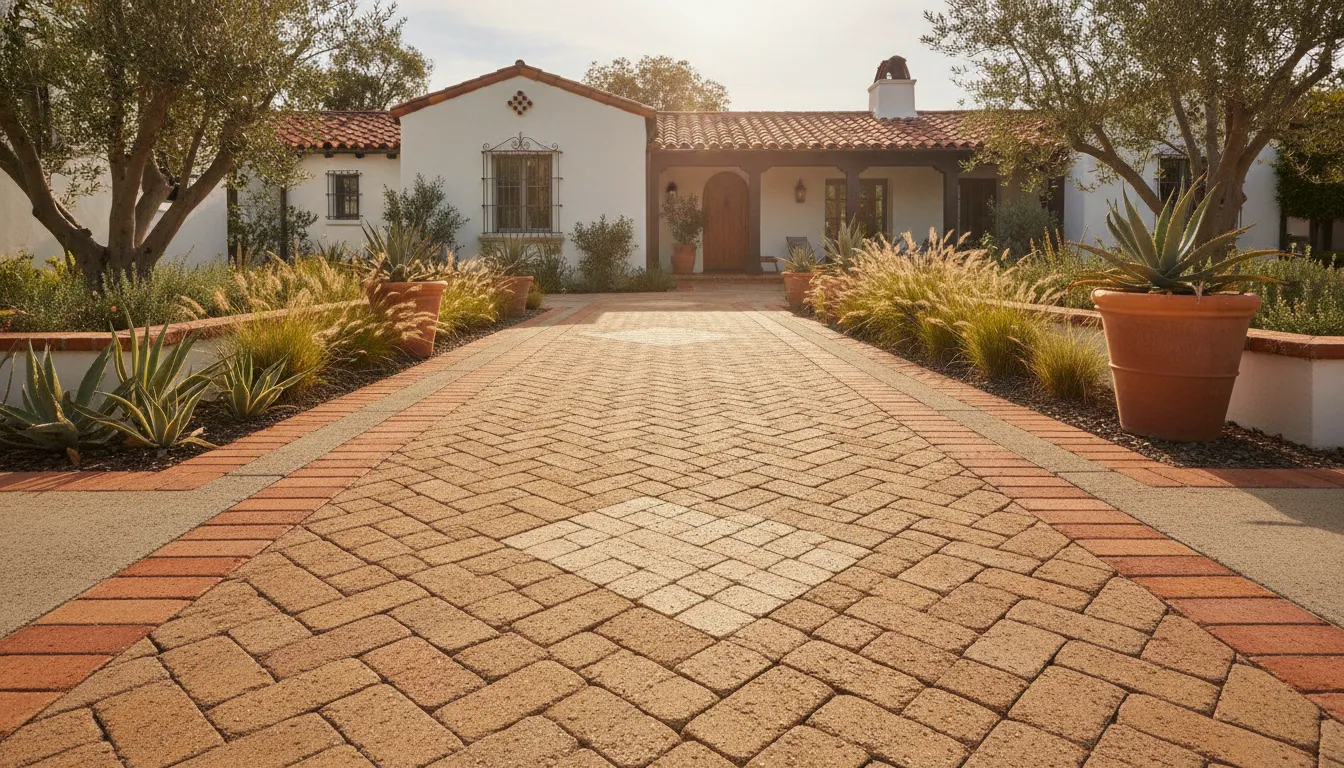
Summary: For Spanish-style OC homes, choose warm-toned concrete pavers or travertine with herringbone or basketweave patterns. A dark contrasting border and decorative insets add the Old World character these homes need.
Coastal and Beach-Style Entry Paver Ideas
For homes in Newport Beach, Laguna Beach, Huntington Beach, and Dana Point, the front entry should feel light, airy, and relaxed. Coastal Orange County homes call for paver designs that withstand salt air and morning marine layer while looking effortlessly stylish.
Coastal entry paver ideas prioritize light colors, clean lines, and materials that handle marine conditions without sacrificing style. The coastal look is about restraint and natural beauty, matching the relaxed elegance of beach-adjacent neighborhoods.
Materials for Coastal Entryways
- Light-colored concrete pavers – white, cream, pale gray, and warm beige reflect sunlight instead of absorbing heat
- Travertine in ivory or silver tones – stays cool underfoot and resists slipping when damp from coastal fog
- Salt-resistant joint sand – polymeric sand with salt-resistant formulation prevents joint washout in marine environments
Design Approach for Beachside Homes
Keep the design clean and uncluttered. A simple running bond or stacked bond pattern with wide joints in a light sand color reads as fresh and contemporary without competing with the ocean views. Use a narrow border in a slightly darker tone to define the edges. Avoid overly ornate patterns or heavy dark colors that can feel out of place in a beach neighborhood.
Salt-Resistant Installation
Coastal installations require attention to the base preparation and joint stabilization. Polymeric sand with a salt-resistant formulation helps prevent joint washout, and a quality sealer protects the pavers from the marine environment without altering their natural appearance. Pacific Pavers uses salt-resistant installation methods for all coastal Orange County projects.
Summary: Coastal front entries in Orange County need light-colored, salt-resistant materials installed with marine-grade joint stabilization. Simple patterns like running bond in cream or pale gray create a relaxed beach-adjacent look that lasts.
Contemporary and Modern Entry Paver Designs
Orange County has a growing number of contemporary and modern homes, particularly in Irvine, Tustin, Newport Coast, and planned communities throughout South County. Modern front entries are defined by clean lines, minimal ornamentation, and a focus on material quality. The paver design should reflect those principles.
Modern front entry paver ideas center on simplicity: large-format materials, restrained color palettes, and patterns that let the material speak for itself.
Large-Format Pavers for a Sleek Look
Large-format concrete pavers, typically 12×24, 18×18, or 24×24 inches, create a clean surface that reads as sophisticated and minimal. Fewer joints mean less visual distraction. For an ultra-modern look, choose pavers in charcoal, bluestone gray, or warm black. A smooth or brushed finish reinforces the contemporary aesthetic. Pacific Pavers offers a range of large-format Belgard options ideal for modern Orange County homes.
Monochromatic Color Palettes
Modern designs thrive on restraint. Stick to a single paver color or a subtle two-tone palette within the same tonal family. A charcoal gray field with a slightly lighter border defines the walkway without introducing contrast that competes with the home’s clean lines. For a warmer take, use a sandy gray paired with a warm beige border.
Patterns for Contemporary Homes
The stacked bond pattern (pavers aligned in a simple grid) is the quintessential modern look. For more interest without clutter, try a running bond pattern using large rectangular pavers. Avoid herringbone and basketweave in truly modern settings, as these patterns lean traditional. If you want texture, consider mixing two rectangular sizes in a staggered ashlar pattern.
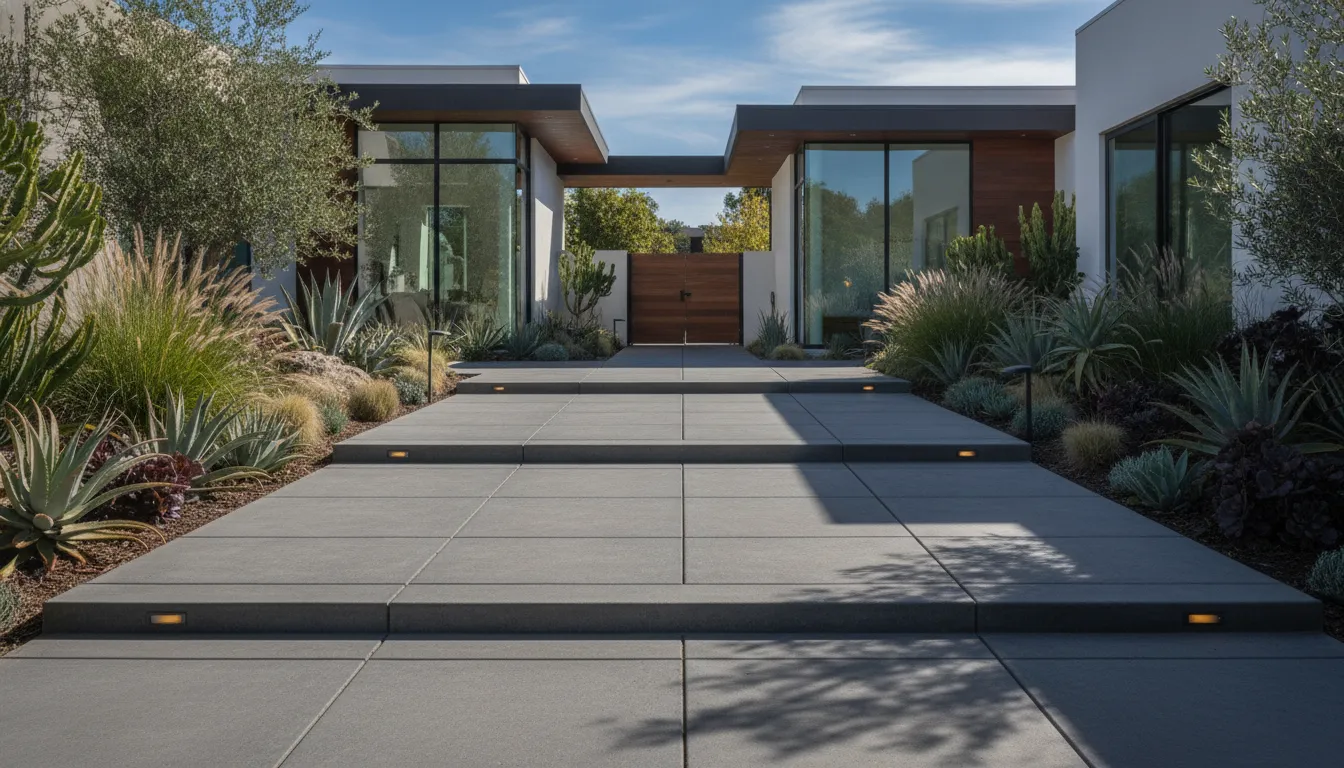
Summary: Modern Orange County front entries work best with large-format pavers in monochromatic palettes using stacked or running bond patterns. Charcoal gray, warm black, and bluestone tones reinforce the contemporary aesthetic.
Estate and Formal Entry Paver Designs
Homes in Villa Park, Yorba Linda, Anaheim Hills, and the gated communities of Newport Coast and Coto de Caza often call for more formal, grand entryway designs. These entries need to make a statement: wider paths, intricate patterns, and richer materials that signal quality without trying too hard.
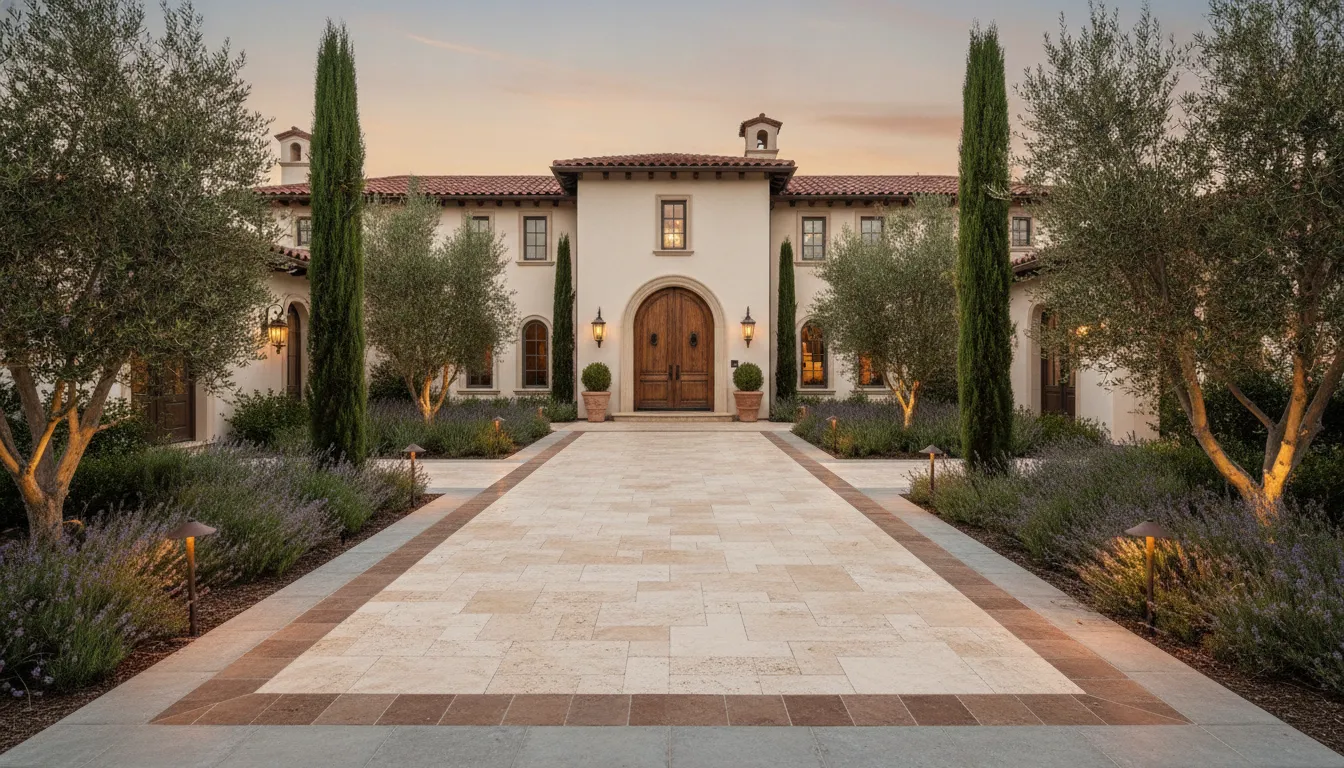
Estate entry paver ideas demand scale and craftsmanship. A grand approach requires wider walkways, premium natural stone, and border details that distinguish the home from standard tract development entries.
Wider Walkways for a Grand Approach
An estate entry should be at least five to six feet wide, with room for two people to walk side by side. In some cases, the walkway widens as it approaches the front steps or terminates in a small landing area with a water feature, urns, or a seating bench. The scale should match the home’s frontage and the distance from driveway to door.
Premium Materials for High-End Homes
- Natural stone – travertine french pattern or tumbled limestone for Old World character
- Belgard Antique or Dublin Cobble – high-end concrete paver lines with realistic stone textures
- Granite cobblestone borders – combined with limestone paver fields for a timeless, built-to-last quality
Intricate Border Details
Estate entries can carry more elaborate border treatments. Consider a double border in contrasting colors, or a rope-course border that adds texture. A decorative medallion or compass rose at the midpoint of the walkway is a signature detail that elevates the design from nice to exceptional.
Summary: Estate entries in Orange County require five-to-six-foot-wide walkways with premium natural stone or Belgard Antique pavers, double borders, and signature details like medallions. Pacific Pavers specializes in these high-end installations for Villa Park and Newport Coast estates.
Explore our paver entryway services →
Paver Patterns and Borders for Every Entryway
The paver pattern you choose affects how the entryway feels, how durable it is, and how well it complements your home. Here is a breakdown of the most popular patterns for Orange County front entry paver designs.
| Pattern | Best For | Visual Effect |
|---|---|---|
| Herringbone | Spanish, traditional, formal homes | Rich texture, strong visual direction, excellent load distribution |
| Running Bond | Most styles, especially contemporary and coastal | Clean linear look, elongates narrow walkways |
| Stacked Bond | Modern, contemporary, minimalist | Clean grid, sleek appearance, minimal joints |
| Basketweave | Spanish, Mediterranean, traditional | Timeless geometric look, old-world character |
| Ashlar (Mixed) | Estate, rustic, traditional | Random natural appearance, high-end feel |
| French Pattern | Formal, estate, Mediterranean | Classic European look with varied paver sizes |
Borders are not optional. They are the frame for your paver design. At minimum, use a single soldier course in a complementary color along both sides of the walkway. For wider entries, a double border or a border with corner blocks adds polish. Choose a border color that is two to three shades darker than the field for definition, or match the field color for a more subtle look.
Summary: Herringbone suits traditional homes, running bond works for most styles, stacked bond fits modern designs, and ashlar or French pattern elevates estate entries. Every walkway needs a border to frame the design.
How Can Lighting Transform Your Front Entry Paver Design?
Lighting transforms a front entry from a daytime feature into a nighttime experience. It also serves a practical safety purpose: well-lit steps and walkways prevent trips and falls, especially on properties with grade changes or multiple levels.
The right lighting plan turns good front entry paver ideas into great ones by extending their impact past sunset.
Step Lighting Integration
For entries with steps, low-voltage step lights set into the riser or the side wall provide even illumination without glare. If the steps are wide, space lights every two to three feet for balanced coverage. Many paver manufacturers offer step-nose pieces that accept integrated LED strip lighting for a clean, built-in look.
Path and Bollard Lighting
Low path lights along the walkway edge define the route and create a welcoming glow. For wider estate entries, bollard lights at regular intervals along both sides provide more substantial illumination and a formal appearance. In coastal settings, choose fixtures rated for salt-air environments.
Uplighting and Accent Lighting
Uplights at the base of columns, pillars, or specimen trees near the entry create depth and drama. For Spanish-style homes, uplighting textured stucco walls highlights the architectural detail. For contemporary homes, linear LED strips under the first step tread or along the walkway edge reinforce the clean, modern line.
Summary: Step lighting, path lights, and uplighting extend your paver entry’s impact after dark. Pacific Pavers recommends planning lighting during the design phase, not as an afterthought, to achieve the best integrated result.
Steps, Accessibility, and Transitions
A front entry must work for every visitor, regardless of mobility. Thoughtful step design and smooth transitions between the driveway, walkway, landing, and front door are essential to a design that is both beautiful and functional.
Step Design and Proportion
Steps should have a rise of no more than seven inches and a tread depth of at least 11 inches for comfortable, safe use. For Orange County homes where the front yard slopes toward the street, a series of shallow, wide steps creates a more gracious approach than a single tall step. Consider adding a landing at the top and bottom of any stair run for a natural stopping point.
Accessible Routes
For homes where accessibility matters, consider a zero-step entry or a gently sloped paver path that meets ADA guidelines. This does not mean sacrificing design. A gently curving paver walkway with a broad landing at the door can be as beautiful as anything with steps, and it works for strollers, wheeled luggage, and aging-in-place needs.
Driveway-to-Walkway Transitions
The point where the driveway meets the walkway is often overlooked in paver designs. A clean transition using a header course or a contrasting band of pavers signals the change in direction and prevents paver shifting at the joint. For driveways that are also being paved, establishing a clear visual break between the driveway pavers and the entry pavers creates definition and a more intentional design.
Summary: Safe step proportions (7-inch rise, 11-inch tread), accessible routes, and clean driveway-to-walkway transitions are essential for a front entry that is both beautiful and functional. Pacific Pavers includes these details in every design.
How Do You Coordinate Your Entry with Your Driveway?
The entry walkway and the driveway are part of the same visual system. They should relate to each other without matching completely. A driveway in a simple running bond pattern can support a more elaborate herringbone entry. Alternatively, using the same paver in both areas but with different patterns (a stacked bond driveway and a herringbone entry, for example) creates cohesion without monotony.
Color coordination matters too. If your driveway is a warm charcoal, the entry path can use the same paver in a lighter color family. Tying the two spaces together through material rather than color. If you are planning both a new driveway and a new entry, designing them together yields the best result. For more ideas, see our guide to modern paver driveway ideas for OC homes.
Pacific Pavers frequently coordinates entry and driveway designs for Orange County homeowners, ensuring the two spaces complement each other without competing. Browse our gallery to see examples of coordinated entry and driveway projects.
Summary: Your entry walkway and driveway should coordinate through material or color families without matching completely. Using the same paver line with different patterns creates cohesion. Pacific Pavers offers combined design for both areas.
Material Selection Guide for OC Homes
Choosing the right paver material for your Orange County front entry involves balancing aesthetics, durability, maintenance, and budget. Here is how the main options compare.
| Material | Lifespan | Maintenance | Best For | Cost Level |
|---|---|---|---|---|
| Concrete Pavers | 25-40 years | Seal every 2-3 years | Versatile, any style | Moderate |
| Travertine | 30-50 years | Seal every 2 years | Coastal, Mediterranean | High |
| Porcelain | 40-50 years | Minimal, no sealing | Contemporary, modern | High |
| Clay Brick | 30-50 years | Low, color is integral | Spanish, traditional | Moderate |
Concrete Pavers
Concrete pavers are the most versatile and cost-effective option. They come in a wide range of colors, shapes, and textures. Modern concrete pavers from manufacturers like Belgard offer fade-resistant pigments and realistic stone textures. They perform well in OC’s climate, handling both sun exposure and occasional rain without cracking. Expect a lifespan of 25 to 40 years with proper installation and sealing. Pacific Pavers is a Belgard Master Craftsman and can guide you to the best concrete paver options for your front entry.
Travertine Pavers
Travertine is a natural stone that stays cool underfoot, a real advantage in Southern California summers. Its naturally textured surface provides good slip resistance, and its cream, ivory, and silver tones work beautifully with coastal and Mediterranean architecture. Travertine is more expensive than concrete pavers but offers a premium, timeless look. It requires sealing every two to three years to prevent staining.
Porcelain Pavers
Porcelain pavers are a growing trend for Orange County front entries because they are exceptionally durable, fade-resistant, and require minimal maintenance. They can mimic the look of natural stone, wood, or concrete with remarkable accuracy. Porcelain is non-porous, so it resists staining and does not require sealing. The upfront cost is higher than concrete, but the maintenance savings offset the difference over time.
Clay Brick Pavers
Clay brick pavers offer a classic, traditional look that pairs well with Spanish, Tudor, and colonial-style homes. They hold their color over time because the pigment runs through the entire brick. Clay brick is durable but can be more slippery than textured concrete when wet. It works best in traditional and historic neighborhoods.
Summary: Concrete pavers offer the best value and versatility. Travertine suits coastal and Mediterranean homes. Porcelain requires the least maintenance. Clay brick is ideal for traditional Spanish styles. Pacific Pavers works with all four materials and can help match the right one to your home.
Frequently Asked Questions
What is the best paver material for a front walkway?
The best material depends on your home’s architecture, budget, and maintenance preferences. Concrete pavers offer the best value and design flexibility for most Orange County homes. Travertine is ideal for coastal and Mediterranean styles, while porcelain works well for contemporary designs that prioritize low maintenance. For Spanish and traditional homes, clay brick is a strong choice. Pacific Pavers recommends a material consultation to match your specific home style.
How wide should a front entry paver walkway be?
A minimum width of 42 inches is recommended for comfortable single-person use. For a two-person walkway, aim for 60 to 72 inches. Estate entries and formal approaches often use widths of 72 to 96 inches for a grander presence. The ideal width depends on the scale of your home and the distance from the driveway to the front door.
Should I seal my front entry pavers?
Yes. Sealing protects the pavers from staining, fading, and joint sand erosion. In Orange County, a quality sealer also helps resist the effects of sun exposure and marine air. Most paver installations benefit from sealing every two to three years, though natural stone like travertine may need more frequent attention. A sealer with a matte or satin finish preserves the natural look of the pavers.
Can I install pavers over my existing concrete entry?
In most cases, yes. Pavers can be installed over sound existing concrete at a lower height, which is useful when you want to match an existing adjacent surface grade. However, the concrete must be in good condition with no major cracks or settlement issues. Pacific Pavers offers a free site assessment to evaluate your existing surface before proceeding with overlayment.
How much does a front entry paver project cost in Orange County?
Costs vary based on the size of the entry, material selection, pattern complexity, and site conditions. Simple concrete paver entries typically start in a lower range, while natural stone and intricate patterns in premium estates fall into a higher tier. The best way to get an accurate estimate for your specific property is through a site consultation. Contact Pacific Pavers for a free consultation and design package.
Get your front entry paver project started with a free consultation →
Start Your Orange County Front Entry Project
Your front entry is the gateway to your home. It deserves a design that reflects your style, complements your architecture, and stands up to Southern California’s climate. Whether you are drawn to the warmth of Spanish-style herringbone, the clean lines of a modern large-format entry. The relaxed feel of a coastal walkway, or the sophistication of an estate-grade design, the right paver installation makes all the difference.
At Pacific Pavers, we specialize in front entry paver designs for Orange County homes. Our team handles every stage of the process, from 2D and 3D design to material selection, site preparation, and professional installation. We are Belgard Master Craftsman certified, ICPI certified, bonded, and insured (CLS #1005154). Learn more about our paver entryway services and explore our project gallery for inspiration.
Schedule your free consultation today →