
A driveway can handle daily vehicle traffic without turning your front yard into a hard, heat-reflecting sheet of concrete. Open-cell grid systems create a structured surface where turf can grow, rain can move into the soil, and the landscape still feels connected to the home.
Schedule a free design consultation to evaluate your site, drainage needs, and the right surface for your Orange County property.
Grass pavers are open-cell grids made from plastic or concrete that stabilize a driveway or lawn while leaving space for grass, water infiltration, and root growth. With a properly compacted aggregate base, the system can support vehicle loads while creating a more water-wise alternative to a fully paved surface.
The right result depends on more than selecting a grid pattern. The system, base preparation, grass choice, and intended traffic all work together. First, it helps to understand how these open cells turn a planted surface into a durable outdoor finish.
What Are Grass Pavers and How Do They Work?
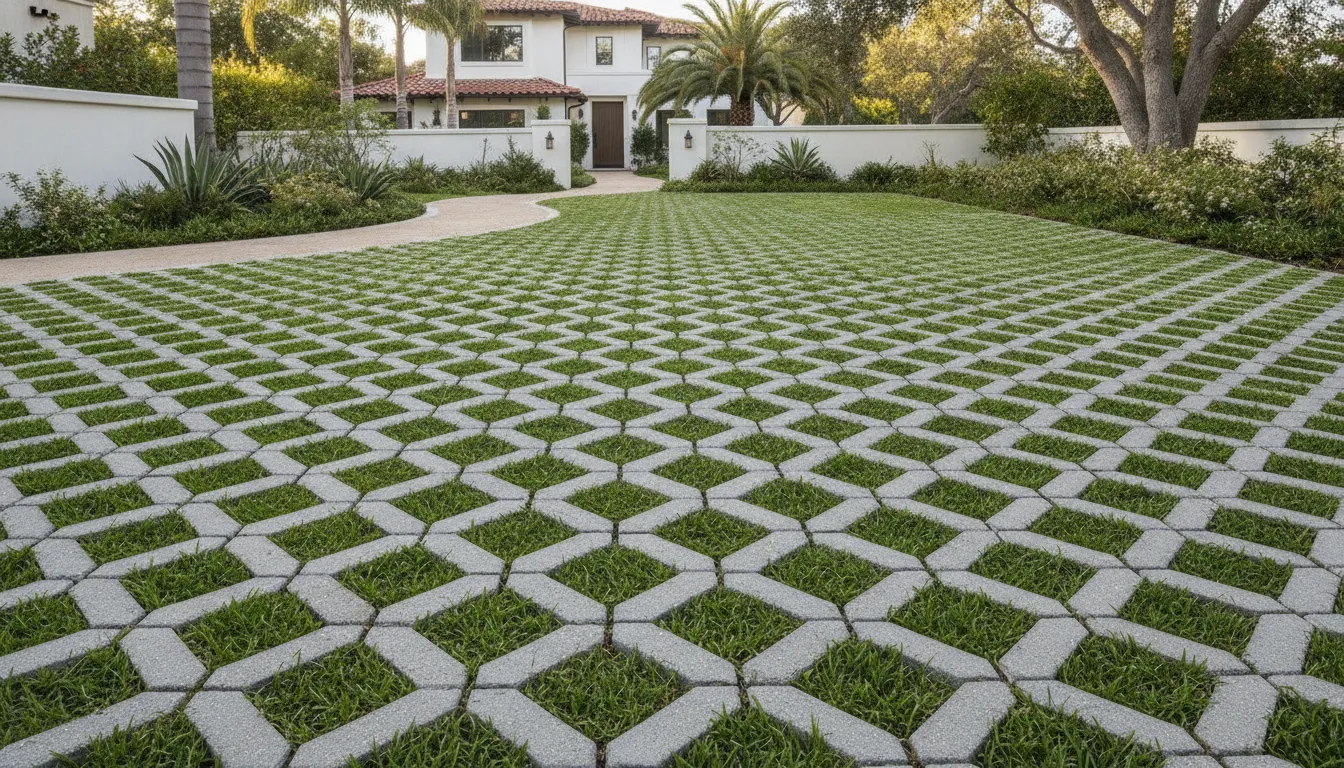
Grass pavers are open-cell paving systems that combine a stable structural surface with living turf or another permeable fill. Instead of covering the entire area with solid concrete, the grid creates pockets where grass can grow while rainwater filters downward. The result can support walkways, parking strips, and well-designed driveways without giving up a softer landscape appearance.
Types of grass pavers
There are two primary categories. Plastic grid systems use interlocking panels made from rigid, high-density plastic. Some high-performance systems are manufactured from approximately 100% recycled HDPE and feature up to 92% void space. That open area gives roots room to develop and creates channels for drainage. Product-specific strength and lifespan claims vary, so the system should be selected around the site, expected traffic, and installation design.
Concrete lattice pavers, also called turfstone or lattice pavers, use a molded concrete pattern with open cells. Many provide approximately 40% open area for grass growth and infiltration. The cells may also be filled with crushed stone where turf is not appropriate, such as a shaded edge or a section that receives concentrated traffic. These systems offer a more visibly architectural finish, while plastic grids can create a quieter, lawn-like appearance once established.
The terms open-cell pavers, grass grid pavers, lattice pavers, and turfstone pavers are often used interchangeably, although the material, cell shape, and performance specifications can differ. That distinction matters when coordinating a premium landscape with drainage goals, planting plans, and HOA requirements.
How the grid carries weight
The grid distributes pressure across many connected cells instead of leaving vehicle tires to compress unprotected soil. During installation, the open-cell units are placed over a properly graded and compacted aggregate base. The base provides the primary foundation, while the grid confines the fill and helps maintain a consistent surface under foot or vehicle traffic. Placing the system directly on loose dirt is not an equivalent installation and can lead to rutting or settlement.
Once filled and rooted, the vegetation contributes to surface stability, while the paving structure manages the load. This is why design and preparation matter as much as the visible product. A qualified installer can coordinate excavation, aggregate depth, drainage, edge restraint, and turf selection for the intended use. For a larger vehicle area, compare the structural requirements with those of conventional paver driveways before choosing the finish.
Can Grass Pavers Handle Driveway Weight?
Yes, grass pavers can support everyday driveway traffic when the system is engineered for the load and installed over the right base. The open-cell surface is not the structural layer by itself. Stability comes from the combined performance of the grid, the fill material, edge restraint, drainage design, and a properly compacted aggregate foundation.
What base does a grass paver driveway need?
A driveway grid should never be placed directly on bare dirt. Soil can shift, hold water, and lose bearing capacity under repeated vehicle loads. Instead, the installation needs an excavated section with appropriately graded aggregate, compacted in lifts to create a firm, even base. The required depth depends on soil conditions, drainage, slope, and the expected traffic. So a residential parking pad and an emergency access lane should not automatically receive the same assembly.
The grid is then installed over the prepared foundation and filled with suitable soil, aggregate, or a grass-growing medium. That layered approach distributes weight while preserving the infiltration benefits of the open cells. The Environmental Protection Agency notes that plastic grid pavers can allow water to seep through the surface into underlying soil and gravel layers, helping reduce runoff: permeable pavement guidance from the EPA.
Call Pacific Pavers at (714) 718-3970 to schedule a design consultation for a driveway that balances vehicle loads, drainage, planting, and the visual character of your Orange County property.
How much vehicle weight can grass pavers support?
Load capacity varies by product and installation. Concrete lattice systems are rated at up to approximately 5,000 psi, while some high-strength plastic grid systems report compressive strength up to 15,940 psi. Those figures describe the grid material under specified testing conditions, not a blanket guarantee for every driveway. Subgrade preparation, aggregate quality, compaction, edge restraint, wheel patterns, and maintenance all affect real-world performance.
With a base designed for the anticipated load, properly installed grid systems can serve residential driveways, parking strips, and, in specialized designs, emergency vehicle access. The aggregate base must be engineered for that specific loading rather than selected from a generic residential template.
When should you choose a full concrete surface instead?
Grass-filled grids work especially well when you want a softer landscape transition, stormwater infiltration, and a driveway that integrates with drought-tolerant planting. They may be a strong fit for occasional or regular passenger vehicles where the owner accepts ongoing mowing, watering, and weed control.
A full concrete surface may be more appropriate when the site requires a continuous. Easy-to-sweep surface, frequent concentrated turning, heavy commercial traffic, or a highly controlled finish with no living groundcover. Pacific Pavers can compare both assemblies through 2D/3D design services, accounting for the property, circulation pattern, HOA requirements, and long-term maintenance expectations.
How Do Grass Pavers Manage Stormwater and Drainage?
A well-designed grass-paver area can do more than soften the look of a driveway or parking strip. Its open cells create space for rainwater to move below the finished surface instead of immediately flowing toward a curb, planting bed, or neighboring property. That can reduce localized pooling, help protect adjacent landscape areas, and make the hardscape feel more integrated with the rest of the site.
The U.S. Environmental Protection Agency explains that permeable pavement, including plastic grid pavers, allows rain and snowmelt to pass through surface materials into underlying soil and gravel layers. The same process can help filter pollutants from runoff before they reach downstream water bodies. Read the EPA guidance on permeable pavement for additional stormwater context.
For Orange County properties, the drainage result depends on more than the grid itself. Soil conditions, slope, base depth, subgrade preparation, and connections to existing drainage all need to be evaluated during design. A properly prepared aggregate base gives water a predictable path while supporting the intended pedestrian or vehicle use. It is also important to plan transitions so runoff does not simply collect at the edge of the grass-paver area.
Choosing drought-tolerant grass for Orange County
Grass selection should match the property’s sun exposure, coastal or inland microclimate, traffic level, and irrigation plan. Warm-season grasses such as bermudagrass and zoysiagrass may be considered for sunny areas because they can handle heat and periods of reduced irrigation once established. A local design review is still essential. Shade, salt air, compacted edges, and repeated tire movement can change which option performs best.
In a frequently driven area, the goal is not simply to choose the most drought-tolerant seed. The grass must establish within the cells, recover from traffic, and remain compatible with the maintenance schedule. Mowing, targeted watering during establishment, and weed control help preserve a clean, intentional appearance. Where living turf is not the right fit, selected cells may use decorative aggregate, or the design can transition to another water-wise planting treatment.
Pacific Pavers can coordinate the paving, grading, drainage, and planting decisions as one design-build plan. See this guide to drought-tolerant paver and turf design for ideas that connect permeable hardscape with a water-wise Orange County landscape.
How Do Grass Pavers Compare to Other Driveway Surfaces?
The right driveway surface depends on more than appearance. Compare how each material handles stormwater, vehicle loads, maintenance, heat, and the design character you want for your Orange County property.
| Material | Installed cost | Drainage | Maintenance | Durability | Aesthetics |
|---|---|---|---|---|---|
| Grass pavers | Higher initial investment | Open cells allow water to infiltrate through the surface | Mow, water, and control weeds in the planted cells | Strong when installed over a properly compacted aggregate base | Green, textured, and distinctive; blends hardscape with planting |
| Permeable pavers | Moderate to high, depending on the system and base | Water moves through open joints or permeable paving material | Periodic joint maintenance and surface cleaning | Highly durable with correct base preparation and installation | Broad range of colors, patterns, and architectural finishes |
| Concrete | Often lower at installation than specialty permeable systems | Impervious surface; runoff must be directed elsewhere | Low routine maintenance, but cracks and stains can require repair | Rigid and durable, though cracking can affect appearance and service life | Clean and uniform, with limited flexibility after placement |
| Asphalt | Often economical for large, straightforward areas | Impervious surface; needs intentional drainage planning | Sealing and periodic repairs may be needed | Practical, but heat, weather, and water can accelerate deterioration | Functional and understated, with less design presence |
| Synthetic turf | Varies by product, base, and installation complexity | Not a structural driveway surface; drainage depends on the sub-base | Little mowing or watering, but requires cleaning and occasional grooming | Best for pedestrian areas and landscaping, not routine vehicle traffic | Consistent green appearance; better suited to adjacent landscape zones |
One important distinction is that grass pavers are not simply standard permeable pavers with a different finish. Grass pavers use open cells intended for turf or aggregate, while permeable pavers typically rely on open joints or porous paving material. Both can reduce runoff when the entire assembly is designed correctly. The U.S. Environmental Protection Agency explains that permeable pavement allows water to move through the surface into underlying soil and gravel layers. While porous pavement guidance notes that it can reduce the need for separate stormwater infrastructure in some projects.
That drainage benefit can help offset the higher installed cost of a permeable system, particularly where stormwater facilities would consume valuable space. Long-term maintenance and water-management needs should still be considered. Grass-filled cells require landscape care, while concrete and asphalt avoid mowing but may offer fewer opportunities for on-site infiltration. For a broader greenery comparison, review Pacific Pavers’ guide to artificial turf.
For vehicle-focused projects, the base, grading, edge restraint, and material selection matter as much as the surface itself. A professional evaluation can determine whether a planted grid, permeable paver pattern, or conventional finish best fits your property. Explore Pacific Pavers’ paver driveways service for a design-build approach that balances appearance, performance, and site drainage.
What HOA Boards and Property Managers Should Consider
For an HOA, a grass paver project is not only a landscape upgrade. It is a decision about appearance, drainage, resident access, maintenance, and contractor accountability. A clear approval process helps the board evaluate the proposal on documented criteria rather than react to an unfamiliar material after installation begins.
Confirm compliance before approving the design
Start by reviewing the governing documents and architectural standards. Confirm whether the proposed grid, infill, edge treatment, and finished color comply with the community’s CC&Rs. A contractor should provide a scaled design proposal, material samples, drainage notes, and realistic views of how the grass-filled surface will look when established. Pacific Pavers can support this review with 2D/3D design services, giving board members a clearer basis for discussion and resident communication.
Permeable systems can also support an HOA’s stormwater objectives. Open cells allow rainwater to filter into the soil, which can help reduce localized runoff and pooling. That makes the approach relevant when a common-area improvement must address both visual standards and drainage concerns.
Make disruption and costs visible
Ask for a phased schedule that identifies access restrictions, staging areas, dust control, and daily cleanup. For larger communities, work may be sequenced by building, parking area, or walkway so residents retain practical routes through the property. The board should also request a line-item budget that separates demolition, base preparation, grid installation, planting or infill, irrigation adjustments, and ongoing maintenance. Include contingency funds for unsuitable subgrade or drainage corrections rather than treating those conditions as surprises.
- Documented approval workflow: Provide samples, drawings, scope details, and maintenance expectations for the architectural committee and board record.
- Phased resident access: Coordinate work zones and low-traffic scheduling to limit disruption to driveways, walkways, and shared amenities.
- Transparent long-term budget: Show installation, irrigation, mowing, weed control, warranty, and reserve-planning considerations separately.
- Verified contractor qualifications: Confirm licensing, insurance, references, and relevant permeable-paving experience before contract approval.
Vet the installer, not just the material
Installation quality determines whether the surface remains stable under traffic. Ask how the aggregate base will be engineered and compacted for the intended loads, and request documentation of the contractor’s license and insurance. Pacific Pavers is ICPI Certified and holds California contractor license CLS #1005154. Those credentials do not replace project-specific due diligence, but they give the board meaningful qualifications to verify alongside references, warranty terms, and a written scope.
How Do You Design a Grass Paver Project With Pacific Pavers?
A successful grass paver driveway is designed as an integrated outdoor system, not simply a grid placed over an existing lawn. Pacific Pavers manages the project from concept through establishment, with owner involvement, clear documentation updates. And a finished design that balances vehicle performance with the look of a living landscape.
- Begin with a design consultation. We review how the driveway or parking area will be used, vehicle patterns, drainage goals, existing grades, sun exposure, and the visual character of your Orange County property. This is also the right time to discuss HOA or architectural committee requirements. Preferred grass or aggregate infill, and how the project should connect to walkways, planting, and the home’s architecture.
- Complete the site survey and 2D/3D design. Accurate measurements and field conditions guide grading, transitions, drainage, and material quantities. Our 2D/3D design services help you evaluate the proposed layout before construction begins, making it easier to review proportions, materials, and planting integration with family members, property managers, or an HOA board.
- Prepare the structural base. Grass pavers must not be installed directly over bare dirt where vehicles will drive. The excavation is shaped for the intended loads, then a properly specified aggregate base is placed and compacted in lifts. A compacted gravel base is essential to prevent surface failure under vehicle weight; the aggregate and finished elevations also support the project’s infiltration goals.
- Install the open-cell grid. Once the base is ready, the selected grid or concrete lattice system is placed, aligned, and secured across the planned drive lanes. Pacific Pavers checks edges, transitions, curves, and connections to hardscape so the result feels intentional rather than improvised. As an ICPI Certified contractor, our team treats installation standards and load planning as part of the design-build process.
- Fill the cells and establish the grass. The cells are filled with the specified soil, seed, or other approved growing medium, then watered and protected while the grass establishes. A grass-filled grid can support vehicle loads when installed over a properly compacted base, but establishment still requires patience. We document progress and explain watering expectations so the finished surface develops evenly.
- Maintain the living surface. After establishment, plan for periodic mowing, watering, weed control, and occasional attention to worn areas. Maintenance keeps the driveway clean and the grass healthy. If your priorities change, the open cells can also be evaluated for a compatible aggregate or landscape treatment during a future service visit.
For a complete driveway transformation, explore our paver driveways service and discuss how a grass-grid section can complement more traditional paver areas. The result is a coordinated, documented project built around your property, not a one-size-fits-all installation.
Get a free design consultation to review your site, drainage plan, and projected timeline before you commit to a grass paver project.
Frequently Asked Questions
Can you drive a car on grass pavers?
Yes, when the system is engineered for the intended load and installed over a properly compacted aggregate base. The grid should not be placed directly on bare dirt. Base depth, drainage, edge restraint, and the vehicle pattern all matter, especially for a frequently used Orange County driveway.
Do grass pavers require more maintenance than concrete?
They require living-turf maintenance that concrete does not, including mowing, irrigation, and periodic weed control. Grass can also thin in heavy shade or along concentrated tire paths. If those conditions are difficult to manage, the open cells can be designed with aggregate or another appropriate fill instead of turf.
Do grass pavers help with driveway drainage?
Yes. Their open cells allow rainwater to move through the surface and into underlying soil and gravel layers, which can reduce surface runoff. The U.S. Environmental Protection Agency explains that permeable pavements, including plastic grid pavers, can also help filter pollutants from runoff. Site soil, slope, and base design still determine how well the system infiltrates water.
What is the difference between grass pavers and permeable pavers?
Grass pavers use open cells intended for turf or aggregate, creating a visibly green, structured surface. Other permeable pavers typically manage water through porous units or open joints while presenting a more conventional hardscape appearance. The better choice depends on your preferred look, traffic, maintenance plan, and drainage goals.
Are grass pavers suitable for an Orange County HOA project?
They can be, provided the proposal addresses the HOA’s CC&Rs, appearance standards, irrigation plan, drainage objectives, construction schedule, and maintenance responsibilities. A complete submittal with material samples, a clear base-and-drainage design, insurance and licensing documentation, and phased scheduling gives the board a stronger basis for approval.
Ready to Plan Your Grass Paver Project?
A thoughtful design consultation can help you evaluate the right open-cell system, drainage approach, and finish for your Orange County property. Schedule a design consultation with Pacific Pavers to discuss your grass paver driveway or lawn project. Call (714) 718-3970 to get started.

Jeff Tobin is the founder of Pacific Pavers, an award-winning outdoor living company serving Orange County, California. With a 30-person team of ICPI-certified professionals, Jeff specializes in transforming residential and HOA properties through custom paver installations, pool remodeling, and complete outdoor living spaces. His company philosophy—”Flawless craftsmanship. Clear communication. Zero stress.”—reflects his commitment to delivering premium results and exceptional customer experiences. As a BBB-accredited business and Belgard Master Craftsman, Pacific Pavers has become known for process-driven operations and elite craftsmanship in the hardscape industry.