
The question many Orange County homeowners type into Google is simple: how to choose artificial turf for my backyard. The useful answer is not to start with the tallest blade or the most impressive product label. Start with how your family will use the space, how water moves across the property, and how the turf will meet patios, walkways, planting beds, and the home.
Request your complimentary design consultation for a qualified Orange County project
The right turf is part of a larger outdoor plan. A family play area, a dog run, a quiet side yard, and a lawn beside a paver patio all need different priorities. This guide gives you a practical way to compare options before you commit to a material or layout.
What should you decide before comparing artificial turf?
Write down the job your backyard needs to do before you compare samples. A turf surface that looks beautiful in a product photo may not be the best fit for a yard with active dogs, frequent entertaining, children at play, or a steep transition to a patio.
- Primary use: Decide whether the space is mainly for appearance, play, pets, entertaining, walking, or a combination.
- Traffic pattern: Note where people, pets, furniture, pool users, and service equipment will travel.
- Sun and shade: Record areas with all-day sun, afternoon heat, coastal shade, or shade from walls and trees.
- Water movement: Look for low spots, downspouts, slopes, existing drains, and places where water collects after irrigation or rain.
- Hardscape connections: Mark the patio, steps, gates, walkways, pool edge, and planting beds that the turf must meet cleanly.
This short site inventory keeps the decision focused on performance rather than marketing language. It also helps a designer understand what needs to happen below the turf, where many long-term problems begin.
How does pile height affect the way turf performs?
Pile height is the length of the visible turf blades. Taller turf can create a soft, full appearance, but more height is not automatically better for a busy backyard. The best choice balances appearance, resilience, brushing, and the way the surface will be used.
- Shorter pile: Often creates a neat, tailored look and can be easier to keep tidy in paths, narrow side yards, or higher-traffic zones.
- Medium pile: A practical middle ground for many residential lawns because it can look natural without feeling overly plush.
- Taller pile: Can provide a softer, more luxurious appearance, but may need more brushing and may flatten sooner in concentrated traffic areas.
Judge a sample from standing height and close up. Look at how the blades recover after you press them with your hand, whether the thatch looks natural, and whether the color fits the home and surrounding planting. Ask the installer which pile height is appropriate for the traffic pattern instead of selecting a height from a product chart alone.
What is face weight, and how should you use it?
Face weight describes the amount of yarn used in the turf face, usually measured over a defined area. It can help you compare density, but it should not be treated as a complete quality score. A heavier face is not useful if the pile, backing, drainage, base, and installation details do not fit the yard.
Use face weight as one comparison point. Place samples side by side, part the blades, and inspect how much backing is exposed. Then ask four practical questions:
- Will the surface receive concentrated traffic or mostly serve as a visual lawn?
- Will furniture, play equipment, or pets press the fibers down?
- Does the turf have a realistic color blend and thatch rather than a flat green appearance?
- Does the backing support the drainage and edge details required at this property?
A selection conversation that focuses only on density can push a homeowner toward the wrong material. The goal is a balanced system that looks right and keeps working after daily use.
How important are blade shape and color?
Blade shape affects how the turf catches light, feels underfoot, and responds to traffic. Color affects whether the lawn looks believable beside the home, pavers, and planting. In Orange County, a sample should be viewed in the actual outdoor light whenever possible because indoor lighting can make a product look more uniform than it will outside.
Look for variation rather than a single bright green tone. A natural-looking sample usually has more than one green value plus a thatch layer that softens the overall appearance. Check it beside the exterior paint, masonry, paver colors, and nearby plants. A sample that looks attractive by itself may feel disconnected from the rest of the yard.
Also consider the direction from which the lawn will be viewed. Turf beside a pool, seating area, or kitchen may be seen at close range, while a larger lawn may be judged from the windows or patio. Your best choice should look convincing from the places where your family actually spends time.
What drainage features should you evaluate?
Drainage is a system decision, not a single product feature. Water must move through the turf surface, pass through the backing and base, follow the property’s grade, and reach an appropriate outlet. A premium-looking turf can still perform poorly if the site has a low spot, an undersized base, or a transition that traps water.
Ask the installer to walk the property with you and explain:
- Where irrigation and rainwater will go after installation.
- How the existing soil and grade affect the base design.
- How downspouts, drains, walls, and the home’s foundation will be protected.
- How pet-use areas will be cleaned and kept from developing persistent odor.
- How the turf edge will meet pavers without creating a lip or a place for water to collect.
For a deeper explanation of the layers involved in a high-use yard, see this guide to synthetic turf drainage for dogs and busy yards. The selection guide and the drainage guide serve different purposes: one helps you compare materials, while the other explains how a complete drainage system works.
Will artificial turf get too hot in an Orange County backyard?
Any outdoor surface can become warm in direct sun. The practical question is how much sun the area receives, how the yard is used during the hottest part of the day, and what design choices can make the space more comfortable.
Review heat as part of the whole layout. Shade from a patio cover, tree, or structure can change how often a surface is used. A nearby planting bed, seating area, or paver path can provide alternative routes and places to pause. If children or pets spend long periods on the lawn, discuss shade, watering, infill, and surface-care recommendations with the installer rather than relying on a generic promise that one specification will solve heat.
Ask to see the actual turf in daylight and consider its surroundings. The same sample may feel different in a sunny inland yard than in a shaded coastal courtyard. A site-specific plan is more useful than a heat claim detached from the property.
Which turf features matter most for pets and play?
Pet and play areas need a selection that matches repeated use, cleanup, comfort, and drainage. Start by separating the different activities. A dog relief zone may need fast drainage and easy rinsing. A play lawn may prioritize a consistent surface and comfortable footing. A yard used for both should be planned around the busiest routine, not the quietest day.
For pet areas, ask about the turf backing, infill options, cleanup routine, and how the base will move liquid. For play areas, check the surface transitions, hard edges, furniture locations, and whether the proposed layout leaves enough clear space. Do not assume that a dense or tall turf is automatically the safest choice. The base, grade, seams, edging, and installation quality all affect how the finished surface feels and performs.
If your yard includes both dogs and children, map gates and paths before finalizing the turf shape. A narrow strip beside a wall may work well as a pet route but create a maintenance challenge if it is too tight to access. A designer can use pavers and planting to separate uses without making the yard feel divided.
See how Pacific Pavers can plan turf, pavers, and planting together
How should you plan edging and transitions?
Edging is both a visual and functional detail. It holds the turf in place, defines the lawn, protects the edge from movement, and determines how the lawn meets other materials. The best edge is planned before the turf is ordered.
Walk the proposed perimeter and look for gates, steps, downspouts, pool coping, planting beds, and corners where a straight line may not fit the property. Discuss the restraint method, the finished elevations, and the transition to each neighboring material. At a paver patio, the turf should meet the hardscape with a clean, stable line rather than a loose edge that can curl or collect debris.
Curves can look natural in a planting area, while straight lines may better support a modern patio. Either can work when the perimeter is deliberate. Avoid creating thin leftover strips that are difficult to brush, rinse, or repair. A slightly simpler shape often looks more intentional and performs better.
Can artificial turf work with pavers in a backyard?
Yes. Turf and pavers can create a useful division between soft lawn, walking routes, outdoor dining, pool areas, and planting. The key is to design the relationship as one outdoor room rather than install two unrelated surfaces next to each other.
Use pavers where you need a stable path for furniture, carts, pool traffic, or an entertaining zone. Use turf where you want a softer visual field, a play surface, or a low-water lawn character. The exact balance depends on the home’s architecture, the yard’s grade, and how people move through the space.
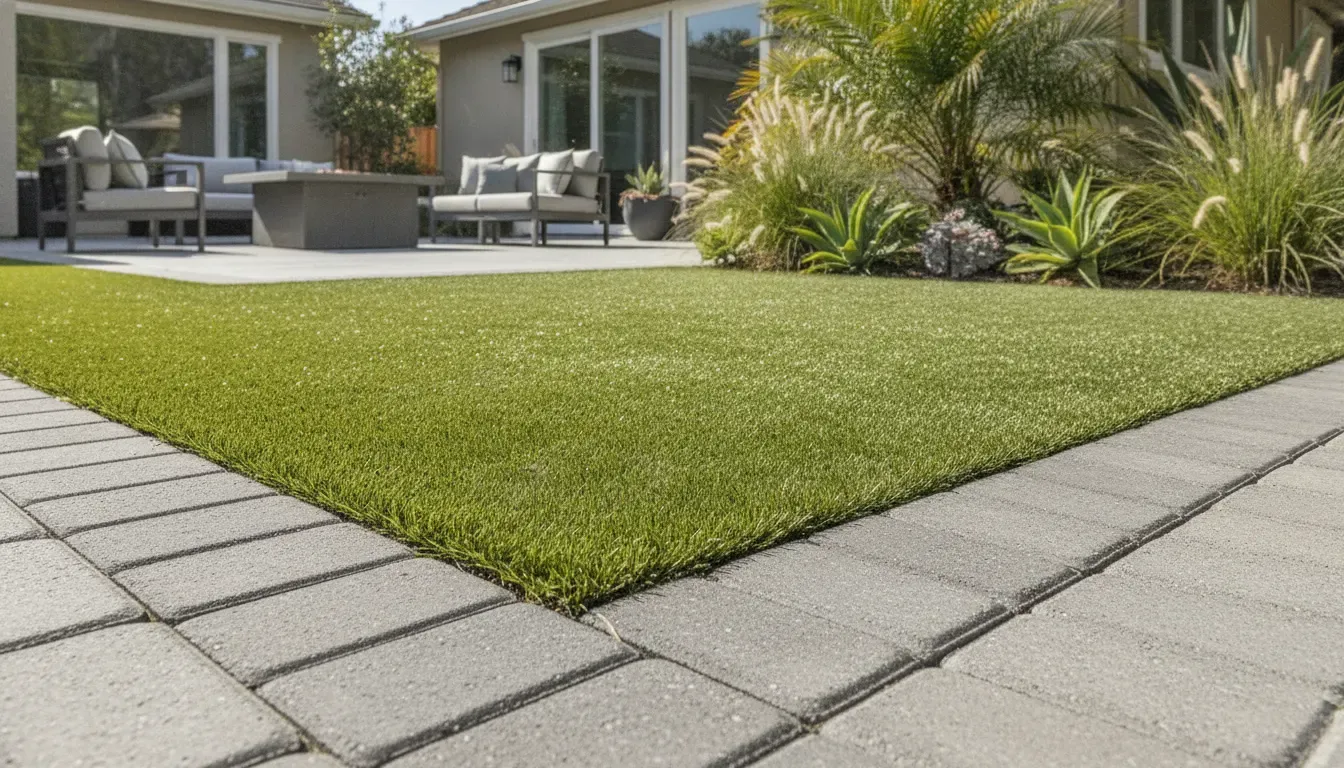
For a focused look at the installation relationship between the two materials, read the turf and paver integration guide. This article stays focused on choosing and planning the turf, while that resource covers the integration process in more detail.
What maintenance should you expect?
Artificial turf reduces routine lawn work, but it is not maintenance-free. Expect to remove leaves and debris, rinse areas that receive regular use, and brush fibers when they need to be lifted. Pet areas may need a more deliberate cleaning routine, and furniture or heavy activity can create concentrated wear.
Maintenance should influence the layout. Leave enough access around gates, planting beds, and walls to clean the surface. Avoid placing a narrow turf strip where a hose or brush cannot reach. Ask what the installer recommends for infill, brushing direction, spot cleaning, and repairs before the project begins.
For broader Orange County context, including how synthetic grass fits into a complete outdoor renovation, read Pacific Pavers’ artificial turf guide. For the installation sequence itself, use the synthetic grass installation service page rather than treating this selection guide as a DIY installation manual.
What is the simplest way to choose the right turf?
Use this order of decisions:
- Define the use: pets, play, entertaining, appearance, or a combination.
- Map the site: sun, shade, grade, drainage, access, and existing hardscape.
- Compare samples: pile height, face weight, blade shape, color, thatch, and feel.
- Plan the edge: transitions to pavers, planting, walls, gates, steps, and the house.
- Confirm the system: backing, base, drainage, infill, restraint, maintenance, and installation scope.
- Review the whole design: make sure turf supports the way your family moves through the backyard.
This process keeps one specification from dominating the decision. The right artificial turf is the one that fits the site, the routine, and the surrounding design.
Frequently asked questions
What pile height is best for a backyard?
There is no universal best height. A medium pile is often a practical starting point for a multipurpose residential yard, while shorter or taller options may fit specific traffic, appearance, or maintenance goals. Compare samples in the actual outdoor light and match the pile to how the space will be used.
Is artificial turf a good choice for dogs?
It can be, when the turf, backing, infill, base, grading, and cleaning routine are designed for pet use. Ask how liquid will move through the system and how the finished area will be rinsed and maintained.
Can I combine artificial turf and pavers?
Yes. Pavers can define walkways and entertaining zones while turf provides a softer lawn area. Plan the edge, finished elevations, drainage, and circulation together so the two materials read as one backyard design.
What should I ask an artificial turf installer?
Ask how the recommendation accounts for your yard’s use, sun, shade, grade, drainage, pets, play, edging, base, maintenance, and hardscape transitions. A useful proposal should explain the complete system rather than focus on one product specification.
Request your complimentary design package for a qualified Orange County project

Jeff Tobin is the founder of Pacific Pavers, an award-winning outdoor living company serving Orange County, California. With a 30-person team of ICPI-certified professionals, Jeff specializes in transforming residential and HOA properties through custom paver installations, pool remodeling, and complete outdoor living spaces. His company philosophy—”Flawless craftsmanship. Clear communication. Zero stress.”—reflects his commitment to delivering premium results and exceptional customer experiences. As a BBB-accredited business and Belgard Master Craftsman, Pacific Pavers has become known for process-driven operations and elite craftsmanship in the hardscape industry.