
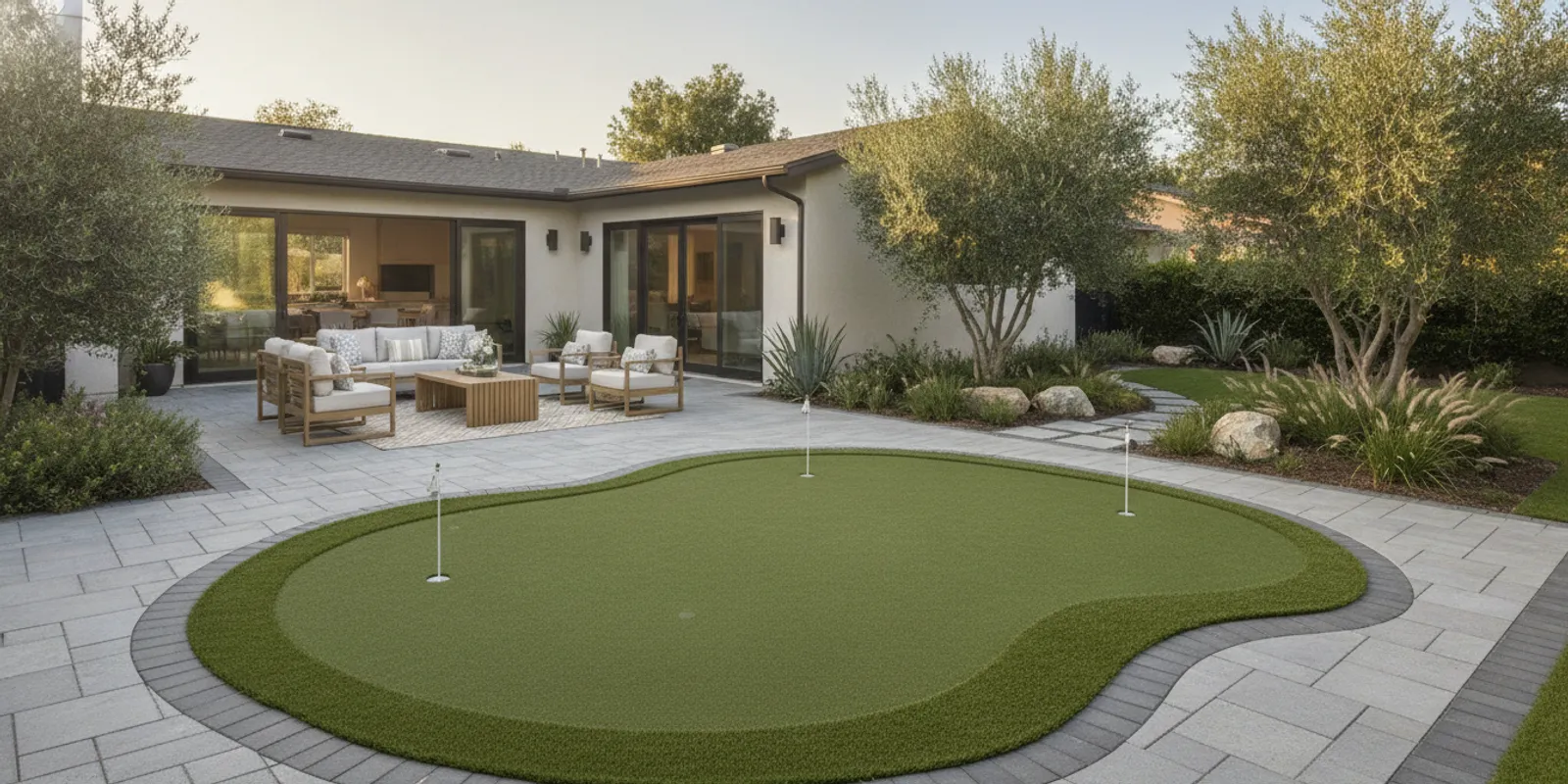
A backyard green can create a dedicated place to practice without taking over the entire yard. Good putting green installation starts with more than choosing turf: the site, base, drainage, contours, and intended style of play all affect how the finished surface looks and performs. This Orange County planning guide walks through those decisions in a practical order.
What should you decide before planning a backyard green?
Begin with how the green will be used. A simple practice area has different needs from a more varied surface intended for repeated games. Think about who will use it, how often, and what kind of shots you want to practice. A compact putting area may fit a side yard, while a larger design may need to share space with seating, circulation, or other outdoor features.
Then consider the yard as a whole. Identify the main views from the house, likely walking routes, gates and access points, existing trees, and nearby hardscape. A green placed in a leftover corner can be less useful than one that connects naturally to the patio and the rest of the landscape. If the project includes several outdoor elements, review the range of outdoor living and hardscape services as you consider how the spaces might work together.
Write down a short project brief before discussing layout. Include the approximate area you have in mind, intended users, preferred amount of challenge, existing yard conditions, and any features you hope to include. You do not need a finished design. A clear brief helps a contractor ask useful questions and identify constraints early.
How do you assess the site?
Walk the proposed area after dry weather and, if possible, after rain. Note low spots, standing water, slopes, soft ground, roots, and places where runoff already travels. Look at how water moves across the lawn and toward neighboring areas, structures, and paving. A putting surface should not be planned in isolation from the site’s existing drainage patterns.
Measure the usable footprint, not just the open patch of lawn. Account for the paths and edges, room to walk around the green, and the distance from fences, walls, planting beds, and other obstacles. Mark buried utilities and irrigation components before excavation is considered. A contractor should confirm how site access and existing conditions affect the work; do not assume that a narrow side gate or a steep route will accommodate equipment.
Ask what is under the existing surface. Soil type, previous landscaping work, buried debris, tree roots, and old irrigation lines can influence preparation. The exact response depends on what an on-site assessment finds. A proposal should explain its assumptions about removal, excavation, base depth, drainage, and access rather than treating every yard as identical.
Orange County properties vary in grade, lot layout, and outdoor-space constraints. Consider whether rainwater can move away from the home without creating a new problem elsewhere. If the green will adjoin a patio, driveway, or pool deck, review how elevations and transitions will meet. Pacific Pavers’ Orange County service-area page provides a way to check the company’s stated service region; a project discussion should still confirm that the particular property and scope are a fit.
Which turf should you choose?
Artificial turf products are not interchangeable. A putting surface is selected for how the ball rolls as well as for appearance, feel, and upkeep. Ask the installer to explain the intended use of the proposed turf, its pile and density, how seams will be handled, and what kind of ball response you can reasonably expect. If possible, view a sample in person and putt on a representative surface before approving a specification.
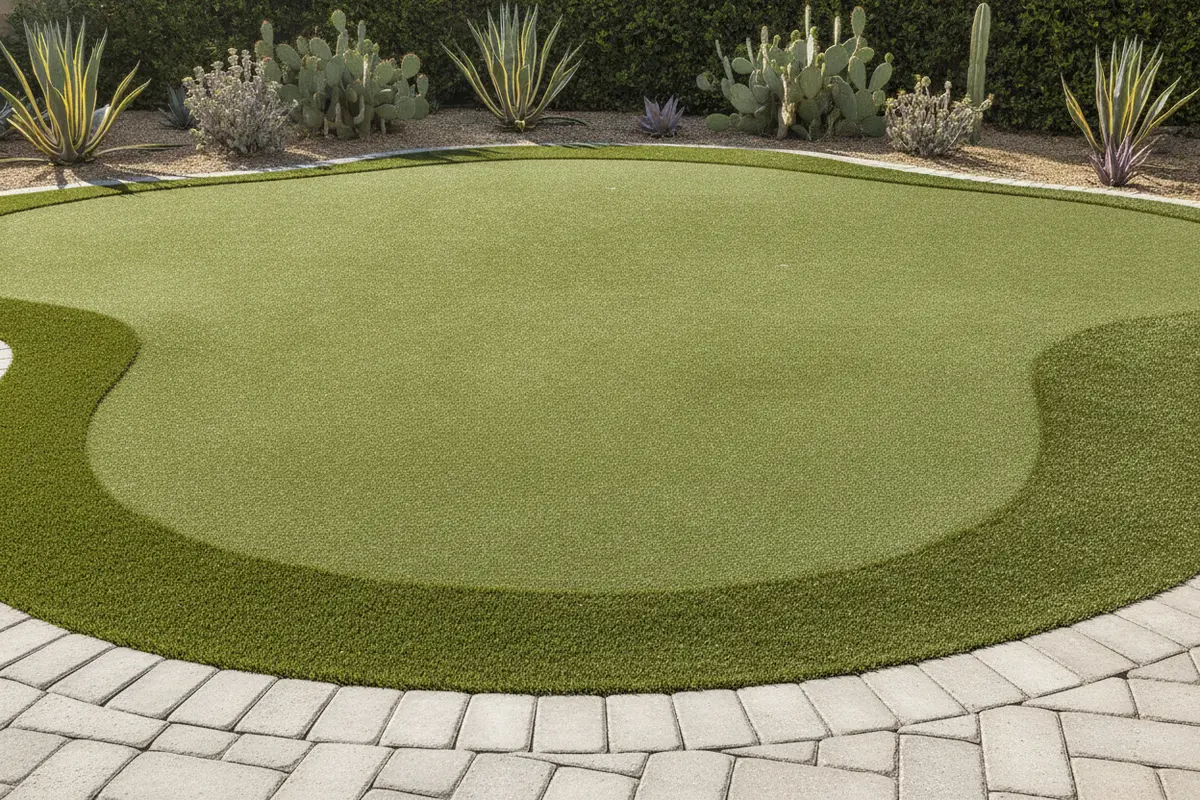
Ask whether the proposed material is designed for the putting area itself or for surrounding fringe. Some designs combine a short, smooth putting surface with a taller border turf to create a defined edge. Confirm how the transition will look and feel underfoot. Compare samples in daylight, since color and texture can read differently outside than in a small indoor sample.
Discuss infill and brushing requirements with the installer. The product and system determine whether infill is used and how it is maintained. Do not assume that every synthetic turf requires the same material or care routine. Request the manufacturer’s care instructions for the exact turf proposed, along with any installation-specific guidance.
Pacific Pavers lists synthetic grass installation among its services. For a putting green, ask directly whether the proposed scope includes a golf-specific surface, how the putting area differs from landscape turf, and what performance characteristics are part of the selection. The name of a general turf product alone does not answer those questions.
Should you choose natural grass or synthetic turf?
The choice is about more than appearance. Natural grass offers a living surface, but it needs ongoing horticultural care. The University of Arkansas Division of Agriculture describes specialized equipment, frequent mowing, irrigation, and other management as considerations for a backyard natural putting green. Think through whether you are prepared to handle that routine through the seasons, including the time and supplies it requires.
Synthetic turf avoids mowing and irrigation for the putting surface, but it still has product-specific upkeep and relies on a carefully built base. Consider how the surface will look beside the rest of the yard, how you want the ball to roll, and what care you are willing to do. Ask for the exact proposed turf and its maintenance instructions rather than comparing generic product labels. A sample and a discussion of realistic expectations will be more useful than assumptions about either system.
Also consider how the green fits with the existing landscape. You might keep a natural lawn elsewhere while installing a synthetic putting area, or choose an outdoor space where turf, planting, and paving each serve a purpose. Clarify boundaries and transitions in the plan. The preferred option is the one that suits your use, site, and upkeep preferences.
Why does base preparation matter?
The layers beneath the turf help create a stable, consistent surface. Preparation generally includes clearing the selected area, shaping the subgrade, building and compacting a suitable base, and creating the planned surface transitions. Details depend on the site, product, and design. A contractor should explain the proposed assembly and why it suits the conditions instead of relying on a one-size-fits-all description.
Ask how the crew will establish the final shape before turf is laid. A smooth, uniform practice area may call for a different profile from a green with gentle breaks. Contours should be deliberate and playable, not accidental dips or ridges. Clarify how the design will be checked during preparation and what the plan is if excavation exposes unexpected conditions. A USGA account of a backyard putting green describes using compacted granite screenings for a base and finer screenings to shape contours; that is one project’s approach, not a specification for every yard.
Compaction is another important discussion. A base that is not properly prepared can settle unevenly; a rough or poorly shaped layer may show through the finish. Ask what materials are proposed, how they will be placed and compacted, and how the installer will check the surface before covering it. The answer should be specific to the project rather than a promise that the green will be perfectly uniform forever.
For background on natural-green care, the University of Arkansas publication notes that a backyard putting green may require specialized equipment, frequent mowing, irrigation, and other ongoing care. Those needs are one reason homeowners compare natural grass with synthetic systems, though the right choice depends on the intended experience and maintenance preferences. See Building a Backyard Putting Green for that natural-green context.
How should drainage be planned?
Drainage is a site-specific design issue, not a detail to leave until the end. The green’s shape and underlying layers should work with the surrounding grade so water does not collect on the surface or flow toward a building. A contractor should assess existing slopes, nearby paving, downspouts, and low points before proposing a solution.
Ask where runoff will go and how the green will meet adjacent surfaces. If the site has a history of ponding, share that information before design approval. If the proposed surface includes a perimeter edge, discuss whether that edge changes the path of water. The response may involve grading, drainage components, or adjustments to the layout; the appropriate option depends on what the site assessment shows.
Do not accept vague assurances that water will simply drain away. Ask the installer to describe the intended drainage path in plain language and show it on a plan when the project needs one. Also ask how the finished work will protect existing drainage routes and avoid sending concentrated runoff into a neighboring yard or toward a structure.
What design features affect play?
Contours, cup locations, and the amount of fringe determine how a green can be used. A straightforward surface can support repeated putting practice, while slopes and breaks add variety. More features are not automatically better: if contours are too severe for the intended user, the green may be less enjoyable for everyday practice.
Talk through the pace and difficulty you want rather than asking only for a particular number of holes. Where a cup sits affects the available putts and how much flat area remains. Include space around each target so the design is useful, not just visually busy. If multiple players will use the area, consider how they can stand, retrieve balls, and move around without crossing planting beds or a seating area.
Edges also shape the experience. A clean border can separate the green from planting or paving and make cleanup easier in adjoining areas. Where turf meets a paver patio, the transition should be comfortable to walk across and visually intentional. Looking through the outdoor transformation gallery can help you discuss how a green might relate to other finished outdoor surfaces, without assuming that any pictured project has the same site or scope as yours.
What happens during putting green installation?
The exact sequence varies by project, but a clear plan commonly moves through these stages. Ask the contractor to identify what is included at each stage, who is responsible for decisions, and how changes will be communicated.
- Site review and scope: The contractor reviews the space, access, grade, drainage, existing landscape, and intended use. Confirm the project boundaries and any exclusions.
- Layout and material decisions: Agree on the footprint, turf zones, contours, cup placement, edges, and connections to other surfaces. Review product information and samples where available.
- Preparation: Existing material is removed as specified, the area is shaped, and the base is installed and compacted according to the agreed system.
- Surface and edge work: The installer checks the prepared profile, fits the turf, completes seams and edges, and installs the planned play features.
- Walk-through and care guidance: Review the finished area, confirm how to maintain it, and collect product and care information for future reference.
Before work begins, ask what you need to move or protect, whether access to the yard must remain clear, and what happens to removed materials. Confirm how the crew will handle irrigation lines or other discoveries. If the putting green is one part of a larger renovation, agree on how the work will be sequenced with paving, planting, or other construction so one phase does not damage another.
How can you compare proposals?
Compare scope and specifications, not just the final line. Two proposals can describe different footprints, base assemblies, turf products, edging, drainage measures, or site assumptions. Use the same questions for each contractor and request written clarification when an item is not defined.
| Item to compare | Questions to ask | Why it matters |
|---|---|---|
| Site preparation | What will be removed, excavated, shaped, and protected? | Clarifies the assumed starting condition and work limits. |
| Base and surface | Which base materials and turf products are specified? How will the profile be checked? | Shows how the support system and playing surface are defined. |
| Drainage | Where will water flow, and what site conditions inform the plan? | Connects the design to grading and nearby structures or paving. |
| Features and edges | Are contours, cups, fringe, seams, and transitions included? | Prevents assumptions about the finished layout and play features. |
| Project coordination | How are access, unexpected conditions, cleanup, and changes handled? | Sets practical expectations for work at the property. |
| Care information | What maintenance does the selected turf require, and what instructions will be provided? | Helps plan upkeep for the specific product and use. |
Ask for a description of what is excluded as well as what is included. Confirm the expected sequence, how questions will be handled, and whether the proposal reflects the same layout you discussed. If you are also considering a patio or other hardscape, review the paver patio option as a connected part of the space and make sure boundaries and transitions are clear in the project documents.
What maintenance should you plan for?
Synthetic turf can reduce some routine work associated with natural grass, but it is not maintenance-free. Leaves and other debris may need to be removed, the surface may need brushing, and care instructions vary by product and installation. Ask for a written routine specific to the turf and infill proposed. Keep that information with the project documents instead of relying on generic advice.
Check the area periodically for debris, changes at seams or edges, and drainage behavior after rain. Address unusual movement or pooling in line with the installer’s guidance. Avoid tools or cleaning products that the manufacturer does not recommend. For a green with infill, confirm whether redistribution or replenishment is part of the maintenance plan and who can advise on the correct material.
Natural greens involve a different upkeep commitment. Review the University of Arkansas backyard green guide if you are comparing that route with synthetic turf. The decision should account for the time, equipment, water, and horticultural care you are prepared to provide, not only the initial appearance.
What should Orange County homeowners ask before approving a plan?
Before approving a layout, make sure you can answer these questions:
- Does the footprint fit the yard and leave practical routes to the rest of the property?
- Is the turf specified for putting, fringe, or both, and have you reviewed the actual product?
- What contours and cup locations are planned, and do they suit your intended level of play?
- How will the base, edge, and surface transitions be built?
- How will rainfall move through or away from the site?
- What site assumptions, exclusions, or possible discoveries are noted in the proposal?
- What maintenance does the installed system require?
Also confirm that the plan reflects any HOA review, access constraints, or property requirements that apply to your home. Do not assume approval requirements or permit needs are identical across projects. Ask the relevant property or local authority when a rule needs confirmation, and make sure the construction scope accounts for requirements that apply to your site.
To understand how drawings and project layouts can support planning, review the company’s construction design services and ask what documentation is appropriate for your particular scope. A visual concept is useful, but it should be paired with clear notes about materials, grade, drainage, and what the proposed work includes.
Frequently asked questions
Can a putting green fit in a small backyard?
It may, depending on the usable footprint, access, and the kind of practice area you want. Measure the space and consider circulation, edges, and other yard functions before choosing a layout. A site review can show whether a compact design is practical.
Is synthetic turf the same as regular landscape turf?
Not necessarily. A putting surface is selected with ball roll and play in mind, while landscape turf serves a different purpose. Ask the installer to identify the proposed putting product, any separate fringe turf, and the care instructions for each.
Does artificial turf eliminate maintenance?
No. It can avoid some natural-grass tasks, but synthetic turf still needs care based on its product and use. Ask about debris removal, brushing, infill, seams, and cleaning before installation, and keep the manufacturer’s instructions.
How do I know whether the proposal includes drainage?
Look for a written description of existing site conditions, the intended direction of runoff, and any grading or drainage components included in the scope. If that information is unclear, ask the contractor to explain the plan before approving the work.
Plan the green around the whole yard
A successful putting green is shaped by choices made before turf reaches the site. Start with the intended use, assess the yard and drainage, compare putting-specific materials, and ask for a clear explanation of the base, edges, features, and care plan. When the green is considered alongside patios and circulation, it can feel like part of a coherent outdoor space rather than an isolated patch of turf.

Jeff Tobin is the founder of Pacific Pavers, an award-winning outdoor living company serving Orange County, California. With a 30-person team of ICPI-certified professionals, Jeff specializes in transforming residential and HOA properties through custom paver installations, pool remodeling, and complete outdoor living spaces. His company philosophy—”Flawless craftsmanship. Clear communication. Zero stress.”—reflects his commitment to delivering premium results and exceptional customer experiences. As a BBB-accredited business and Belgard Master Craftsman, Pacific Pavers has become known for process-driven operations and elite craftsmanship in the hardscape industry.