
Saltwater swimming pools represent the pinnacle of backyard luxury in Orange County, offering a softer. Gentler swimming experience that mimics the coastal breeze of Laguna Beach or Newport Coast. However, the very salt systems that keep your pool water pristine present a severe chemical challenge to standard hardscape materials. Traditional poured concrete and low-grade, porous stones quickly succumb to salt exposure, resulting in unsightly scaling, severe pitting, and structural degradation. For homeowners seeking a durable, high-performance outdoor living space, investing in specialized saltwater pool deck pavers is the only way to preserve both beauty and safety.
Installing saltwater pool deck pavers requires selecting dense, non-porous materials with exceptionally low water absorption rates, ideally below 4 percent, to prevent salt crystallization and surface scaling. Premium options such as modern porcelain pavers, high-density engineered concrete, and professionally sealed natural stones like travertine or limestone offer the highest resistance to saltwater exposure. According to industry research on saltwater pool safety, these advanced materials block water penetration, keeping the deck cool underfoot, slip-resistant, and chemically stable. Partnering with an ICPI-certified contractor like Pacific Pavers ensures a beautiful, turnkey design-build installation that withstands the unique coastal climate of Southern California.
Affluent homeowners in Newport Beach and San Clemente often wonder why their outdoor living spaces age prematurely. The answer lies in the microscopic reaction between sodium chloride and porous concrete. Understanding the chemical challenge of saltwater pool systems is the first step in designing a resilient, jaw-dropping pool deck that stands the test of time. Let us delve into why specialized decking materials are absolutely vital for these premium installations.
Why Do Saltwater Pools Require Specialized Hardscape and Decking Materials?
Saltwater pool deck pavers must be specially formulated or selected to resist the corrosive effects of salt crystallization, also known as salt attack. Standard concrete and porous stones absorb saltwater splashes, allowing salt crystals to grow inside their pores, which forces the surface to flake, scale, and crack over time.
The Science of Salt Attack: How Splash-Out Damages Concrete
Saltwater pools are highly favored for their low-maintenance sanitation and silky, skin-friendly feel. They make a popular addition for premium estates in Yorba Linda and Anaheim Hills. However, these systems still rely on sodium chloride, which presents a silent threat to standard hardscapes. When saltwater splashes onto standard poured concrete or low-density stone, it penetrates deep into the material’s interconnected pores.
As the Southern California sun evaporates the water, the dissolved salt remains behind and crystallizes. These growing crystals exert immense internal pressure, often exceeding 2,000 pounds per square inch, which is far higher than the tensile strength of standard concrete. Studies published by the National Institutes of Health confirm that sodium chloride accelerates the physical degradation of porous cementitious matrices. Over a relatively short period, this microscopic crystal growth causes the top layer of concrete to flake away, a destructive process known as spalling.
Understanding the Risks of Pitting, Scaling, and Structural Spalling
For Orange County homeowners prioritizing aesthetics, salt-induced pitting and scaling are major visual and structural defects. Pitting manifests as small, irregular craters across your pool deck, which collect dirt, harbor mold, and stay damp long after the sun has set. Scaling causes the surface to peel away in thin layers, exposing the rough, abrasive aggregate beneath.
Not only do these defects compromise the clean, modern look of a premium pool deck, but they also introduce serious safety hazards. Scaled and pitted surfaces can easily cut bare feet, while salt residue forms a slick film when wet, significantly increasing slip risks. Rather than dealing with the headache of continuous repairs, choosing specialized, high-density saltwater pool deck pavers provides a permanent solution that remains smooth, elegant, and safe underfoot.
Long-Term Hardscape Protection in the SoCal Climate
The Southern California climate further intensifies hardscape wear. Bright, hot days in inland cities like Tustin and Mission Viejo accelerate water evaporation. This means the wet-and-dry cycles that drive salt crystallization occur much faster. Standard concrete can quickly lose its structural integrity and color vibrancy when subjected to these relentless cycles.
To safeguard your investment, installing dense, low-absorption saltwater pool deck pavers is the most effective approach. Regularly rinsing your deck with fresh water using a garden hose helps wash away surface salt before it can penetrate the material. Starting with the right low-absorption materials, and relying on a skilled design-build contractor like Pacific Pavers. Is the only way to guarantee a lifetime of maintenance-free beauty around your pool. If you’re exploring deck options, our pool deck resurfacing complete guide compares different surface materials and approaches.
Which Paver Materials Perform Best Around Saltwater Pools?
The best saltwater pool deck pavers include dense natural stones like travertine and limestone, premium porcelain tiles, and engineered concrete pavers. Selecting materials with minimal porosity ensures that your pool deck remains structurally sound, slip-resistant, and comfortable for bare feet.
The Crucial Role of Water Absorption Rates
When evaluating materials for a saltwater pool deck, water absorption is the single most important technical metric. A highly porous material acts like a sponge, drawing in salt-laden water which subsequently crystallizes and expands, causing rapid deterioration. High-density pavers, such as those manufactured by Belgard, feature a water absorption rate of less than 4 percent, making them exceptionally resilient.
By contrast, standard poured concrete has an absorption rate ranging from 5 to 8 percent, rendering it highly susceptible to salt damage. A study published by the National Institutes of Health illustrates how cyclic salt exposure quickly compromises standard cement structures. To prevent this, Pacific Pavers utilizes only premium, low-absorption products that block water penetration and resist scaling, preserving the look and value of your Orange County home.
Travertine and Limestone: Luxury Natural Stone Performance
Natural stone remains a timeless favorite for luxury pool surrounds in Corona del Mar and Newport Coast. Travertine and limestone are highly sought after because they stay comfortable to walk on, even during the peak of Southern California summers. Travertine, a unique form of limestone deposited by mineral springs, features natural textures that offer built-in slip resistance.
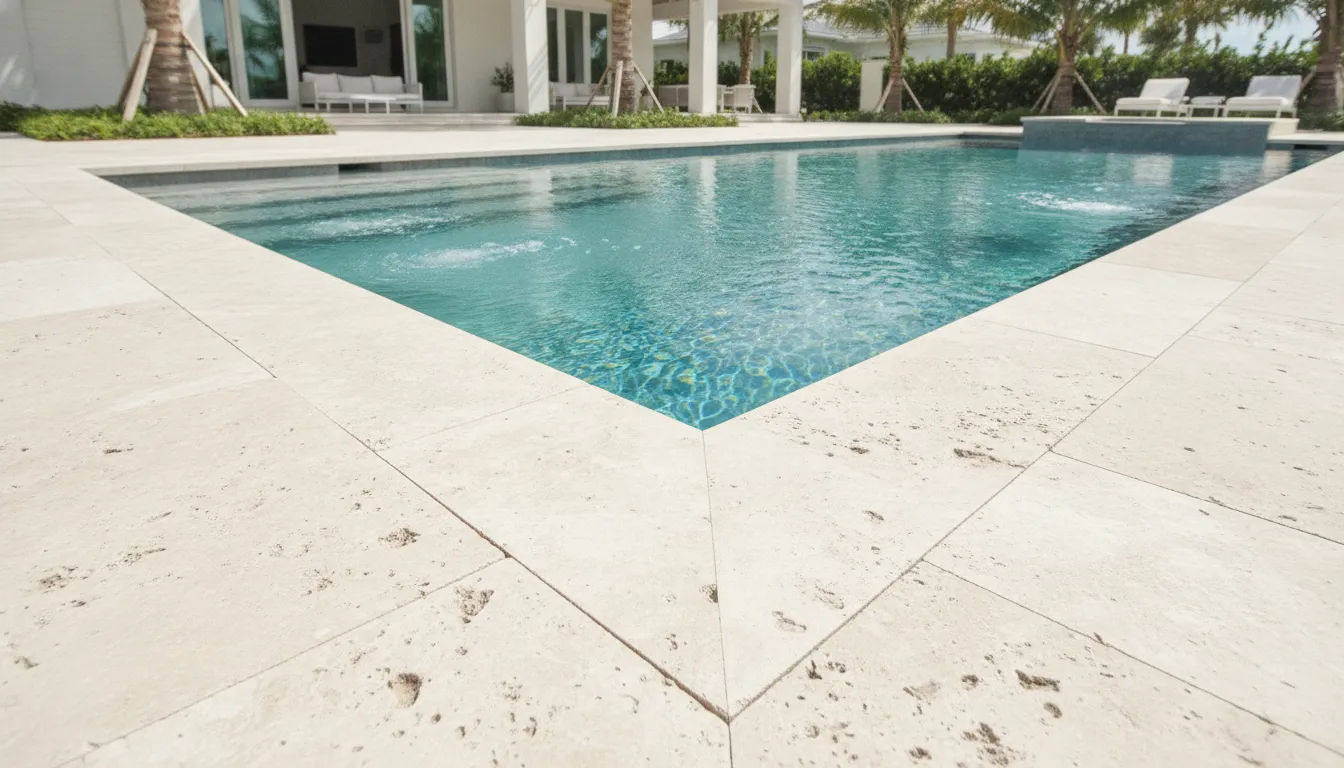
While natural stone is inherently durable, its micro-porous structure means it must be sealed to perform optimally next to a saltwater pool. A high-quality silane-siloxane impregnating sealer creates an invisible, hydrophobic barrier that prevents salt water from penetrating the stone, without changing its slip-resistant texture or luxurious finish. Our team at Pacific Pavers handles this sealing process with meticulous care as part of our turnkey service.
Porcelain and Engineered Concrete: High-Performance Solutions
For the ultimate in modern design and durability, porcelain pavers are an outstanding choice. Fired at temperatures exceeding 2,000 degrees Fahrenheit, porcelain becomes completely vitrified, resulting in an absorption rate of less than 0.5 percent. This makes it virtually impossible for saltwater or pool chemicals to penetrate the surface. Additionally, porcelain is stain-resistant, fade-resistant, and naturally slip-resistant, offering a sleek, contemporary aesthetic for modern coastal homes.
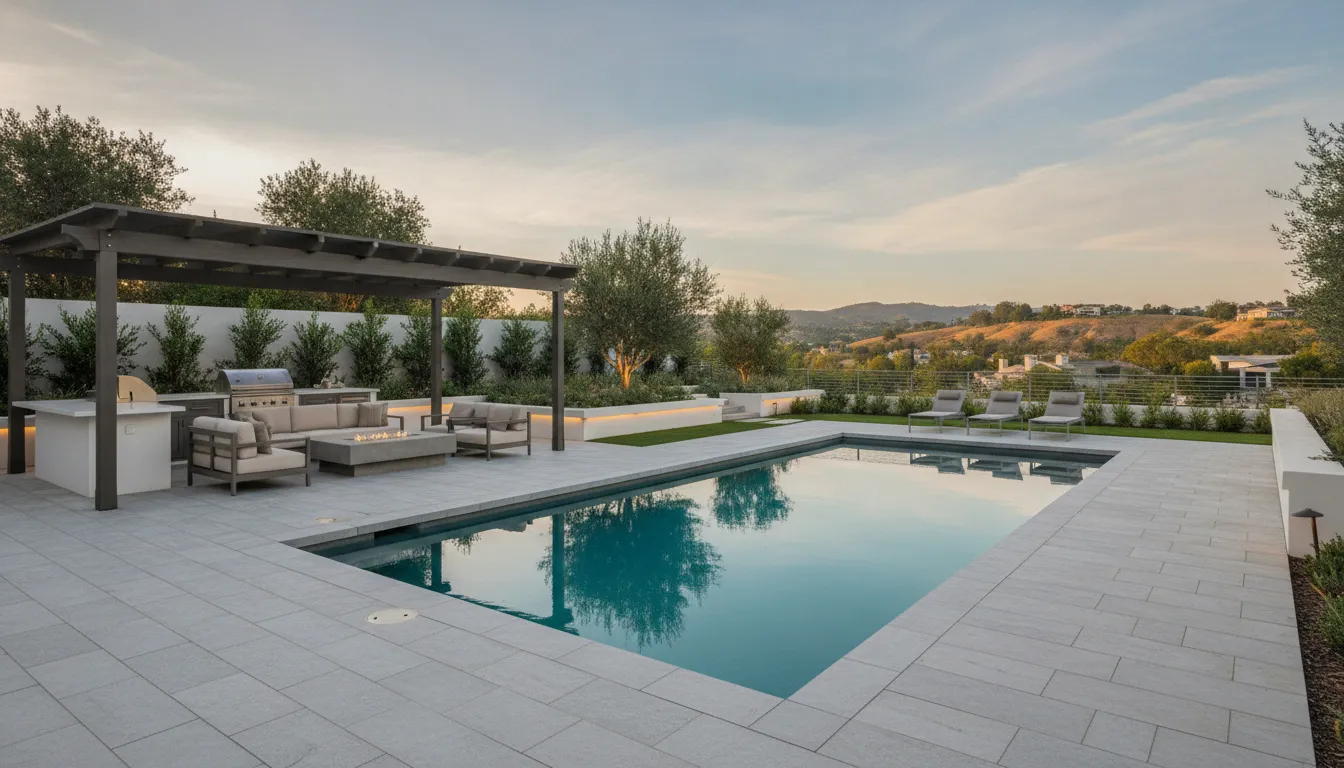
Engineered concrete pavers also represent a significant upgrade over traditional concrete. These pavers are manufactured under immense pressure, resulting in a dense, tight matrix that resists water absorption and salt damage. Both porcelain and engineered concrete are available in a variety of styles that mimic natural stone or wood, providing a premium, low-maintenance solution for your outdoor living space. To see how these materials would look in your yard, take advantage of the custom 2D and 3D design services offered by Pacific Pavers.
| Material. | Salt Resistance. | Heat Resistance. | Water Soak Rate. | Price Range. |
|---|---|---|---|---|
| Porcelain. | Excellent. | Good. | Under 0.5%. | High. |
| Travertine. | Good (Sealed). | Excellent. | 2% to 4%. | Mid to High. |
| Engineered Concrete. | High. | Good. | Under 4%. | Mid. |
| Standard Concrete. | Poor. | Fair. | Over 5%. | Low. |
Bottom line: For luxury Orange County homes seeking a low-maintenance, ultra-modern aesthetic, porcelain is the premier option. While sealed travertine offers unmatched classic beauty and heat control for barefoot comfort.
Are Concrete Pavers Safe Around Saltwater Pools?
Yes, concrete pavers are exceptionally safe and durable around saltwater pools, provided they are high-density, low-absorption units manufactured specifically for harsh environments. When installed by an ICPI-certified professional and treated with a high-quality breathable sealer, these pavers easily withstand salt exposure without scaling or pitting.
Why Manufacturing Density and Quality Matter
Many homeowners worry that concrete pavers will crumble around salt pools just like standard poured concrete decks. The difference lies in the manufacturing process. Unlike standard wet-cast concrete poured on-site, premium engineered concrete pavers are dry-cast under extreme vibration and compression. This process eliminates excess water and minimizes the air pockets within the concrete matrix, creating a highly dense product.
Leading manufacturers like Belgard and Techo-Bloc design their premium pavers to have an absorption rate below 4 percent. This low porosity prevents saltwater from entering the paver, protecting it from internal salt crystallization. These robust units are built to withstand the demanding conditions of a saltwater pool surround, ensuring your hardscape remains beautiful and stable for decades.
The Science of Concrete and Saltwater Interaction
Standard concrete contains high amounts of calcium hydroxide, which reacts with pool chemicals and salt to form soluble compounds, leading to structural leaching. Over time, this chemical leaching results in a weakened surface that easily pits and scales. In contrast, high-density pavers use specialized aggregate blends and curing techniques that minimize free lime, making them chemically inert and highly resistant to salt attack.
According to extensive materials science research, dry-cast concrete surfaces show superior resistance to sodium chloride degradation compared to standard wet-cast concrete. This makes premium concrete pavers a highly reliable and cost-effective choice for saltwater pool surrounds. Particularly when installed by the skilled team at Pacific Pavers, who understand the technical requirements of pool-adjacent hardscapes.
Sealing: The Ultimate Defense Against Salt and Sun
To ensure maximum longevity, we highly recommend sealing your concrete pavers. A premium, breathable penetrating sealer acts as an invisible shield, filling the microscopic pores on the paver’s surface. This barrier stops saltwater splashes and pool chemicals from penetrating the concrete, while still allowing internal moisture vapor to escape.
Sealing also provides several additional benefits for your pool deck:
- Prevents salt and chemical staining from pool water splash-out.
- Protects the rich, multi-toned color pigments from UV fading.
- Simplifies maintenance by making the surface easy to rinse clean.
- Strengthens the joint sand, preventing weed growth and insect nesting.
For homes in affluent Orange County neighborhoods, regular sealing every two to three years is a simple. Cost-effective maintenance practice that preserves the pristine appearance and structural integrity of your hardscape. Our turnkey services at Pacific Pavers include professional sealing, ensuring your pool deck remains in flawless condition.
What Are the Safest and Coolest Pavers for Saltwater Pool Decks?
The safest and coolest saltwater pool deck pavers combine excellent slip resistance with high solar reflectance to keep the deck comfortable and secure. Selecting light-colored natural stones like travertine and limestone, as well as textured porcelain. Represents the ideal choices for preventing bare-foot burns and slips under the intense Southern California sun.
Prioritizing Slip Resistance and Material Safety
Safety is paramount for any pool deck, especially in active homes with kids and guests. When pool water splashes onto a smooth surface, it creates an immediate slip hazard. To prevent accidents, we select pavers with natural, slip-resistant textures. Travertine features natural clefts and pits that provide excellent grip underfoot, even when fully saturated.
For engineered concrete and porcelain, manufacturers utilize specialized surface textures, often rated as R11 on the slip-resistance scale, to provide dependable traction. Unlike poured concrete, which can wear smooth and slick over time, high-density pavers retain their textured grip for their entire lifespan. Investing in premium saltwater pool deck material safety features ensures your family can enjoy pool days without worry.
Managing Surface Heat with High Solar Reflectance
The Southern California sun can quickly heat pool decks to uncomfortable temperatures, making it painful or even dangerous to walk barefoot. Darker hardscapes absorb solar radiation, trapping heat within the material. To keep your outdoor living space comfortable, Pacific Pavers recommends utilizing light-colored pavers with high solar reflectance.
Light shades of travertine, limestone, and cream-toned concrete pavers reflect the sun’s rays instead of absorbing them. These cool stones remain significantly cooler than standard poured concrete or dark slate. This thermal comfort is a critical consideration for premium homes in cities like Irvine and Tustin. Ensuring your outdoor space remains comfortable and inviting even during hot summer afternoons.
Integrating Custom Drainage and Water Management
Proper water management is an essential but often overlooked aspect of pool deck safety. Standing water can harbor algae, create slip hazards, and allow salt to pool and dry on the surface, accelerating material wear. At Pacific Pavers, we do not rely on standard, unsightly trench drains that disrupt your hardscape’s aesthetic.
Our ICPI-certified team designs custom, integrated drainage solutions that follow the precise slope of your yard. We often utilize hidden slot drains that sit discreetly between the paver joints, moving water away from the pool and your home’s foundation. This advanced engineering ensures your deck dries rapidly, stops salt accumulation, and protects the structural base of your outdoor living space.
Professional Installation and Maintenance: The Key to Saltwater Longevity
The long-term performance of saltwater pool deck pavers depends entirely on a professional, ICPI-certified installation and a consistent maintenance routine. Establishing a robust crushed stone base, utilizing polymer joint sand, and performing routine freshwater rinses will prevent stone shifting and salt damage for decades.
The Turnkey Design-Build Installation Process
A gorgeous pool deck is only as stable as the engineering beneath it. At Pacific Pavers, we do not simply lay stones on soil. Our 30-person in-house team, led by Jeff Tobin, follows a rigorous, multi-step installation process to guarantee structural integrity and flawless alignment.
- Excavation and Site Preparation: We excavate the area to the precise depth required, carefully accounting for the unique soil conditions and drainage requirements of coastal Orange County.
- Sub-Base Compaction: Our team installs a heavy-duty geotextile stabilization fabric followed by a robust, densely compacted crushed stone base to prevent future shifting.
- Screeding the Bedding Layer: A precise, uniform layer of clean bedding sand is applied to establish a perfectly level foundation for the pavers.
- Hand-Laid Paver Placement: Our skilled craftsmen place each travertine, porcelain, or concrete paver by hand to ensure the chosen pattern is structurally locked and visually flawless.
- Joint Sand Stabilization: We fill the paver joints with premium polymeric sand and compact the entire surface, locking the stones together and preventing weed growth.
Factual Warranties and Certified Quality
Investing in your home’s outdoor living space should come with absolute peace of mind. That is why Pacific Pavers provides a comprehensive 25-year warranty on our hardscape installations. Our projects are led by ICPI-certified project managers who ensure full compliance with national paving standards, guaranteeing that your saltwater pool deck is built to last.
As a Belgard Master Craftsman, our company is licensed (CLS #1005154), bonded, and fully insured, representing the highest standards of professional service in Southern California. We manage every phase of your project from initial 3D design to the final clean-up, ensuring a completely stress-free experience.
Routine Maintenance and Care for Saltwater Pavers
While high-density pavers are highly resistant to salt, consistent care is still essential to prevent salt accumulation and maintain their brilliant colors. When pool water splashes onto the deck and evaporates, it leaves behind a thin layer of salt. Over months, this salt can build up and dull the stone’s appearance.
The most effective maintenance habit is to rinse the pool deck with fresh water from a garden hose once a week, or after hosting a lively pool party. This simple wash dissolves and removes the salt before it can settle or dry. Additionally, sweeping away leaves and debris prevents organic staining, keeping your outdoor entertainment space in pristine, guest-ready condition.
Frequently Asked Questions
Are concrete pavers safe around saltwater swimming pools?
Yes, high-density concrete pavers are completely safe and highly durable around saltwater pools. Unlike standard concrete, which is porous and prone to salt damage. Premium engineered pavers feature a very low water absorption rate (under 4 percent) that prevents salt crystals from forming inside the material. For maximum protection, these pavers should be professionally sealed and rinsed regularly with fresh water.
What pool decking materials should you avoid with saltwater systems?
You should avoid standard wet-cast poured concrete, low-density limestone, and unsealed porous natural stones around saltwater pools. These materials absorb water easily, allowing salt to enter and crystallize within their structures, which leads to physical pitting, scaling, and surface cracking. Non-breathable coatings should also be avoided as they can trap moisture and cause the surface to peel.
How often should saltwater pool deck pavers be sealed?
We recommend sealing your pool deck pavers every two to three years using a high-quality, breathable penetrating sealer. This sealer creates a hydrophobic barrier that prevents salt and chemical absorption while allowing internal moisture vapor to escape. Regular sealing preserves the color vibrancy of the stone and simplifies routine cleaning.
What is the minimum project size for Pacific Pavers installations?
At Pacific Pavers, we specialize in high-end, turnkey outdoor living transformations. To maintain our high standards of craftsmanship and dedicated owner involvement, our minimum project size is $30,000. This includes comprehensive design-build services, custom 3D renderings, and premium material installations backed by our 25-year warranty.
Transform Your Backyard with Premium Saltwater Pool Deck Pavers
Don’t let salt exposure and intense sun degrade your outdoor investment. With Pacific Pavers, you can enjoy a gorgeous, slip-resistant, and heat-reflective pool deck that stands up to the elements and enhances your home’s value. Our 30-person in-house team manages every phase of your turnkey design-build transformation, from custom 3D designs to final professional sealing, ensuring flawless craftsmanship and zero stress. Backed by our 25-year installation warranty and ICPI-certified expertise, we are ready to bring your vision of coastal luxury to life.
Ready to get started? Call Jeff Tobin and the Pacific Pavers team at (714) 718-3970 or contact us online to schedule your free design consultation today.