
A 25-year driveway does not start with the pavers you can see. In Southern California, longevity starts below grade with the base, slope, drainage, and details that prevent early movement.
Schedule your complimentary Pacific Pavers design consultation →
How long do paver driveways last in Southern California? Most professionally installed systems can serve homeowners for 25 to 50 years when the base, drainage, edge restraints, joint sand, and maintenance plan are handled correctly for the property.
For Orange County homeowners, the practical question is simple: How long do paver driveways last in Southern California? Look beneath the surface before judging the finish, because the base and drainage determine whether that long lifespan is realistic. Here’s how:
How long do paver driveways last in Southern California?
For Orange County homeowners asking, “how long do paver driveways last,” the practical answer is decades. A paver driveway does not have one fixed replacement date. Its service life depends on the full system below and around the visible surface, not just the pavers themselves.
Southern California conditions can be favorable, but a mild climate is not a substitute for sound work. A well-built driveway needs the right materials, base, drainage plan, and upkeep. Pacific Pavers explains the broader process in its guide to professional paver driveway installation.
What determines driveway lifespan?
The base carries the driveway. It must be planned for the site, compacted with care, and matched to the expected use. If the base settles unevenly, the surface can show low spots or movement. The importance of a proper paver base is hard to overstate when cars use the space each day.
Pattern choice also influences durability. The article on best paver patterns for sloped driveways explains how herringbone layouts and interlocking patterns help distribute vehicle loads, which supports long-term surface stability on inclined properties.
Vehicle load matters as well. A residential driveway used by passenger cars faces a different demand than one that often holds heavier vehicles. Edge restraints and joint sand also help the surface act as a connected system. When one part is overlooked, the driveway can need repair earlier than expected.
Drainage in Southern California
Drainage is part of longevity, even in a region known for dry weather. The design should direct rain away from low spots and account for each property’s slope. Water that sits where it should not can expose weak points in the base and create avoidable upkeep.
Climate also shapes the maintenance plan. Sun, dust, leaves, irrigation, and occasional rain all affect how the surface looks over time. The right response is not a generic schedule. Homeowners should watch for joint sand loss, stains, weeds, movement, and areas where water collects.
Maintenance and repair planning
Routine care protects the investment and helps small issues stay small. Cleaning, joint sand replenishment, and sealing should be based on the driveway’s condition and use. This maintenance and sealing schedule explains what homeowners should review when planning care.
Pavers also give homeowners a practical repair path. If a local area shifts, the affected section can be assessed without treating the whole driveway as one slab. The goal is not to promise a universal lifespan. It is to build and maintain a driveway that performs well for decades in its specific Orange County setting.
What makes paver driveways last longer than poured surfaces?
Interlocking paver driveways last longer when separate units, a compacted base, strong edge restraints, and joint sand work together. That system can absorb small movement and make local repairs easier than a cracked poured surface. Homeowners considering cast-in-place options can explore best stamped concrete patterns for driveways as a concrete surface alternative with a tailored design finish.
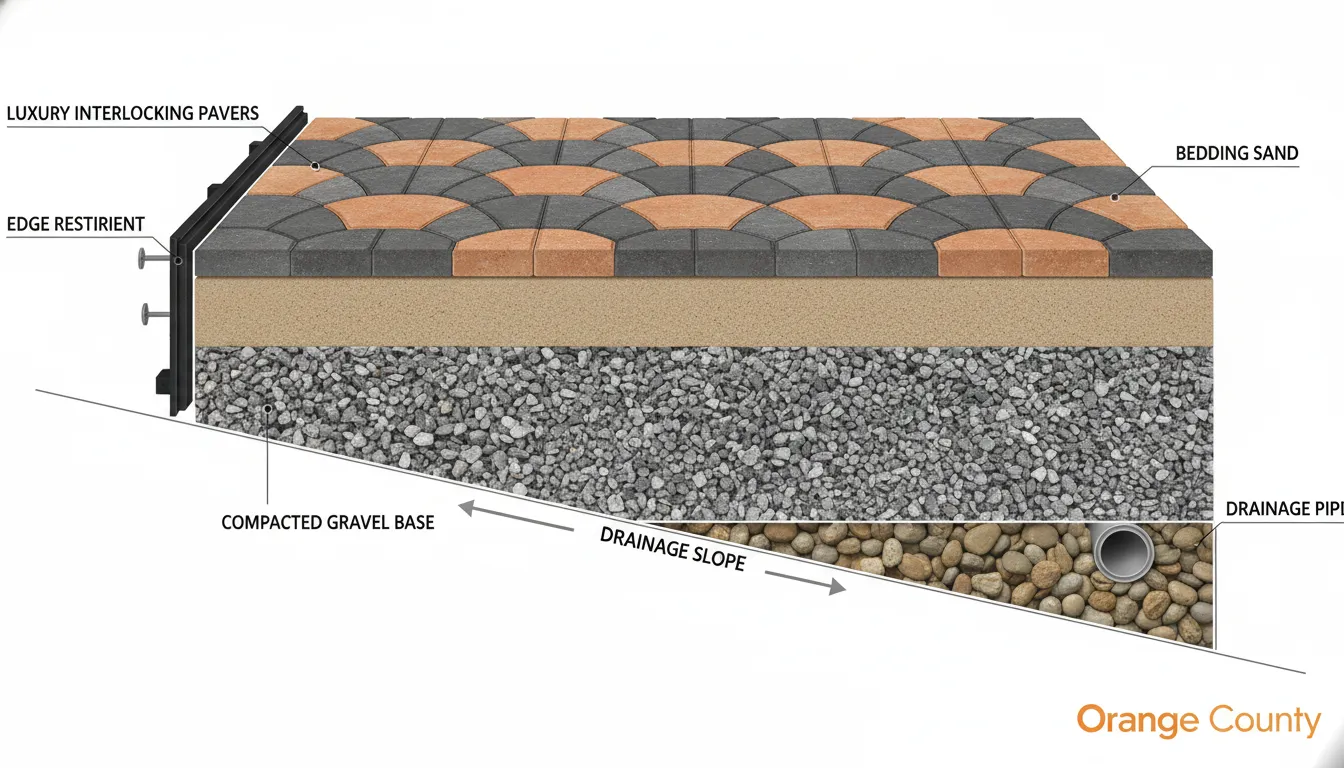
A driveway surface does not age on looks alone. Its structure matters when tires, weather, and small ground shifts place stress on it. Interlocking concrete pavers use separate units rather than one continuous slab. That difference shapes how the driveway moves, wears, and gets repaired.
Separate units and surface movement
Poured concrete acts as one large surface. When the ground below it shifts, stress can show as a crack across the slab. Asphalt can flex more than poured concrete, but it can still develop cracks, low spots, and worn areas over time.
Pavers handle movement in a different way. The individual units work together while the joints allow small changes across the surface. Still, the surface is only as sound as the layers below it. The importance of a proper paver base becomes clear when a driveway carries daily vehicle loads.
. . . . . . . .
| Comparison point. | Interlocking concrete pavers. | Poured concrete. | Asphalt. |
|---|---|---|---|
| Surface structure. | Separate units with joints. | Continuous slab. | Continuous paved layer. |
| Response to movement. | Joints allow small shifts. | Stress may appear as cracks. | Surface may crack or settle. |
| Repair approach. | Lift and reset affected units. | Patch or replace damaged area. | Patch or resurface worn area. |
| Heat and appearance. | Varies with color and finish choice. | Broad, uniform slab surface. | Dark surface with a uniform finish. |
| Long-term refresh. | Clean, maintain joints, and reset units. | Repair cracks or replace sections. | Seal, patch, or resurface. |
Repairs without a full surface replacement
Repairability is a key part of long-term value. If a paver area sinks or shifts, the affected units can be lifted. A crew can correct the base and reset the surface. The repair does not require replacing the full driveway.
Learn more about our paver entryway curb appeal.
Learn more about our paver entryway curb appeal.
With poured concrete, a crack can remain visible after a patch. Replacing a slab section may also create a color difference beside the older surface. Asphalt repairs can also show against the original finish. Pavers offer a more focused repair path because the work can stay within the affected area.
Appearance over the long term
Surface choice also affects how pavement handles heat. The EPA notes that cool pavements use several methods to reduce surface temperatures. With pavers, color and finish choices give homeowners more design options than a standard asphalt surface.
Long-term appearance depends on care as well as material choice. Cleaning, joint sand care, and sealing help keep a paver driveway in good condition. A clear maintenance and sealing schedule helps homeowners plan that work before wear becomes more noticeable.
Installation quality remains the starting point. Pavers are not a shortcut around base prep, drainage, or careful compaction. Those details should be set before the first vehicle reaches the surface.
The Southern California factors that shorten driveway life
Southern California’s mild weather helps paver driveways avoid freeze-thaw damage, but sun, coastal air, drainage patterns, irrigation, and soil movement still affect lifespan. The best designs plan for those site conditions before installation begins.
Sun, wind, and coastal exposure
In Orange County, driveway life depends on more than the paver itself. Long days of sun can fade an unprotected surface. Santa Ana winds can also carry leaves, grit, and small debris into the joints. That buildup should not sit in place for long periods.
Homes closer to the coast may face more moisture and salt in the air. Those conditions call for steady cleaning and routine inspections. Oil stains also deserve prompt care because they can settle into the surface. A practical maintenance and sealing schedule helps keep these issues from becoming harder to manage.
Water flow, slope, and soil movement
Water needs a planned path away from the driveway. Irrigation runoff, poor drainage, and low spots can leave water where it does not belong. Real cost of installing a permeable paver driveway — our cost guide provides a complete breakdown. The EPA also provides a useful overview of permeable pavement as one way to help manage rainwater where site conditions allow.
Slope matters as well. A sloped Orange County lot needs a layout that guides water without washing out joints or sending runoff toward the home. In areas with clay or shifting soils, the base must account for movement below the surface. Tree roots can add pressure from below, especially near mature landscaping.
These risks are easier to address before work starts. Drainage paths, irrigation lines, nearby trees, and soil conditions should be reviewed as one system. If the site has a grade change, the design should account for it instead of treating the driveway as a flat rectangle.
Load and base preparation
A driveway that carries heavy vehicles needs support below the visible surface. Delivery trucks, work vehicles, and large SUVs place more stress on weak spots. Repeated loads can expose poor compaction, thin base layers, or edge details that were not built for the site.
The importance of a proper paver base is hard to overstate. Poorly compacted or unpermitted base work can lead to settling, uneven areas, and avoidable repairs. Surface care alone cannot fix a weak foundation.
For Orange County homeowners, the useful question is not only how long do paver driveways last. It is also whether the driveway was designed for the property. Sun, drainage, soil, roots, and vehicle weight all shape the answer.
Maintenance steps that protect a paver driveway
The best maintenance plan is simple: keep debris off the surface, manage stains early, monitor joint sand, inspect drainage, and schedule sealing based on exposure. These habits protect the finish and help reveal small issues before they become expensive repairs.
Learn more about our paver sealing and maintenance.
Learn more about our paver sealing and maintenance.
A well-built driveway still needs routine care. Small tasks help preserve the clean surface, stable joints, and finished edges that make pavers perform well. Use this practical sequence, then adjust it for traffic, shade, and drainage conditions.
A simple care routine
-
Sweep leaves, grit, and loose debris from the driveway as needed. Regular sweeping keeps buildup from collecting in joints or sitting on the surface.
-
Rinse the surface after sweeping when dust or residue remains. Use a gentle approach, since harsh pressure can disturb joint sand.
-
Remove weeds early and check joint sand after cleaning. If joints look low, ask a paver professional whether sand should be replenished.
-
Clean oil, food, and plant stains soon after you notice them. Choose a cleaner made for your paver material and test a small area first.
-
Inspect edge restraints, borders, and joints for movement. Early attention can keep a small issue from spreading across the driveway.
-
Watch where water flows after rain or irrigation. If water pools or moves toward a structure, arrange an on-site drainage review.
-
Consider sealing after a professional checks the paver type and surface condition. Follow a suitable maintenance and sealing schedule rather than using a fixed date for every driveway.
Seasonal inspection points
A quick inspection after heavy rain can reveal drainage concerns, low joints, or shifted borders. For broader context on runoff near hardscape, review the EPA’s rainwater guidance. Also check the driveway after nearby landscape work or irrigation changes.
Set a reminder to walk the surface on a regular basis. Look for rocking pavers, uneven spots, spreading gaps, and sand loss near tire paths. The right timing varies because each property has different traffic, soil, trees, and water flow.
When repair needs professional attention
Call for an assessment when settling appears, edges shift, or water keeps collecting in one area. These signs may point to a base, edge, or drainage issue. A surface-level fix may not address the cause.
Do not wait for an uneven area to grow. A professional can review how the pavers, joints, edges, and base work together. That approach follows the same quality focus used for professional paver driveway installation.
When sealing helps and when drainage matters more
Sealing protects color, joint sand, and stain resistance, while drainage protects the structure below. If water pools or moves toward the wrong area, fix drainage before relying on sealer to improve driveway performance.
What sealing protects
Sealing is a useful maintenance step, but it is not a structural repair. It helps protect paver color, limit stains, and keep joint sand in place. Those benefits can keep a driveway looking cared for through daily use.
The right timing depends on the surface condition, product, and exposure. A maintenance and sealing schedule should reflect how the driveway is used. Cleaning and sand replenishment may also be needed as the surface ages.
What sealing cannot fix
Sealer cannot correct a weak base, poor compaction, or a drainage problem. If pavers settle, spread, or hold water, the cause is below or around the surface. Applying another coat may improve appearance, but it does not address that cause.
This distinction matters when homeowners ask how long do paver driveways last. A long service life begins before the first vehicle uses the driveway. The importance of a proper paver base becomes clear when heavy loads and water test the finished surface.
Surface movement calls for an assessment before more sealer is applied. A professional can look for low spots, loose edges, joint loss, and signs of settlement. The right response may involve the base or drainage path rather than the finish.
Drainage before finish
Water should move away from the driveway instead of sitting in low spots. Good base preparation and planned drainage work together. They help the surface carry loads and reduce conditions that can lead to movement.
The EPA explains how runoff moves across hard surfaces and can carry pollutants into waterways. For a driveway, runoff also needs a clear path away from the paved area. Sealer does not create that path.
Drainage must be assessed for the actual property. The grade, nearby structures, and runoff path can affect the plan. A finish choice comes after those site details are understood.
Pacific Pavers reviews these details during a design consultation for Orange County projects. The goal is a professional assessment, not a one-size-fits-all seal recommendation. Sealing can protect a sound driveway; drainage and base work help make that sound driveway possible.
Repair signs that mean your driveway needs attention
Surface movement and trip hazards
A paver driveway does not need to look perfect every day. Still, a change in the surface can be an early reason to take a closer look. Watch for sunken areas, loose pavers, or units that rock underfoot. A raised edge or uneven row can also create a trip hazard.
Small surface issues may call for a focused repair rather than a full rebuild. The key question is whether the change affects one paver or a larger area. If several pavers have settled together, the base may need attention. Our guide explains the importance of a proper paver base beneath a driveway.
Water, joints, and shifting edges
Check the driveway after rain or rinsing. Pooling water deserves attention, especially when it appears in a low spot that was not there before. Widening joints are another useful clue. They may show that pavers are moving apart instead of staying in a consistent pattern.
Look at the outer rows as well. Edge restraint movement can let nearby pavers spread or shift. A few loose units may be suitable for a careful local fix. A growing low area, repeated pooling, or movement along an edge calls for a professional review.
Stains, weeds, and the right next step
Oil staining and weeds do not always mean the driveway needs structural work. They are still worth addressing before the surface looks neglected. Start with routine cleaning and joint care when pavers feel firm and stay level. A clear maintenance and sealing schedule can help you plan that upkeep.
Use a simple rule when deciding between DIY care and repair help:
- Handle light cleaning, minor weeds, and basic joint touch-ups when the pavers remain stable.
- Request an inspection for rocking units, widening joints, sunken sections, or a new trip hazard.
- Seek repair advice when water keeps pooling or the driveway edge continues to move.
These checks make the lifespan question more practical. If you are asking how long do paver driveways last, focus on visible changes and act before a small issue spreads. For a broader view of materials and upkeep, review the Paver Driveways service page.
What to ask before installing a new paver driveway
When asking how long do paver driveways last, look past the surface finish. A contractor’s process shapes how well the driveway holds up over time. Use the first meeting to learn what will happen below the pavers. Written answers also make bids easier to compare.
Base, drainage, and edge details
Start with the foundation. Ask the contractor to explain the planned base depth, base material, and compaction method for your property. The importance of a proper paver base becomes clear when you compare the full installation plan, not just the visible materials.
- How deep will the base be after excavation and compaction?
- How will the crew compact each layer and check the finished base?
- Where will rainwater flow, and how will the plan prevent pooling near the garage or street?
- Which edge restraints will hold the field of pavers in place?
- Which paver type fits the driveway’s vehicle load and the home’s style?
Ask to see how the contractor will manage runoff around the driveway, garage, and street. Drainage should be part of the site plan, not an afterthought. Edge restraints also deserve a clear answer because they help keep the paver field in place.
Approvals and written protection
Review color, pattern, border, and surface texture before approving the order. Then ask whether the work needs a permit, an HOA review, or both. Find out who handles the paperwork and confirms approval before work begins.
- What does the written warranty cover, and what does it exclude?
- Does the warranty apply to installation work, materials, or both?
- What happens if a section shifts or settles later?
- Will the contractor explain the repair process before work starts?
Request the warranty in writing. Ask for plain answers about the coverage and any homeowner duties. These details can matter more than a broad promise about lifespan.
Maintenance and design planning
A driveway needs a care plan after installation. Ask about cleaning, joint sand care, and sealing steps for your chosen pavers. Pacific Pavers’ maintenance and sealing schedule can help you discuss upkeep before the work starts.
Finish by asking how the design process works. A contractor should explain how layout, borders, drainage, and material choices come together. Review the consultation and project minimums before scheduling a Pacific Pavers design discussion for an Orange County property.
Frequently asked questions about paver driveway lifespan
How long do paver driveways last with regular maintenance?
A professionally installed paver driveway can last for decades when the base, drainage, joint sand, and edges are maintained. Cleaning, stain removal, sand replenishment, and sealing help protect the surface, but they do not replace sound installation.
Do paver driveways last longer than concrete?
They can perform very well over the long term because individual pavers can move slightly and be reset in affected areas. Poured concrete may show cracks as one continuous slab. The better choice still depends on base prep, drainage, design, and workmanship.
How often should a paver driveway be sealed?
Sealing should be based on the paver type, exposure, traffic, and surface condition. Many homeowners review sealing every few years, but a fixed schedule is less useful than inspecting color, stains, joint sand, and water behavior.
What causes paver driveways to fail early?
Early problems often come from poor base compaction, weak edge restraints, bad drainage, heavy loads, tree roots, or ignored maintenance. Sun and stains affect appearance, but settling and pooling water usually point to issues below or around the surface.
Can sunken driveway pavers be repaired?
Yes, many sunken or shifted paver areas can be lifted, corrected, and reset. A professional should first identify why the area moved. If the base or drainage caused the problem, a surface reset alone may not last.
Schedule a driveway design consultation
If you want a paver driveway built for long-term performance in Orange County, start with the details that affect lifespan: base preparation, drainage, paver selection, edge restraints, and maintenance planning. Pacific Pavers brings premium craftsmanship, clear communication, and an in-house team to high-end outdoor living projects.
Ready to plan a driveway that fits your home and your timeline? Schedule a complimentary Pacific Pavers design consultation and discuss the right next step for your property.

Jeff Tobin is the founder of Pacific Pavers, an award-winning outdoor living company serving Orange County, California. With a 30-person team of ICPI-certified professionals, Jeff specializes in transforming residential and HOA properties through custom paver installations, pool remodeling, and complete outdoor living spaces. His company philosophy—”Flawless craftsmanship. Clear communication. Zero stress.”—reflects his commitment to delivering premium results and exceptional customer experiences. As a BBB-accredited business and Belgard Master Craftsman, Pacific Pavers has become known for process-driven operations and elite craftsmanship in the hardscape industry.