
Homeowners asking how long does stamped concrete driveway last should know that a well-installed, maintained surface may serve for 30 years or more. Concrete Network gives that as a general reference, not a guarantee; service life varies with design, subgrade, drainage, loads, and care. For Orange County properties, check the actual slab condition and runoff, not age alone.
Request a Complimentary Design Consultation
How long does a stamped concrete driveway last?
With proper installation and maintenance, a stamped concrete driveway may last 30 years or longer. Concrete Network lists 30+ years for maintained stamped concrete, but that is a general estimate, not a guarantee for a particular property. Poor drainage, soil movement, excessive loads, or neglected cracking can shorten service life.
Concrete Network also gives 40+ years as a reference lifespan for concrete driveways generally. These estimates are not promises: site conditions and workmanship matter. Stamped concrete is a concrete slab with decorative texture and often color, so the imprint itself does not remove the need for a well-prepared base, control joints, and upkeep. A local contractor should assess the actual slab before recommending repair or replacement.
What determines the service life of stamped concrete?
Longevity is cumulative. Concrete mix and thickness must suit the use; the subgrade should support the slab evenly; water needs a safe path away; joints should anticipate normal movement; and vehicle loads should match the design. Sealing and cleaning help preserve the decorative surface, but neither can correct a poorly supported slab or structural movement underneath it.
- Installation and curing: Proper placement, finishing, curing, reinforcement where specified, and joint layout affect strength and cracking behavior.
- Subgrade preparation: Uniformly compacted, stable support reduces settlement and uneven stress.
- Drainage: Water should not pond on the slab or wash out supporting soil at edges.
- Traffic and loads: Repeated heavy vehicles or loads beyond the design can increase cracking or surface wear.
- Maintenance: Cleaning, timely attention to cracks, and resealing at a suitable interval can protect appearance and slow surface deterioration.
Concrete Network identifies mix design, environmental exposure, subgrade preparation, reinforcement for heavier traffic, and maintenance as important durability considerations. Ask the installer how the proposed slab and base address your site’s soil, slope, intended vehicle use, and water flow, instead of relying on a broad lifespan number alone.
Why do subgrade preparation and drainage matter so much?
The concrete surface depends on the ground below it. If support is uneven or water erodes the base, parts of the slab can settle or flex differently, concentrating stress and contributing to cracks, offsets, or rocking sections. Good drainage also helps protect adjoining planting beds, garage thresholds, and foundations from unwanted runoff.
On a sloped Orange County property, a contractor should evaluate where roof and driveway runoff will go, whether water currently collects, and whether existing grades can be preserved. A driveway that looks smooth on installation day may still have a drainage problem if its slope sends water toward a garage or concentrates flow at an unprotected edge. Avoid sealing over symptoms such as recurring ponding or settlement before identifying their cause.
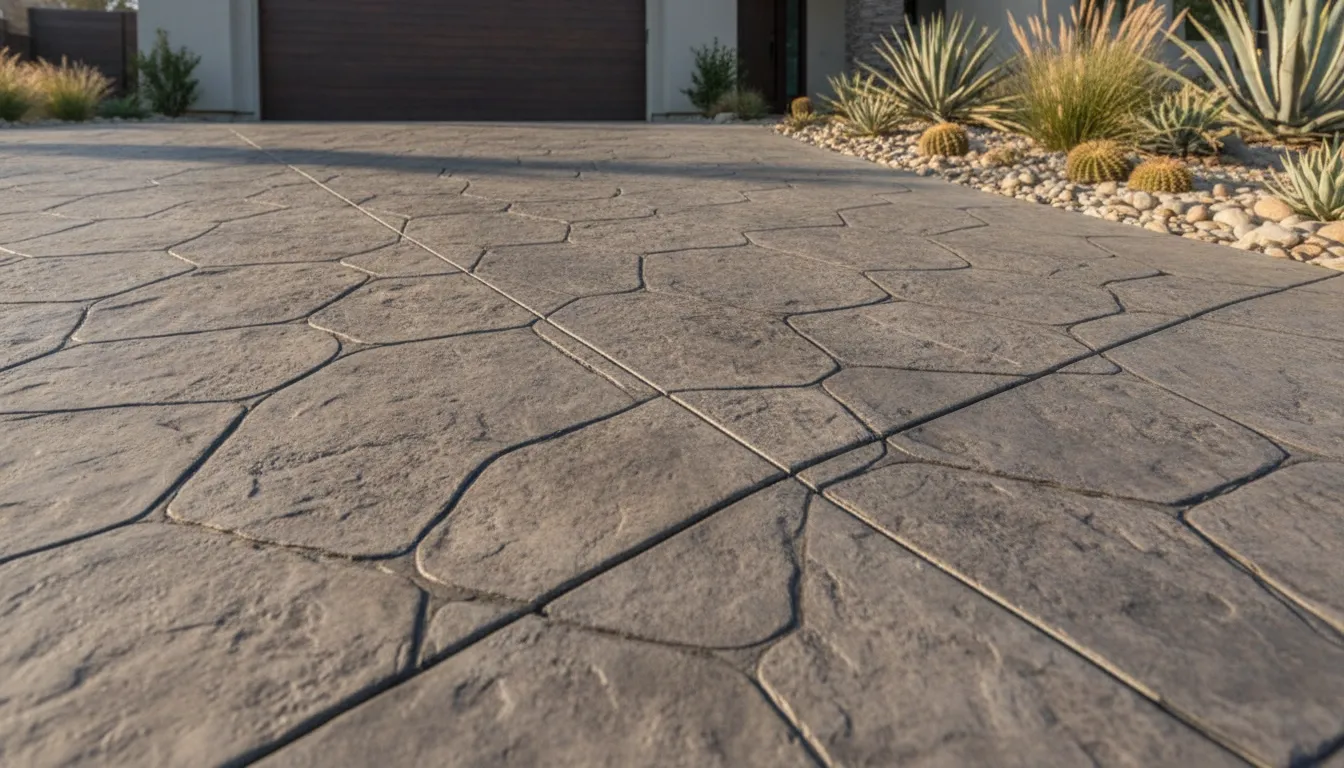
For a broader look at concrete driveway layout and appearance, see concrete driveway ideas and design considerations. For general stamped concrete finish and pattern options, review Pacific Pavers’ stamped concrete driveway guide.
Does Orange County weather affect stamped concrete longevity?
Orange County’s generally mild climate avoids many repeated freeze-thaw cycles found in colder regions, but local exposure still varies by site. Sun, coastal air, occasional heavy rain, irrigation overspray, slope, and soil conditions can influence appearance and performance. A driveway near the coast or exposed to strong afternoon sun should be assessed for its actual conditions rather than assigned one countywide lifespan.
Heat and direct sun can affect how quickly a surface dries during installation, so placement, finishing, and curing practices should fit the weather on the work dates. Rainwater still needs controlled drainage during storms, and sprinklers should not keep the slab or its edges constantly wet. In coastal settings, salt-laden air and moisture may contribute to faster wear of nearby metal components; the concrete’s condition should be inspected on its own merits rather than inferred from location alone.
Stamped color can fade or look dull as sealer wears, but appearance changes alone do not prove the slab has reached the end of its structural life. Conversely, a decorative surface can conceal a developing issue. Check movement, drainage, crack changes, and trip hazards along with color and gloss.
How often should a stamped concrete driveway be sealed?
There is no one resealing calendar that suits every stamped driveway. The right interval depends on the sealer product, application, sun and weather exposure, vehicle use, cleaning, and current surface condition. Follow the product and contractor’s care instructions, then inspect periodically for loss of water repellency, uneven sheen, peeling, or color changes before applying another coat.
Sealer can help protect the decorative finish from wear and moisture, and a fresh coat may restore color depth. It is not a structural repair and should not be used to hide unresolved cracks, scaling, or drainage problems. Cleaning methods also matter: avoid aggressive chemicals or equipment that can damage the finish, and ask the installer what products are compatible with the specified sealer.
Keep an eye on conditions after the work is done. Note when a crack first appears, whether it widens, and whether the slab changes height. Clear debris from edges and drainage paths, promptly address leaks or irrigation that saturates the base, and consult a qualified concrete professional about changes that are progressing.
Get a project consultation for your Orange County driveway
When should you repair a stamped concrete driveway, and when should you replace it?
Repair may be appropriate when damage is limited, the slab remains stable, and the underlying cause can be addressed. Replacement becomes more likely when cracking is widespread, sections have settled or heaved, drainage cannot be corrected without rebuilding, or repeated repairs have not restored safe, dependable use. A site inspection is needed to distinguish a surface issue from a failing slab.
| Minor, stable hairline crack | |
|---|---|
| What it may indicate | Common concrete movement; not automatically structural failure |
| Reasonable next step | Document it and ask a contractor whether monitoring or a compatible repair is appropriate. |
| Crack widening, offset, or recurring settlement | |
| What it may indicate | Possible movement or inadequate support beneath the slab |
| Reasonable next step | Arrange an assessment of the crack, subgrade, drainage, and loads before patching. |
| Surface color or sealer wear | |
| What it may indicate | Decorative finish may need cleaning or resealing |
| Reasonable next step | Confirm the concrete is sound and follow the sealer maker’s guidance. |
| Widespread broken areas, unsafe edges, or repeated failure | |
| What it may indicate | More extensive deterioration or unresolved site conditions |
| Reasonable next step | Compare repair scope with replacement after an on-site evaluation. |
A patch may restore function without matching the original stamped pattern or color exactly. Before approving cosmetic work, clarify whether the goal is safety, water management, structural stability, or visual uniformity. If replacement is under consideration, compare a new stamped slab with alternatives such as a paver driveway based on the property’s drainage, maintenance preferences, appearance, and long-term repair needs. Pacific Pavers explains general tradeoffs in its paver versus concrete driveway comparison.
What should you ask before installing a stamped driveway?
Questions before installation can reveal whether the plan considers your property as well as the decorative finish. Ask for clear answers in the scope and confirm how the contractor will handle the existing driveway, site preparation, water, joint layout, and finish care. A written plan does not guarantee a specific service life, but it makes design assumptions and responsibilities easier to understand.
- How will you evaluate and prepare the existing soil and base?
- What slab thickness, mix, and reinforcement are specified for my driveway use?
- Where will control joints go, and how will the pattern align with them?
- How will rainwater and irrigation runoff be directed away from the home?
- What curing, sealer, cleaning, and maintenance instructions will I receive?
- What conditions are covered by the written warranty, and what is excluded?
Pacific Pavers serves Orange County homeowners with design and hardscape projects. If you are planning a substantial outdoor renovation, ask the company whether its design package is available for your project and what qualification requirements apply.
What maintenance protects a stamped concrete driveway?
Maintenance should focus on preventing small surface and drainage issues from becoming larger repairs. Start with a simple seasonal inspection. Walk the full driveway after heavy rain and look for ponding, washed soil at the edges, clogged drains, or water moving toward the garage. Check whether tree roots, irrigation, or settling have changed the way water crosses the slab. These observations can help a contractor identify a site problem before it affects a larger area.
Keep leaves, soil, and mulch from building up along control joints and driveway edges. Organic debris can hold moisture against the concrete and hide cracks that are easier to address when they are small. Adjust sprinklers that spray the slab or continuously wet the supporting soil. Downspouts should discharge in a controlled location rather than eroding the base beside the driveway. Do not assume that a new sealer will solve damage caused by a leaking irrigation line or poor grading.
Use the cleaning method recommended for the existing sealer and stamped finish. Harsh chemicals, overly aggressive pressure washing, or incompatible coatings can change the color and texture. Before resealing, confirm that the surface is clean, dry, and free of active problems. A professional should also explain whether a repair material will bond to the current finish and how closely a patch can match the original pattern.
Record changes with dated photographs. A stable hairline crack is different from a crack that grows, develops a height difference, or repeatedly opens after repairs. This record gives the homeowner and contractor a clearer basis for deciding whether monitoring, maintenance, localized repair, drainage work, or replacement is the responsible next step.
Stamped concrete driveway lifespan: practical takeaways
A well-designed and maintained stamped concrete driveway may serve for 30 years or more, but lifespan estimates are not promises. Stable subgrade, appropriate slab design, drainage, suitable traffic loads, and consistent care all influence the result. In Orange County, assess sun, coastal exposure, rain runoff, slopes, and irrigation at the property. Repair decisions should be based on whether the slab is stable and safe, not age or fading alone.
When comparing installation or replacement options, Pacific Pavers’ stamped concrete driveway cost guide covers budget factors. For a design consultation on a qualified project, contact Pacific Pavers and confirm eligibility and scope directly.
Frequently asked questions
Can a stamped concrete driveway last 30 years?
It may. Concrete Network lists 30 years or more for maintained stamped concrete, but this is a general reference, not a guaranteed result. Installation quality, support, drainage, loads, exposure, and maintenance affect the service life of a specific driveway.
Does stamped concrete last as long as regular concrete?
Stamped concrete is concrete with a decorative texture and often color. Its lifespan depends on the same broad fundamentals as other concrete flatwork, including mix, slab design, curing, base support, drainage, loads, and care. Decorative finish maintenance is an additional consideration.
Do cracks mean the driveway must be replaced?
No. Some cracks remain stable and may be suitable for monitoring or repair. Widening cracks, vertical offsets, recurring settlement, widespread damage, or unsafe edges deserve an on-site assessment to determine the cause and appropriate scope.
How often does a stamped driveway need resealing?
There is no universal interval. Follow the product instructions and the installer’s recommendations, and inspect the sealer for wear, peeling, or uneven appearance. Confirm the surface is sound and address drainage or cracking before resealing.
Is stamped concrete a good choice for a sloped Orange County driveway?
It can be considered, but slope, runoff, transitions, traction, and support need site-specific review. Have a qualified contractor explain how the design will direct water safely and address the property’s grades before choosing the finish.

Jeff Tobin is the founder of Pacific Pavers, an award-winning outdoor living company serving Orange County, California. With a 30-person team of ICPI-certified professionals, Jeff specializes in transforming residential and HOA properties through custom paver installations, pool remodeling, and complete outdoor living spaces. His company philosophy—”Flawless craftsmanship. Clear communication. Zero stress.”—reflects his commitment to delivering premium results and exceptional customer experiences. As a BBB-accredited business and Belgard Master Craftsman, Pacific Pavers has become known for process-driven operations and elite craftsmanship in the hardscape industry.